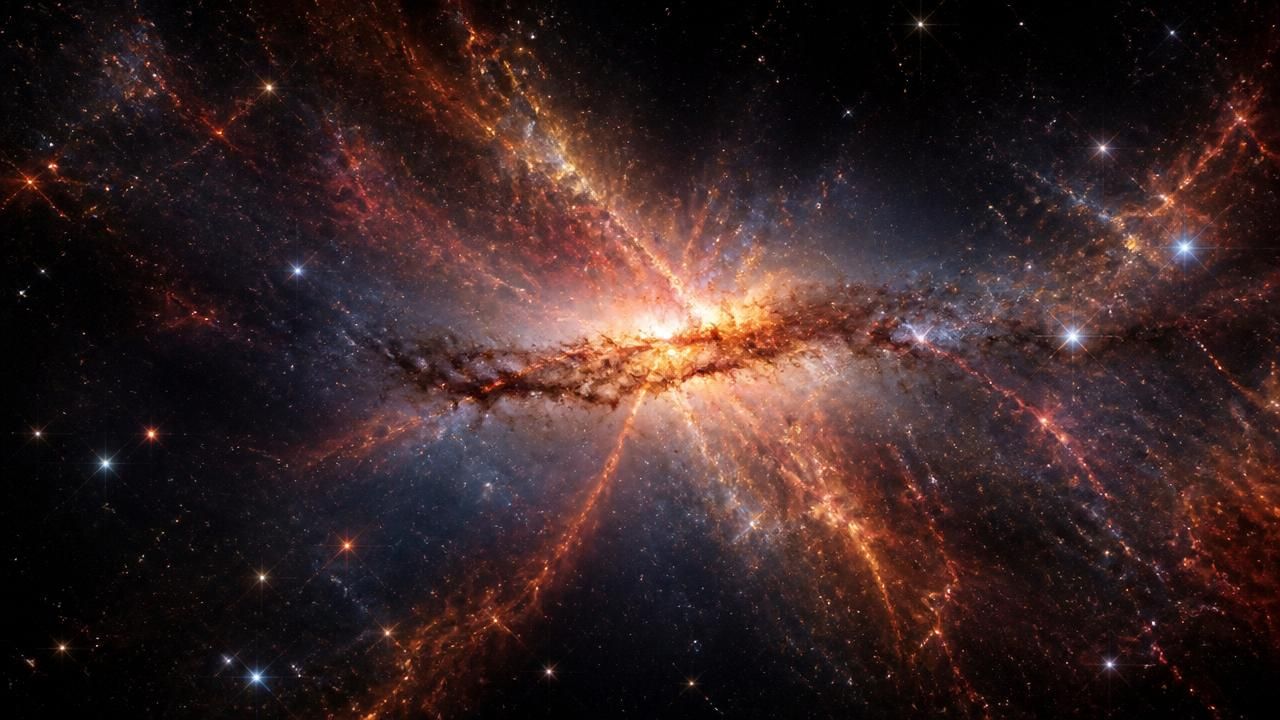
In a striking new image released on July 6, 2026, NASA’s James Webb Space Telescope has peered into the heart of Centaurus A, a nearby starburst galaxy whose chaotic structure tells a story of violent cosmic collisions and hidden black hole activity. The image, captured by Webb’s Mid-Infrared Instrument (MIRI), unveils dusty filaments and glowing gas clouds that have long been obscured from view, offering astronomers a rare glimpse into the processes that shape galaxies and their supermassive black holes.
A Galaxy Caught in the Act of Transformation
Centaurus A, located just 11 million light-years from Earth, is one of the closest active galaxies to our own. Unlike the Milky Way, this galaxy is in a state of upheaval, likely the result of a merger with a smaller galaxy millions of years ago. The new Webb image shows the galaxy’s dusty core in exquisite detail, revealing a complex network of filaments that radiate outward from the center. These structures, invisible in optical light, are brought to life by MIRI’s sensitivity to mid-infrared wavelengths.
“Centaurus A is a powerful laboratory for understanding how galaxies and black holes grow and evolve together,” said a NASA spokesperson. “Webb’s MIRI instrument allows us to see through the dust that hides these processes, giving us a direct view of the engine at work.”
Marking Four Years of Webb Discoveries
The release of the Centaurus A image coincides with the fourth anniversary of the James Webb Space Telescope’s launch. Since its deployment in December 2021, Webb has transformed our understanding of the universe, from capturing the first galaxies to studying exoplanet atmospheres. This latest image serves as a reminder of Webb’s unique ability to uncover hidden phenomena that other observatories cannot reach.
Multiple news outlets highlighted the milestone. MSN noted that “NASA marked Webb’s fourth year with a new image of a galaxy caught mid-collision,” emphasizing the timing of the release. Another MSN article described the image as revealing “a strange galactic structure hidden in dust,” a reference to the previously unseen dusty filaments that trace the galaxy’s turbulent history.
The Science Behind the Image
Centaurus A is classified as a starburst galaxy because of its extraordinarily high rate of star formation. The galaxy also hosts an active galactic nucleus (AGN), a supermassive black hole that is actively accreting matter and emitting powerful jets. Webb’s MIRI instrument is particularly adept at studying these regions, as it can detect the warm dust heated by star formation and the black hole’s activity.
The image reveals a bright, knotty core surrounded by a disk of gas and dust. Filaments of dust stretch outward, likely shaped by the interplay between the black hole’s jets and the interstellar medium. These observations will help astronomers refine models of galaxy evolution and the feedback processes that regulate star formation.
Phys.org, though its original article was inaccessible, had a preview that mentioned “peering into a starburst galaxy with JWST,” indicating the scientific community’s keen interest in these data. Similarly, NDTV’s now-restricted article highlighted “rare views of a galaxy shaped by cosmic collision,” underscoring the dramatic origin story of Centaurus A.
Historical Context and Significance
Centaurus A has been studied for decades, but previous telescopes could not penetrate the dense dust that shrouds its nucleus. The Hubble Space Telescope provided visible-light images of the galaxy’s prominent dust lane, but Webb’s infrared vision cuts through the obscuration, revealing structures that are key to understanding how mergers and black holes shape galaxies. The image also offers clues to the galaxy’s future evolution, including the eventual quenching of star formation as the black hole’s feedback disperses gas.
“This is the kind of observation that Webb was built for,” said an astronomer at the Space Telescope Science Institute. “By combining high resolution and mid-infrared sensitivity, we are seeing Centaurus A in a completely new light, and it is rewriting what we know about starburst galaxies.”
Implications for Future Research
The data from this image will be used to study the distribution of dust, the rate of star formation, and the properties of the central black hole. Comparisons with simulations of galaxy mergers will help scientists understand the physical processes driving the galaxy’s activity. Additionally, the detection of complex organic molecules in the dust lanes could provide insights into the chemistry of the interstellar medium.
As Webb continues its mission, it will observe more galaxies like Centaurus A, building a statistical sample to understand how common these violent transformations are in the universe. The fourth-anniversary image is not just a celebration of past achievements but a promise of more discoveries to come.
How Different Outlets Framed the Story
NASA’s official release focused on the technical capabilities of MIRI and the scientific value of the image, presenting it as a routine yet spectacular observation. MSN’s coverage emphasized the “strange structure” and the anniversary angle, appealing to a general audience. NDTV and Phys.org, though blocked, likely framed the discovery as a major breakthrough in understanding galaxy mergers. The diversity of headlines reflects the multiple layers of this story: a technical achievement, a cosmic spectacle, and a milestone in space exploration.
Conclusion
The James Webb Space Telescope’s image of Centaurus A is a testament to humanity’s growing ability to explore the universe. By revealing the hidden architecture of a galaxy forged in collision, Webb provides a window into the past and a preview of the future of cosmic evolution. As astronomers delve into this rich dataset, the story of Centaurus A—and the universe itself—will continue to unfold.