As the United States tightens its economic stranglehold on Cuba, the island nation is engineering one of the most rapid solar energy expansions on the planet. Faced with severe fuel shortages, rolling blackouts, and a crumbling Soviet-era grid, Cuba has turned to Chinese-backed solar parks as a lifeline—and as a symbol of resilience against geopolitical pressure.
A Crisis Born of Sanctions
President Donald Trump’s administration cut off Cuba’s oil supply, predicting the government would collapse. Yet Cuba endures, in part by accelerating a transition to renewables. “Cuba’s Bet on Solar,” reported by Jack Nicas of The New York Times, details how ordinary Cubans and the state alike are adopting solar power to survive. The crisis is dire: Cuba needs eight oil tankers every month to keep its grid running, according to Havana Times. When tankers don’t arrive, the nation experiences prolonged blackouts—sometimes lasting 12 hours or more.
The Fastest Solar Revolution in the World
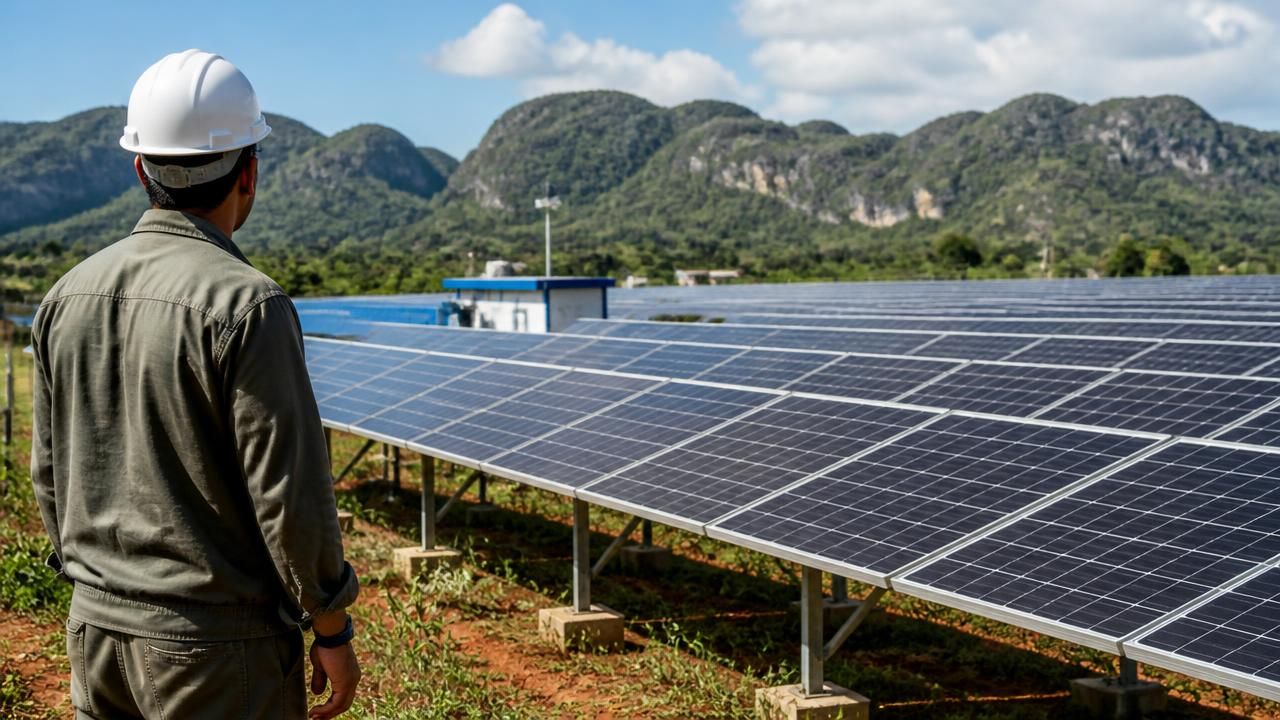
CNN describes Cuba’s push as “one of the fastest solar revolutions on the planet,” with China playing a central role. Vozpopuli reports that China is building 75 solar parks across the island. ECIKS notes a milestone: 49 parks are already connected to the grid, with a target of 92 parks by 2028. These parks, often situated on former sugarcane fields, generate electricity that is fed directly into the national grid, helping to stabilize supply during daylight hours.
The Cuban government has unveiled ambitious plans: 55 new solar parks, many financed through Chinese loans and contracts. According to OilPrice.com, these parks will add over 2,000 megawatts of capacity—a significant fraction of the country’s total generating capacity, which has fallen to less than 500 MW at times. Le Monde highlights how small businesses, or MIPYMEs, are also turning to solar. In Villa Clara, a small business installed a solar charging station for neighborhood residents, as reported by CiberCuba. This grassroots adoption is helping to offset the daily uncertainty of grid power.
“We never know when the lights will go out. Now we can at least charge our phones and run a fan,” said a Havana resident in an interview with CNN.
China Gains Ground
The solar expansion is not just an energy story—it is a geopolitical one. As the US retreats from engagement, China is filling the void. Voz.us analysis calls it “The Dragon’s Strategy: China gains ground on Russia in Cuba.” Chinese companies are providing panels, inverters, and installation expertise, often in exchange for future payments or mining concessions. This deepens Cuba’s reliance on Beijing, which already provides significant diplomatic and economic support. Meanwhile, The Guardian frames the shift as a response to US sanctions, the climate crisis, and aging infrastructure: “US sanctions, power cuts, climate crisis: why Cuba is betting on renewables.”
Challenges Ahead
Not everything is bright. EnergyNow provides a sobering analysis of how the grid collapsed—a combination of decrepit power plants, lack of maintenance, and fuel shortages. Solar alone cannot solve the problem; it provides power only during the day, and battery storage is limited. Additionally, extreme weather poses a threat. In Guantánamo, a severe local storm damaged solar panels and other infrastructure, as reported by CiberCuba and Cuba Headlines. This underscores the vulnerability of the new solar infrastructure in a hurricane-prone region.
Critics argue that the government’s top-down approach may not be sustainable. The New York Times video “A Movie Night in Cuba’s Blackout” captures the daily frustration of Cubans who still face regular outages even as solar parks multiply. Yet, the progress is undeniable. From 49 parks connected to a goal of 92, from no solar capacity a few years ago to over 2 GW planned, Cuba is undergoing a rapid transformation that could serve as a model for other energy-poor nations.
What Comes Next?
If Cuba can maintain this pace—and secure the financing and maintenance parts—it could significantly reduce its reliance on imported oil. For now, the island is an unexpected laboratory for a green energy transition under duress. As The Week noted, Cuba’s energy crisis has sparked a solar expansion that is both a necessity and an opportunity. Whether it will be enough to keep the lights on—and withstand the political storms—remains to be seen.
—Reporting contributed by The New York Times, CNN, The Guardian, Le Monde, ECIKS, Havana Times, CiberCuba, and others.