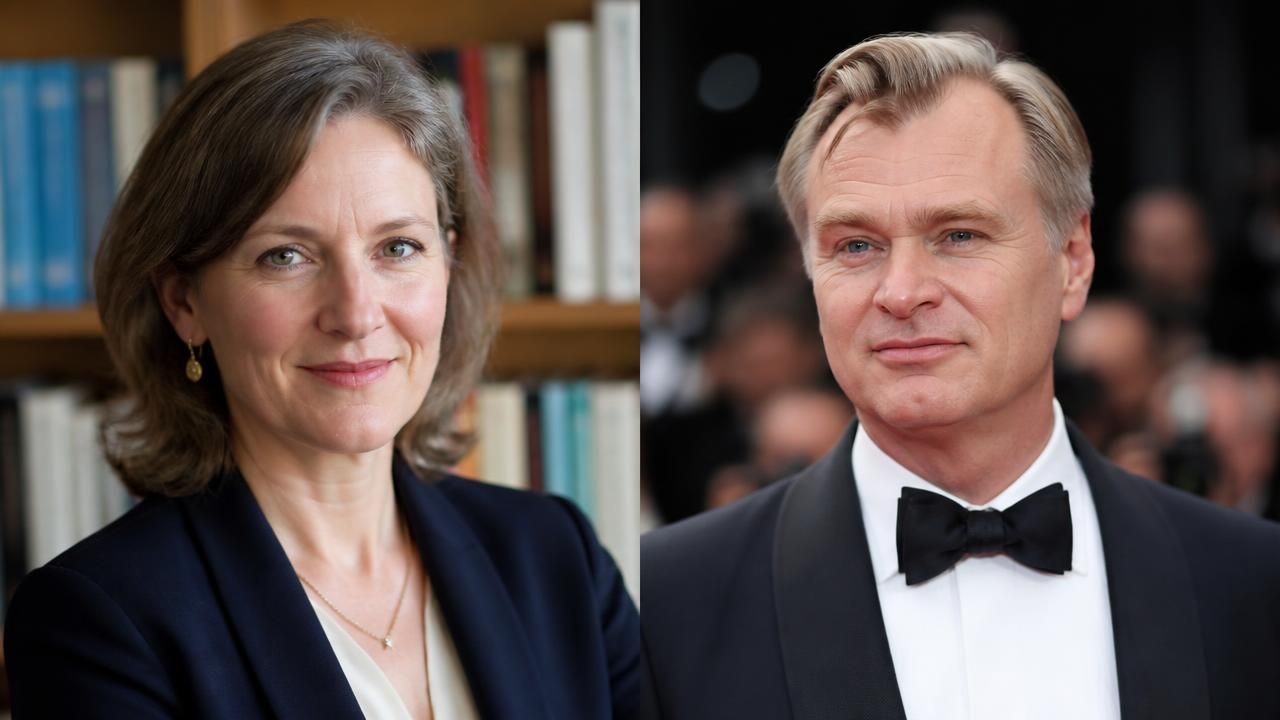
In a review that has ricocheted across media outlets, acclaimed classics scholar and translator Emily Wilson has delivered a blistering critique of Christopher Nolan's upcoming film adaptation of Homer's The Odyssey. Wilson, whose award-winning translations of both the Iliad and Odyssey have revitalized the ancient epics for modern readers, did not hold back in her assessment of Nolan's screenplay, published in the London Review of Books under the title 'An Uncomplicated Man.'
Wilson's critique, which quickly went viral on social media and was picked up by outlets ranging from Deadline to the Times of India, calls the film's narrative structure 'gimmicky' and the writing 'abysmal.' In a statement that has been widely quoted, she declared: 'I would be ashamed to have written any part of this.' The review has sparked a fierce debate about the boundaries of adaptation, the responsibilities of filmmakers to source material, and the role of scholarly expertise in popular culture.
The Critique: Dismantling the Screenplay
In her review, Wilson argues that Nolan's script fundamentally misunderstands the depth of Homer's poem. 'The Odyssey is not a simple hero's journey; it is a complex exploration of identity, memory, and the nature of storytelling itself,' she writes. She charges that Nolan reduces Odysseus to a 'one-dimensional action hero' and strips the epic of its rich ambiguity. The adaptation, she says, 'flattens the moral and emotional complexity of the original into a straightforward revenge plot.'
Wilson reserved particular ire for what she sees as a 'gimmicky' narrative structure that borrows from Nolan's signature non-linear storytelling techniques. 'Homer's use of flashback and embedded narratives serves a thematic purpose; Nolan's feels like a stylistic tic,' she wrote. The translator, who has a PhD in classics from Cambridge and has taught at the University of Pennsylvania, noted that the film seems to 'miss Homer's profound questions about homecoming, violence, and the passage of time.'
“I would be ashamed to have written any part of this. The screenplay is abysmal – it’s uncomplicated in the worst way.” – Emily Wilson, London Review of Books
The review also took aim at the film's characterization of Penelope, arguing that the 'film sidelines her intelligence and agency.' Wilson, who is known for bringing a feminist lens to her translations, said Nolan's Penelope is 'a passive figure waiting for her man, rather than the cunning co-architect of the household's survival.'
A Personal Connection: From Inspiration to Indignation
The irony of Wilson's critique has not been lost on commentators. Multiple sources, including Yahoo News and Entertainment Weekly, note that Wilson's translations are widely believed to have inspired Nolan's interest in making the film. Nolan himself has cited Wilson's work in interviews, and her translations of the Odyssey have become bestsellers, influencing a new generation of readers. Yet Wilson, who has tattoos of a spear and a bow representing Achilles and Odysseus, seems to feel a sense of personal investment in how the epic is handled.
'I love these stories,' Wilson told NPR's All Things Considered. 'I've been living with them since childhood. So when a filmmaker with Nolan's resources and talent gets it so wrong, it's disappointing on a deep level.' She echoed this sentiment in her review, expressing that the film 'felt like a betrayal of the very qualities that make the Odyssey a masterpiece.'
Wilson's background adds another layer of authority to her criticism. She is the first woman to publish a full English translation of the Odyssey (2017) and the Iliad (2023), and her work has been praised for its clarity, rhythm, and contemporary relevance. In her LRB review, she writes, 'I have spent years trying to bring Homer's nuance to life. To see it flattened into a blockbuster template is disheartening.'
Framing the Story: Differing Media Perspectives
The media coverage of Wilson's review reveals how different outlets frame the story. BuzzFeed and Esquire leaned into the viral aspect, with headlines emphasizing the 'brutal' and 'slam' nature of the critique. Deadline and The Independent focused on the 'shame' quote, while USA Today and the Detroit News highlighted the 'abysmal' label. Entertainment Weekly took a slightly more nuanced angle, noting that Wilson later 'regretted' one specific criticism—though the outlet did not specify which one.
Some sources, like Greek Reporter, centered on the idea that Nolan's film 'misses Homer's depth,' while Huffington Post UK framed the story as a 'classics expert who inspired the film rips it to shreds.' The Times of India quoted Wilson's criticism of the narrative structure as 'gimmicky,' and AOL UK repeated the 'ashamed' remark. Notably, two of the sources (sources 8, 13, 20) were preceded by 'Edge: Too Many Requests' or 'Attention Required' messages, indicating high traffic to those pages—testament to the story's viral reach.
Context and Backstory: The Odyssey Goes Hollywood
Christopher Nolan, the director behind Inception, The Dark Knight trilogy, and Oppenheimer, announced his intention to adapt The Odyssey in 2024, with Matt Damon reportedly in talks to star. The film is expected to be Nolan's most ambitious project yet, blending practical effects with his trademark narrative puzzles. However, Wilson's review suggests that the director's stylistic preferences may clash with the source material's thematic richness.
Historically, adaptations of Homer's epics have been mixed. The 1954 film Ulysses starring Kirk Douglas and the 1997 TV miniseries The Odyssey with Armand Assante have been criticized for similar simplifications. Wilson's review taps into a long-standing tension between academic fidelity and commercial adaptation. 'Homer's poem is not a straightforward adventure story,' she wrote. 'It's a meditation on grief, fidelity, and the power of storytelling. To reduce it to a revenge plot is to miss the point.'
Wilson also pointed out that Nolan's decision to write the screenplay himself—rather than bring in a classical consultant—may have contributed to the issues. 'A filmmaker as accomplished as Nolan should recognize when he's out of his depth,' she said. 'He should have collaborated with someone who understands the nuances of the text.' This remark was echoed in NPR's coverage, which highlighted that Wilson believes 'Nolan shouldn't have written the movie himself.'
Reactions and Implications
The backlash from Wilson has prompted a range of responses online. Some fans of Nolan's work defended the director, arguing that cinematic adaptations inherently require simplification and that Wilson's expectations may be too literal. Others praised her for holding a powerful filmmaker accountable. BuzzFeed compiled a selection of social media reactions, with one user tweeting, 'Emily Wilson is absolutely right. We need to stop letting directors butcher classics for the sake of spectacle.' Another countered, 'Nolan has earned the right to reinterpret stories. The Odyssey is not a sacred text.'
Classics scholars have weighed in as well. Dr. Sarah Brown, a professor of ancient Greek literature at the University of Oxford, told The Independent: 'Emily Wilson's critique is rigorous and necessary. She holds a mirror to Hollywood's tendency to strip ancient narratives of their complexity.' However, some have suggested that Wilson's own translations are themselves interpretations and that Nolan's film should be judged on its own terms.
The debate also touches on gender dynamics. Wilson is a prominent female voice in a field historically dominated by men, and her critique of Penelope's portrayal resonates with broader conversations about female agency in epic narratives. As she told Entertainment Weekly, 'Penelope is not just waiting. She is managing a household, thwarting suitors, and maintaining a kingdom. Nolan's version erases that.'
What Comes Next
Neither Nolan nor Warner Bros. has responded publicly to Wilson's review. The film is still in pre-production, with a 2026 release date rumored. It remains to be seen whether the criticism will influence the final script—or whether Nolan will engage with Wilson's points. Some commentators have suggested that the controversy could spark a broader conversation about the role of scholars in Hollywood adaptations.
Wilson, for her part, is already moving on. She is currently undertaking a new translation of the Odyssey for a future edition, and her LRB review continues to stir discussion. 'I don't want to be the person who attacks popular culture,' she said in an interview with WFDD. 'But when something is as reductive as this, and when it claims to be inspired by a work I care about deeply, I feel I have to speak up.'
As the dust settles, one thing is clear: Emily Wilson's voice has become an essential one in the conversation about how we adapt, consume, and honor the stories that shaped our civilization. And Christopher Nolan now faces the formidable challenge of proving that his Odyssey is worthy of the original.