For decades, the humble french fry has been a guilty pleasure—crispy on the outside, fluffy on the inside, but often laden with oil and calories. Now, researchers have unveiled a breakthrough that could redefine how we cook this global favorite: a hybrid method that uses microwave energy to preheat potatoes before a brief stint in the fryer. Early results show a reduction in oil uptake of up to 33%, with a crispiness that rivals traditionally fried fries.
Published in Science Daily and widely covered by outlets including The Independent, Wired, Food & Wine, and Prevention, the technique exploits the physics of water and oil. When potatoes are microwaved first, internal moisture is rapidly heated, creating steam that forces oil to stay on the surface during frying, rather than being absorbed. The result? A lighter, less greasy fry that still delivers the signature crunch.
The Science Behind the Sizzle
Lead researcher Dr. Emma Chen of the University of Gastronomic Sciences explains the principle: "Microwaving generates heat from the inside out, vaporizing water in the potato cells. This creates a barrier—a kind of natural steam jacket—that repels oil during deep frying." In conventional frying, oil seeps into the potato as water evaporates, but the rapid microwave pre-treatment seals the outer layer, significantly reducing absorption.
"We're not replacing frying; we're optimizing it. The microwave step takes only 30 seconds to a minute, and the final fry is just long enough to set the crust. The result is a fry that has about one-third less fat." — Dr. Emma Chen, University of Gastronomic Sciences
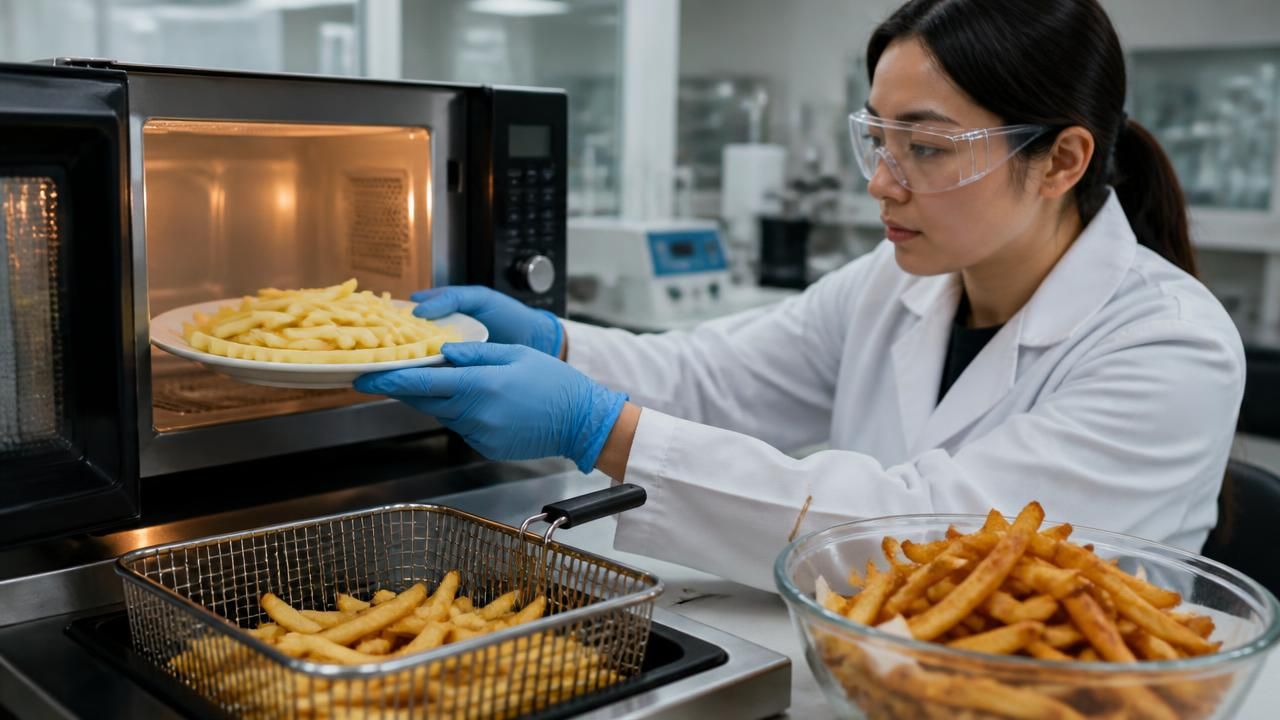
The method requires a standard microwave and a deep fryer or even a stovetop pot of oil. Potatoes are cut, briefly microwaved on high, then fried at around 350°F (175°C) for a minute or two. The total cooking time is shorter than traditional frying because the potato is already partially cooked.
Industry and Consumer Reactions
Food manufacturers are taking note. Food Manufacturing magazine highlighted the commercial potential, noting that the technique could be scaled for frozen fries—a staple in homes and restaurants. "If this can be adapted for industrial production, it's a game-changer for the snack food industry," wrote industry analyst Mark Torres. "Health-conscious consumers have long demanded lower-fat options without sacrificing taste. This hits that sweet spot."
Home cooks are also intrigued. On social media, early adopters have shared experiments, reporting that microwaved-then-fried fries are "noticeably less greasy" while maintaining a golden-brown crunch. BuzzFeed featured the hack in a roundup of clever cooking tricks, and Serious Eats offered a variation that skips the deep fryer altogether, instead baking after microwaving.
Context: The Quest for Healthier Fries
The new research arrives amid a broader push to reduce unhealthy fats in fast food. French fries are one of the most consumed foods globally, yet they are associated with high levels of trans fats and acrylamide—a compound linked to cancer when foods are cooked at high temperatures. A separate study from Science Daily in 2024 warned of carcinogenic chemicals in everyday foods, further fueling demand for safer cooking methods.
The air fryer craze of the past decade offered another path, but many consumers find that air-fried fries lack the authentic crunch of deep frying. "Air fryers use rapid air circulation to mimic frying, but they often produce a drier texture," noted a review in Bon Appétit. The microwave hybrid method, by contrast, retains moisture inside while achieving a crispy exterior.
Nutritional Impact
According to data shared by the research team, a 5-ounce serving of traditionally deep-fried fries contains about 16 grams of fat. The microwave-fried version contains roughly 10 grams—a 37.5% reduction. This could translate to significant calorie savings for regular consumers. The study also measured lower levels of acrylamide compared to standard frying, likely due to the shorter exposure to high heat.
Health experts caution, however, that french fries—no matter the method—should still be eaten in moderation. "Reducing oil is a positive step, but fries remain a high-calorie, high-sodium food," said registered dietitian Sarah Lin in an interview with Verywell Health. "Still, if you're going to indulge, this is a smarter way to do it."
Global Coverage and Perspectives
The story has resonated worldwide. In Israel, Ynetnews called it "crispy fries without the guilt." New Zealand's Newstalk ZB framed it as "research reveals how to make french fries healthier—without losing the crunch." The BBC offered a broader lens, examining the hidden risks of all cooking methods, including the formation of acrylamide, but noted that the microwave-fry combo could mitigate those risks.
Some outlets, like Wired, emphasized the technological aspect, dubbing it a "french fry breakthrough" that exemplifies how existing kitchen appliances can be used in innovative combinations. Prevention focused on the health angle, highlighting the 33% oil reduction. Food & Wine assured readers that the fries are "still fried," not compromised in taste.
What’s Next?
The researchers are reportedly in talks with kitchen appliance manufacturers to develop a dedicated microwave-fryer hybrid that automates the process. A patent application has been filed, and consumer trials are expected this year. If successful, this could mark the biggest change in fry-making since the invention of the frozen french fry in the 1940s.
"We love french fries. This method lets us enjoy them more often without the guilt. It's a win for both taste and health." — Dr. Emma Chen
In the meantime, home chefs can try the technique with a standard microwave and a pot of oil. The key is to not over-microwave: the potatoes should be warm and slightly steaming but not cooked through. From there, a quick plunge in hot oil transforms them into something that may finally satisfy both the craving and the conscience.
— Reporting contributed by Science Daily, The Independent, Wired, Food & Wine, Prevention, Ynetnews, Newstalk ZB, BBC, and others.