The Great Atlantic Sargassum Belt—a sprawling ribbon of brown floating algae stretching from West Africa to the Gulf of Mexico—has reached near-record proportions in 2026, sounding alarms for coastal communities and prompting new scientific scrutiny. According to NASA’s Earth Observatory and the University of South Florida (USF) College of Marine Science, the belt’s June 2026 abundance was the second highest on record, trailing only 2025. Regionally, the Caribbean Sea and the Gulf of America (Gulf of Mexico) both hit record highs, as reported in USF’s June 2026 Sargassum outlook.
Satellite imagery from NASA’s PACE (Plankton, Aerosol, Cloud, ocean Ecosystem) mission, captured by the Ocean Color Instrument (OCI), reveals dense concentrations of sargassum across the tropical Atlantic. This annual phenomenon, which began surging in 2011, has shifted the algae’s range from its historical home in the Sargasso Sea—a region in the North Atlantic—to a vast belt spanning thousands of kilometers. The 2026 bloom underscores a troubling trend: the belt is not only growing but also changing in character, with implications for ecosystems, tourism, and human health.
A Growing Threat to Coastlines
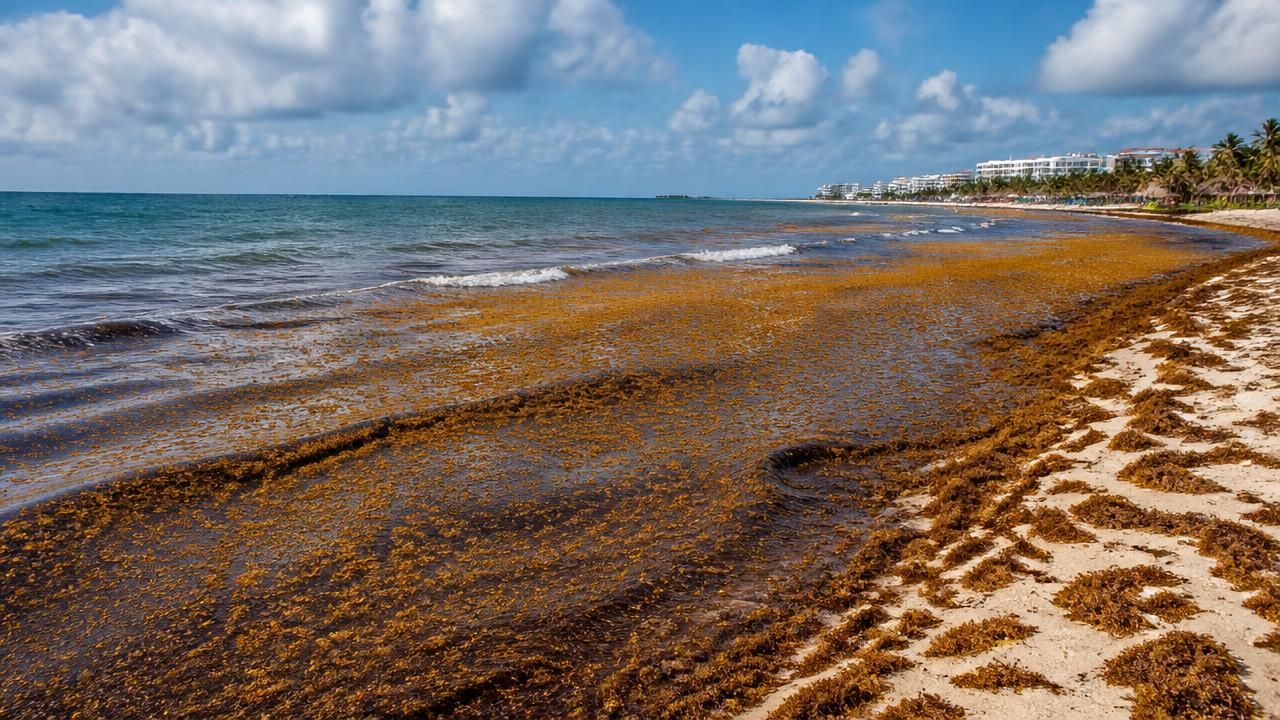
The massive seaweed mat, often described as a “continent-long brown ribbon,” poses significant challenges for beaches from Florida to Mexico, the Caribbean, and Texas. In June 2026, satellite data showed the belt approaching the shores of Florida and the Caribbean, raising fears of another summer of foul-smelling, beach-clogging algae. Local officials in Florida have already begun monitoring, with news outlets like the Jacksonville Sun and Palm Beach Post reporting on tracker tools and potential impacts.
“The sargassum season for Florida is gone,” a scientist told Phys.org, noting the unpredictable nature of recent blooms. While some sources, like First Coast News, suggest that the “enormous floating seaweed patch” may be shrinking in certain areas, the overall biomass remains historically high. CNN reported that 31 million tons of “supercharged seaweed” are creeping toward the region, a figure echoed by Open Jaw for Mexico. The stench and decay of sargassum can harm marine life, deter tourists, and even cause respiratory issues.
Changing Drivers: From Physics to Ecology
Scientific understanding of the belt’s drivers is evolving. A study published in Nature Communications in 2024 highlighted a “regime shift” in the factors controlling sargassum growth. Historically, physical forcing—such as ocean currents and wind—determined the belt’s extent. However, as nutrient pollution from agricultural runoff and climate change alter ocean chemistry, the system may be transitioning to “ecological control,” where biological processes like nutrient cycling and grazing play a larger role.
NASA’s Earth Observatory noted that the belt has thinned in the Sargasso Sea while proliferating in the tropical Atlantic. This shift is linked to changing ocean temperatures and increased nutrient inputs from the Amazon River and African dust. Dr. Chuanmin Hu, a sargassum expert at USF, has emphasized the role of satellite monitoring in tracking these changes. “The belt’s abundance this year is a stark reminder of how human activities are reshaping ocean ecosystems,” he said in a statement.
“The belt’s abundance this year is a stark reminder of how human activities are reshaping ocean ecosystems.”
From Nuisance to Resource: Innovative Solutions
While sargassum is often seen as a nuisance, some voices advocate for turning the problem into an opportunity. A column on Yahoo! News argued that beach-clogging sargassum “doesn't have to go to landfills” and can be used to enrich soils. Researchers and entrepreneurs are exploring ways to compost the algae into fertilizer, biofuel, or even building materials. In the Caribbean, where sargassum piles have devastated tourism, pilot projects are testing conversion techniques.
However, the economic and logistical hurdles remain high. The Cayman News Service reported “new horror revealed in sargassum blob,” citing the release of hydrogen sulfide gas as the algae rots—a toxic compound that can harm humans and animals. St. Pete Catalyst detailed how local scientists are working to identify the origins of the massive seaweed belt, hoping to predict its movements and mitigate impacts.
Broader Implications and Future Outlook
The 2026 sargassum bloom is not an isolated event. Articles from Phys.org, WLRN, and WUSF frame the story as part of a larger narrative of climate change and ecological disruption. The NOAA Climate.gov noted that “massive bloom of seaweed in tropical Atlantic raises the risk for Caribbean, Gulf, and Florida beach impacts in coming months.” Meanwhile, sources like the Daily Galaxy and ECOticias portrayed the belt as a “red flag” for planetary health.
Data from multiple outlets—USA Today, Sun-Sentinel, Orlando Sentinel, and BBC—converge on the message that this is a record-breaking phenomenon with global significance. The BBC called it a “stinky seaweed bloom wider than the US,” while USA Today warned that it could “ruin your spring beach trip.” Yet, amidst the alarm, there is a glimmer of adaptive thinking: scientists and policymakers are recognizing that sargassum, while a challenge, may also be a resource in a circular economy.
Key Takeaways from the 2026 Bloom
- Record Size: June 2026 saw the second-highest sargassum abundance on record, with record highs in the Caribbean and Gulf of Mexico.
- Shifting Drivers: The belt’s growth is increasingly driven by ecological factors rather than physical forces, likely due to nutrient enrichment and climate change.
- Regional Impacts: Florida, the Caribbean, Mexico, and Texas face heightened risks of beach closures, tourism losses, and health hazards.
- Innovative Responses: Efforts to convert sargassum into fertilizer or biofuel offer potential mitigation strategies, though scaling up remains challenging.
- Global Context: The bloom highlights the interconnectedness of land use, climate, and ocean health, serving as a warning for future ecosystem shifts.
As the 2026 sargassum season unfolds, scientists continue to monitor the belt with advanced satellite technology from NASA and NOAA. The hope is that better prediction can lead to better preparation—and perhaps even a way to turn a mountain of seaweed into a sustainable resource. Whether the Great Atlantic Sargassum Belt will continue to expand or eventually recede remains uncertain, but one thing is clear: the brown ribbon stretching across the Atlantic is a signal of changes beneath the waves that demand our attention.