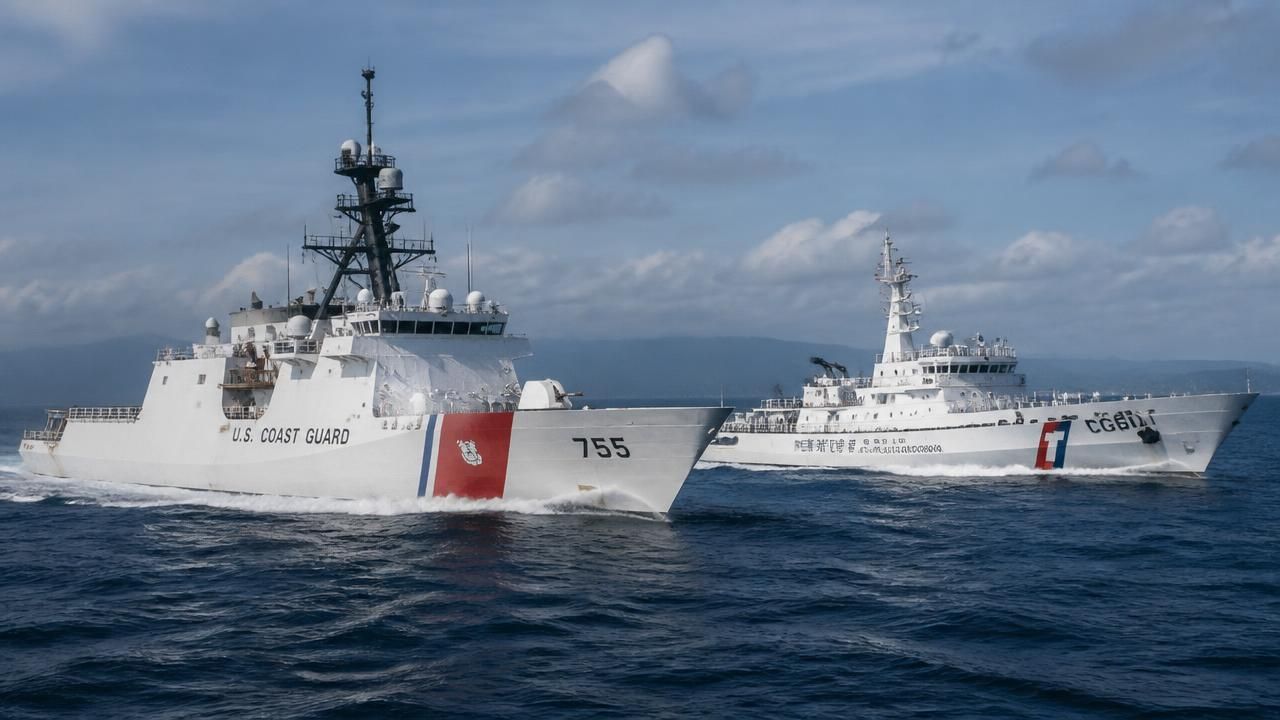
The United States and Taiwan have taken a rare step in maritime cooperation, with the de facto US embassy in Taipei releasing a photograph of US and Taiwanese coast guard vessels sailing together. The image, published by the American Institute in Taiwan (AIT), shows the US Coast Guard cutter Munro alongside a Taiwanese vessel, marking a significant gesture of solidarity as China intensifies its military pressure in the region.
Strategic Message in a Single Shot
The photograph, distributed via AIT’s social media channels, is widely seen as a deliberate signal of US support for Taiwan’s self-defense capabilities. Bloomberg Markets first reported the development, noting that such a public display of joint naval activity is unusual. The move comes amid a series of Chinese military exercises near Taiwan, including incursions into Taiwan’s air defense identification zone. Analysts view the image as a calibrated response to reassure Taipei without escalating to direct US naval deployments.
“This is a carefully framed message—the US is saying it stands with Taiwan, but it’s using coast guard assets rather than warships to avoid crossing Beijing’s red line,” said Dr. Emily Chang, a maritime security expert at the Center for Strategic and International Studies.
Coast Guard’s Expanding Role on the Global Stage
The Taiwan patrol is just one facet of the US Coast Guard’s increasingly visible role in international waters. In a separate incident, the Coast Guard seized a Russian-flagged oil tanker in the Atlantic Ocean after a two-week pursuit, as reported by The Guardian. The vessel, suspected of violating sanctions, was intercepted by a US cutter operating under Treasury Department authority. This action highlights the Coast Guard’s growing involvement in enforcing economic sanctions and maritime law beyond traditional search-and-rescue missions.
Arctic Shipping Safety Standards
Climate change is opening new shipping lanes in the Arctic, and the Coast Guard is adapting. According to a report from Alaska Beacon, ship traffic through the Bering Strait between Alaska and Russia is showing improved adherence to new safety standards. The Coast Guard has mandated enhanced navigation equipment and spill response plans for vessels transiting the region, a response to rising traffic and environmental risks. This regulatory push aims to prevent disasters in one of the world’s most fragile ecosystems.
A Rare Charter Tender
To support its expanding missions, the US Coast Guard has issued an unusual $99 million charter tender for a commercial cargo ship, as noted by TradeWinds News. The vessel is intended to supply remote stations and support logistics for Arctic operations. The tender is part of a broader effort to modernize the Coast Guard’s fleet amid budget constraints, leveraging private-sector capacity for strategic needs.
Domestic Turmoil and Oversight
On the home front, the Coast Guard has faced scrutiny over leadership and ethics. Red Lake Nation News reported that former South Dakota Governor Kristi Noem has been living rent-free in a home used by the Coast Guard commandant, raising questions about potential conflicts of interest. The arrangement, disclosed in a recent inspector general report, has sparked calls for investigations into how such perks are managed. While not directly linked to the Taiwan patrol or Arctic missions, the controversy underscores the institution’s challenges in maintaining public trust.
Implications for US-China Relations
The Taiwan coast guard photo is likely to further strain ties with Beijing, which claims the island as part of its territory. China’s foreign ministry has condemned the image, calling it a “serious violation of the One-China principle.” However, US officials insist that the cooperation is routine and intended to uphold freedom of navigation. The incident reflects a broader trend: Washington is using coast guard assets as a lower-risk tool to signal commitment to allies in the Indo-Pacific, particularly as the US Navy is stretched thin.
The Bigger Picture
From the Arctic to the Atlantic to the Taiwan Strait, the US Coast Guard is operating on multiple fronts—enforcing sanctions, protecting sovereignty, and building partnerships. The simultaneous news of the Taiwan patrol, Russian tanker seizure, Arctic safety standards, and charter tender paints a picture of an agency undergoing transformation. As geopolitical rivalries intensify and climate change reshapes the seas, the Coast Guard’s role as a versatile maritime force is likely to grow, even as it grapples with internal controversies.
The rare joint sail with Taiwan may be a small event, but its symbolism is large. In an era of great-power competition, every vessel and every photograph carries weight.