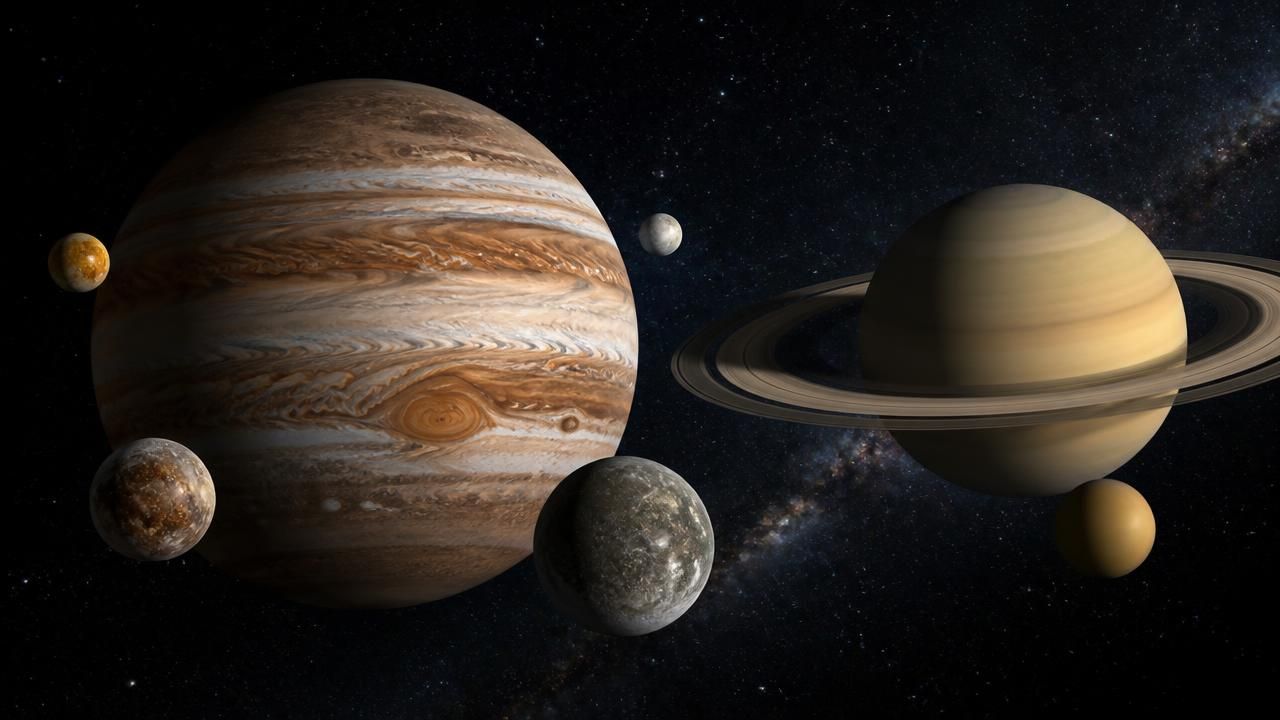
For decades, astronomers have puzzled over a striking asymmetry in our solar system: Jupiter, the largest planet, hosts four giant moons—Io, Europa, Ganymede, and Callisto—while Saturn, the runner-up, has only one large moon, Titan. Jupiter’s Ganymede is the largest moon in the solar system, and Titan ranks second. But why the discrepancy? A new study by an international team from China and Japan offers a compelling answer: Jupiter’s youthful magnetic field acted as a protective cocoon, allowing its massive moons to form and survive, while Saturn lacked such a shield.
Magnetic Accretion: A New Model for Moon Formation
The study, published in a recent issue of Astronomy & Astrophysics, introduces the concept of a magnetospheric cavity—a region cleared of gas and dust by a planet’s magnetic field. Researchers simulated the early stages of gas giant formation, when both Jupiter and Saturn were surrounded by circumplanetary disks of gas and dust. In these disks, moons are born from the accumulation of material. The team found that Jupiter’s strong magnetic field, generated by its rapid rotation and metallic hydrogen interior, created a cavity that reduced friction and allowed moon-forming material to coalesce into large bodies. Saturn’s weaker field, meanwhile, left its disk more turbulent, hindering the growth of multiple large moons.
“Young Jupiter’s powerful magnetic field may have created a safe zone where several large moons could survive. Saturn lacked this protection, possibly explaining why Titan stands almost alone among its largest moons,” noted a press release from the National Astronomical Observatory of Japan (NAOJ), which collaborated on the study.
This magnetospheric cavity model is a significant departure from previous theories, which emphasized the role of orbital resonances or migration. The new model not only explains the moon count disparity but also accounts for the mass distribution within each system: Jupiter’s four large moons account for 99.97% of its satellite mass, while Saturn’s Titan dominates but is accompanied by many smaller icy moons.
Moon Counts and Curiosities
The contrast in moon numbers is stark. Jupiter has over 95 confirmed moons, including its four Galilean satellites. Saturn, however, boasts a staggering 146 known moons—more than any other planet—but most are tiny, with only Titan exceeding 5,000 km in diameter. The discovery of 128 new Saturnian moons in 2024 (as reported by Syfy) brought the total to 274, yet none approach Titan’s size. As Universe Today notes, “Saturn’s system of satellites is dominated by one large moon (Titan), the second largest in the Solar System.”
The new study also helps explain a related mystery: why Jupiter lacks spectacular rings. In 2022, researchers from UC Riverside argued that Jupiter’s giant moons prevent the formation of bright rings by gravitationally scattering ring material. The magnetic cavity model now adds another layer: Jupiter’s magnetosphere may have suppressed the formation of a ring-generating population of small moons.
Broader Implications for Exoplanets
The findings extend beyond our solar system. If magnetic fields play a key role in moon formation, then exoplanets with strong fields may be more likely to host large moons—a factor in the search for habitability. Large moons like Europa and Enceladus (Saturn’s icy moon) are considered prime targets in the hunt for extraterrestrial life due to their subsurface oceans. “Understanding moon formation helps us identify worlds where life might emerge,” said lead researcher Dr. Hao Luo of the Chinese Academy of Sciences.
Saturn’s Titan, meanwhile, remains a world of intrigue. With a thick nitrogen atmosphere, methane lakes, and a size larger than Mercury, it is a target for future exploration. As some sources argue, Titan is “perfect for human exploration,” though its -179°C surface presents challenges.
The Historical Context
The question of moon formation has long evolved. Early models assumed moons formed from circumplanetary disks similar to how planets form from solar nebulas. But simulations repeatedly failed to produce systems like Jupiter’s. The 2010s saw the “Grand Tack” hypothesis, where Jupiter migrated inward and outward, disrupting potential moon growth. The new magnetic model offers a simpler, physics-based explanation.
“We’ve known that magnetic fields can shape disks for decades,” said co-author Dr. Yuki Sato of NAOJ. “But applying it to moon formation provides a unified picture that matches observations.”
Saturn’s Crowded Sky vs. Jupiter’s Elite Club
While Saturn has more moons overall, Jupiter’s moons are far more massive. The Galilean moons contain more mass than all other moons in the solar system combined, minus Titan. The new study explains this as a consequence of magnetic shielding: Jupiter’s cavity allowed large bodies to grow without being broken apart by collisions or dragged into the planet. In Saturn’s turbulent disk, only Titan—formed in a region where the magnetic influence was minimal—survived as a giant.
Future missions, such as NASA’s Europa Clipper and ESA’s JUICE, will explore Jupiter’s moons in detail, testing these predictions. For Saturn, the Dragonfly mission to Titan will search for prebiotic chemistry. Together, they will refine our understanding of how planetary systems—and their moons—evolve.
This research not only solves a longstanding puzzle but also underscores the role of magnetic fields in shaping planetary architecture. As we discover more exomoons, the lessons from Jupiter and Saturn will guide us.