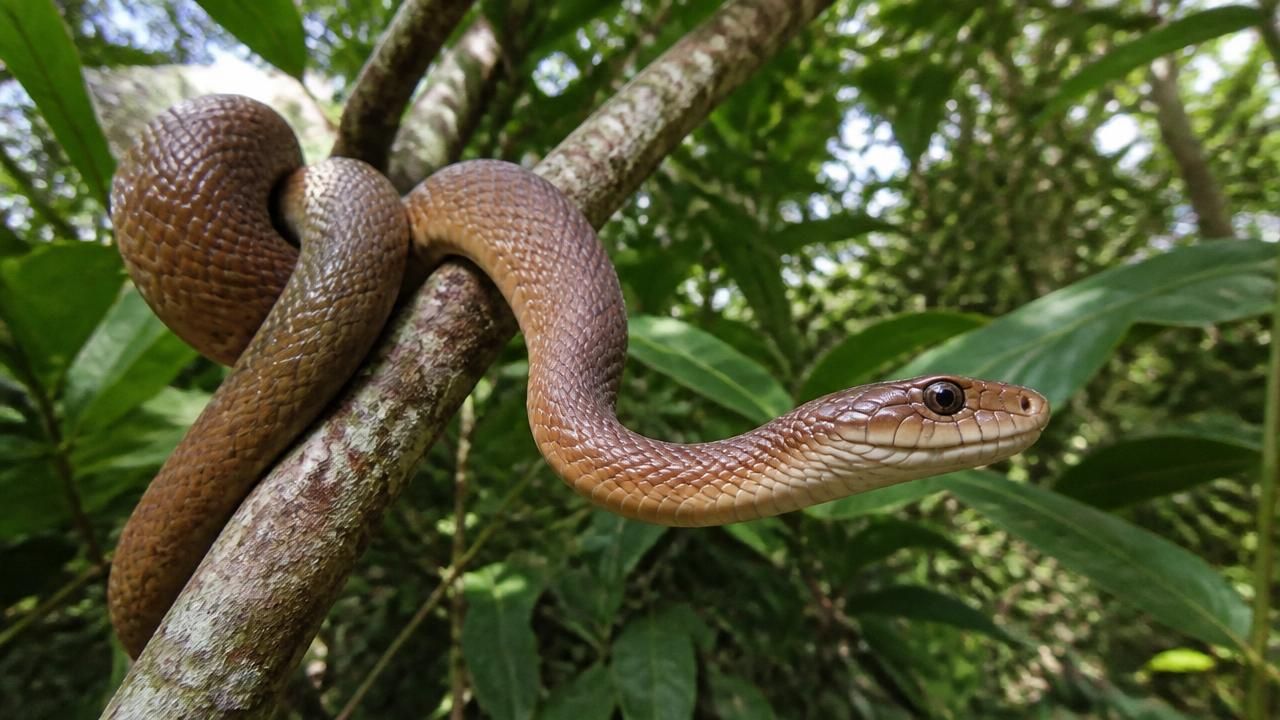
For decades, the brown tree snake's explosive invasion of Guam has puzzled ecologists. How did a small founding population, likely descended from just a few snakes, multiply to densities of up to 13,000 per square mile and decimate the island's native birdlife? The answer, according to a new study using advanced long-read DNA sequencing, lies in a hidden cache of genetic diversity that helped the inbred reptiles adapt and thrive.
The Invasion That Devastated an Island
Brown tree snakes (Boiga irregularis) arrived on Guam shortly after World War II, probably as stowaways in military cargo. With no natural predators and an abundance of prey, the snakes exploded in number. Their appetite for birds led to the extinction of nine of Guam's 12 native forest bird species and caused cascading ecological damage, including the collapse of pollination and seed dispersal networks. The invasion has cost the U.S. government tens of millions of dollars in control efforts and prevention measures, as the snakes continue to threaten other Pacific islands.
The Paradox of Inbreeding
Genetic studies had previously shown that the Guam snake population suffered from low genetic diversity—a classic sign of a population bottleneck. Inbreeding typically leads to reduced fitness, making populations vulnerable to disease and environmental change. Yet the brown tree snake seemed to defy this rule, rapidly adapting to its new home and reaching extraordinary densities. Researchers from the University of Colorado Boulder and other institutions set out to solve this puzzle using a cutting-edge technique: long-read DNA sequencing.
Uncovering Hidden Variation
Unlike standard short-read sequencing, which fragments DNA into small pieces, long-read sequencing allows scientists to see large structural variants—chunks of DNA that have been duplicated, deleted, or rearranged. The team analyzed the genomes of 18 brown tree snakes from Guam and compared them with the known reference genome. They discovered more than 19,000 large structural differences, many of which were concentrated in genes involved in immunity and smell.
"These hidden structural variants may have been the key to the snake's success," said lead author Dr. Sara Simmonds. "By maintaining functional diversity in critical genes, the founders could adapt to Guam's novel environment despite appearing genetically depauperate."
The findings, published in Molecular Ecology, suggest that traditional genetic surveys that only look at small DNA changes (single nucleotide polymorphisms) may miss the bigger picture. Large structural variants can have outsized effects on phenotype and are more likely to be preserved during inbreeding.
Implications for Invasion Biology
The study provides a new framework for understanding how invasive species can overcome genetic bottlenecks. "This is a cautionary tale for biosecurity," said co-author Dr. Nicole Fusco. "A few individuals can carry a surprising amount of genetic firepower, especially if their genome contains structural variants that boost adaptability." The research could help predict which species pose the greatest invasion risk and inform strategies for controlling established populations.
On Guam, control efforts such as trapping and baiting with acetaminophen have proven partially effective, but eradication remains elusive. The snake's ability to persist despite intensive management may partly stem from its genetic resilience. Understanding the genomic basis of that resilience could lead to new control methods, such as targeting specific adaptive genes or using gene drives.
Broader Evolutionary Lessons
The brown tree snake's story also challenges long-held assumptions about inbreeding depression. "We tend to think that inbreeding always leads to doom, but nature sometimes finds a way," said evolutionary biologist Dr. Kristin Lee. The study underscores the importance of structural variation in evolution—a dimension of genetic diversity that has been historically underappreciated. As long-read sequencing becomes more widespread, scientists expect to uncover similar hidden diversity in other invasive species, from cane toads to zebra mussels.
A Paradise Lost, but a Lesson Learned
While the snakes continue to suppress Guam's native birds, conservationists are working to reintroduce species like the Guam rail and the Micronesian starling to predator-free sanctuaries. The new genetic insights do not offer a quick fix, but they deepen understanding of one of the most infamous biological invasions in history. As Dr. Simmonds put it, "The brown tree snake is a masterful invader, and we are only now beginning to understand its secret weapons."