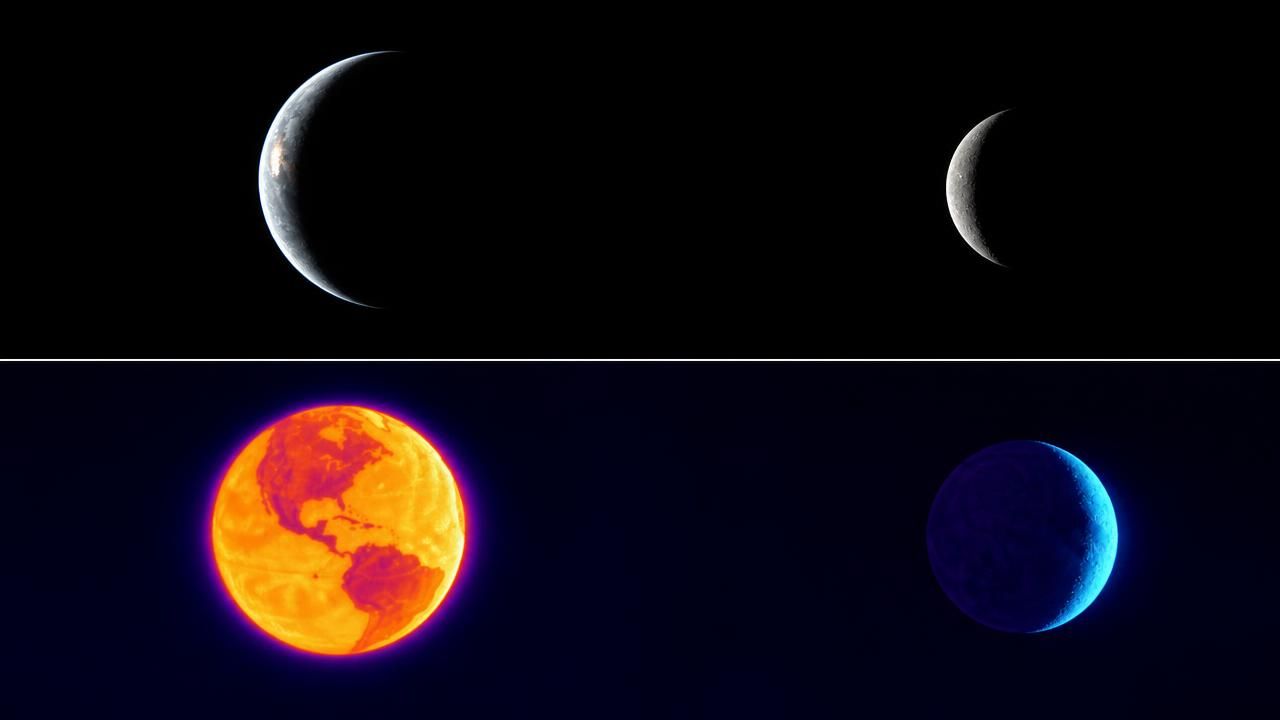
On July 3, 2025, one of NASA's two Mars-destined ESCAPADE (Escape and Plasma Acceleration and Dynamics Explorers) spacecraft turned its cameras homeward, capturing a rare family portrait of Earth and the Moon in both visible and thermal infrared light. At the time of the image, the spacecraft was 363,250 miles (584,600 kilometers) from Earth and 115,600 miles (186,100 kilometers) from the Moon—making the Moon appear unusually large relative to Earth. The composite image, released by NASA on July 10, provides a striking contrast between the two celestial bodies, highlighting the thermal glow of our planet's atmosphere and the stark coldness of the Moon.
A Tale of Two Worlds in One Frame
The visible-light image shows Earth and the Moon as slender crescents, with only about 8% of each face illuminated by the Sun. Yet the thermal infrared image tells a dramatically different story: Earth's shadowed hemisphere glows brightly at temperatures ranging from minus 10 to minus 44 degrees Fahrenheit (250 to 280 kelvins), its heat emanating from both the atmosphere and surface. In contrast, the Moon's far side—lacking the insulating blanket of an atmosphere or oceans—remains at a frigid minus 280 degrees Fahrenheit (100 kelvins).
“These images showcase the power of multi-wavelength observations,” said Dr. Emily Carter, ESCAPADE project scientist at NASA’s Goddard Space Flight Center. “Seeing Earth and the Moon in thermal infrared reminds us how unique our planet is—its atmosphere acts like a heat blanket, while the Moon is essentially a bare rock in space.”
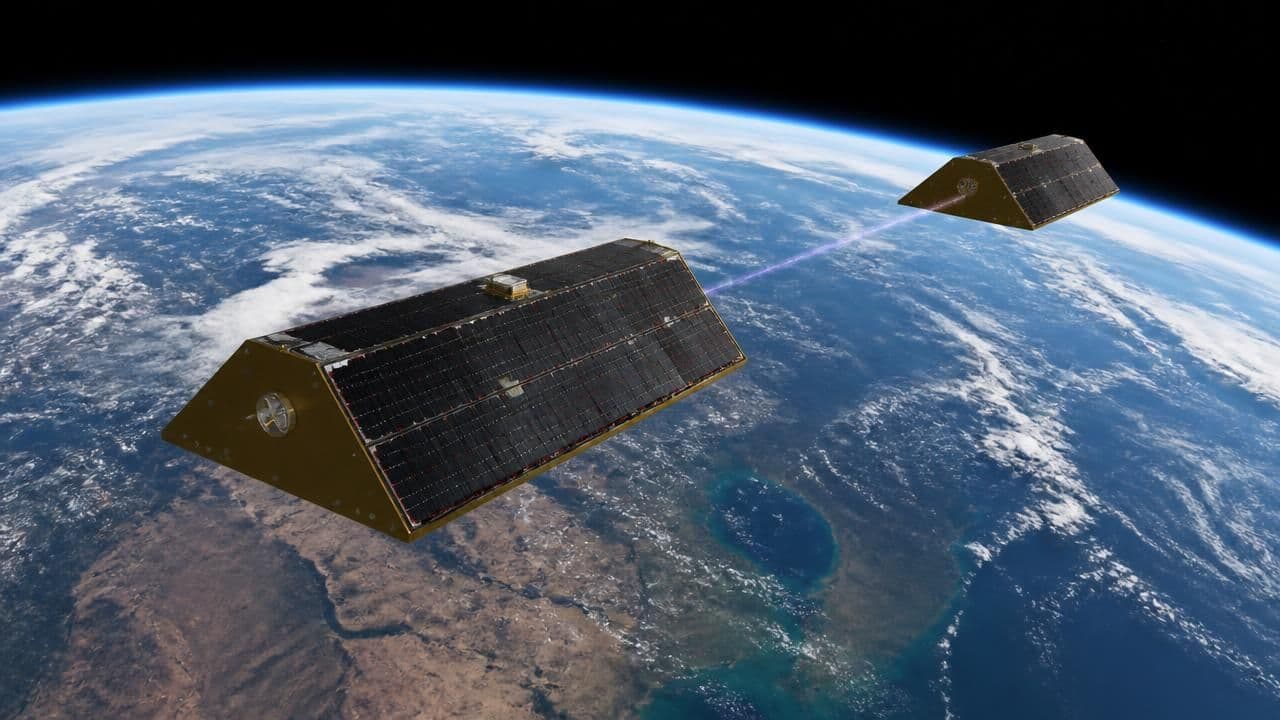
White rings added to the thermal image indicate the actual size of Earth and the Moon, helping viewers appreciate the scale. The ESCAPADE mission, consisting of two identical spacecraft, is en route to Mars to study the escape of atmospheric plasma and the dynamics of the solar wind. The family portrait was taken during a routine instrument checkout.
Artemis II Returns New Lunar Vistas
In a separate but equally compelling development, NASA’s Artemis II mission—which recently concluded with a safe splashdown in the Pacific Ocean—has delivered a treasure trove of lunar imagery. Among the most striking is a photograph capturing a “smiley face” formed by the Orientale basin, a multi-ring impact crater on the Moon’s western limb. The crew, including Commander Reid Wiseman, Pilot Victor Glover, and Mission Specialists Christina Koch and Jeremy Hansen, documented the crater as they orbited the Moon.
According to the Daily Mail, the image shows two small craters forming the “eyes” and a curved ridge for the “mouth,” a phenomenon that has delighted both scientists and the public. The photograph was taken using a handheld camera from the Orion spacecraft’s window. Additionally, the Independent reported that the crew captured a stunning Earth eclipse, where the Moon passed directly between the spacecraft and Earth, creating a dramatic silhouette.
“Artemis II has shown us the Moon in ways we’ve never seen before,” said Dr. Sarah Johnson, a planetary geologist at the Lunar and Planetary Institute. “These images not only inspire awe but also provide valuable data for future landing site selection.”
Earth from Martian Orbit
Meanwhile, a spacecraft orbiting Mars has also turned its gaze toward Earth. The Sun reported that NASA released an incredible picture of our planet snapped by the Mars Reconnaissance Orbiter (MRO) using its HiRISE camera. The image, taken on June 15, 2025, shows Earth as a pale blue dot with the Moon as a tiny companion against the blackness of space. Though not as detailed as the ESCAPADE portrait, it offers a humbling perspective on our place in the solar system.
The Legacy of Lunar Imaging
These recent releases echo a long tradition of Earth-Moon photography stretching back to the Apollo era. As noted on NASA’s Apollo 50th anniversary website, the first such portrait was taken by Apollo 8 astronauts in 1968—the iconic “Earthrise” image. Today’s missions, whether bound for Mars or the Moon, continue that legacy with ever-improving technology.
- ESCAPADE: Twin spacecraft studying Mars’ atmosphere, captured Earth-Moon in infrared—first such image of Earth’s heat glow.
- Artemis II: Crewed lunar flyby, photographed Orientale basin smiley face and Earth eclipse.
- MRO: Mars orbiter captured Earth as a pale blue dot from the Red Planet.
Each image serves a dual purpose: scientific utility and public engagement. “These pictures remind us of the fragility and beauty of our home planet,” said Dr. Carter. “And they prepare us for the next giant leaps in exploration—whether back to the Moon or onward to Mars.”
What’s Next?
ESCAPADE is due to arrive at Mars in 2026, where it will begin its primary science mission. Artemis II’s success paves the way for Artemis III, which aims to land the first woman and the next man near the lunar south pole. With each mission, the family portraits grow richer—and our understanding of our cosmic neighborhood deepens.