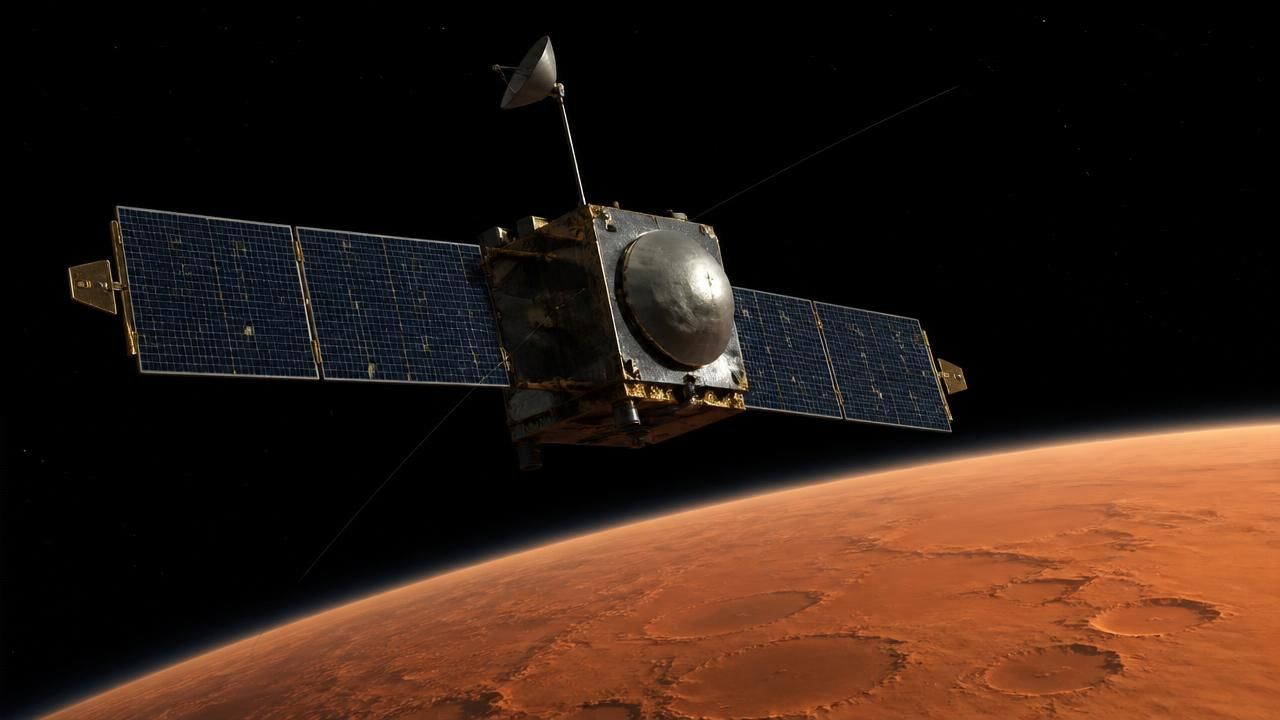
NASA has officially declared the end of its Mars Atmosphere and Volatile Evolution (MAVEN) mission, after the spacecraft went silent in December 2025 and recovery efforts failed. The orbiter, which spent 11 years studying the Red Planet's upper atmosphere and magnetic environment, left behind a legacy of groundbreaking discoveries—including a new understanding of Martian auroras and the mechanisms driving atmospheric loss.
A Sudden Silence
On December 6, 2025, MAVEN suddenly lost contact with Earth. Engineers at NASA's Goddard Space Flight Center and Lockheed Martin, which built the spacecraft, spent six months attempting to re-establish communication. Despite exhaustive efforts, the agency declared the spacecraft unrecoverable on June 3, 2026. The cause of the failure remains unknown, though speculation ranges from a catastrophic power system failure to a collision with debris.
“We've exhausted all options to recover MAVEN,” said a NASA official. “But the data it sent back will continue to inform Mars science for years to come.”
The loss was first reported by multiple outlets, including The Hill, UPI, and Ars Technica, which noted that the spacecraft had operated well beyond its planned two-year primary mission. MAVEN launched in 2013 and arrived at Mars in 2014, providing unprecedented insights into the planet's atmosphere.
Unlocking the Secrets of Martian Auroras
Just weeks before its demise, MAVEN transmitted data that helped solve a long-standing puzzle about auroras on Mars. Published in Nature Communications, the study revealed that Mars experiences a scaled-down version of Earth's aurora-generating mechanism, known as the Dungey cycle. On Earth, the Sun's magnetic field lines reconnect with our planet's magnetosphere, accelerating charged particles that create dazzling light shows near the poles. On Mars, the same process occurs but on a much smaller scale due to the planet's weak, patchy magnetic field.
NASA's MAVEN team explained that the Dungey cycle drives electrical currents, accelerates particles, and controls plasma circulation in Mars' ionosphere. This finding not only explains how auroras form on Mars but also sheds light on how the planet's atmosphere has been stripped away over billions of years.
Atmospheric Loss and the Search for Habitability
MAVEN's primary mission was to study how Mars lost its once-thick atmosphere, which likely transformed the planet from a warm, wet world into the cold desert we see today. The spacecraft measured the rate of atmospheric escape and identified solar storms as a major driver. An illustration released by NASA showed charged particles from a solar storm stripping away ions from Mars' atmosphere—a process MAVEN quantified in detail.
“Understanding atmospheric loss is key to understanding Mars' climate history and its potential to have supported life,” said a planetary scientist quoted by IFLScience. The mission also detected a type of aurora called “proton aurora,” which had not been observed before at Mars.
Mixed Reactions and Tributes
The end of MAVEN has drawn a mix of sadness and celebration from the scientific community. Ars Technica described the spacecraft's end as a “whisper,” noting that it simply stopped transmitting without warning. Autoevolution ran a headline asking, “Something Took Out a NASA Spacecraft in Mars Orbit, And No One Knows What,” reflecting the mystery surrounding the failure.
Meanwhile, Mashable highlighted the abruptness of the demise, while Universe Magazine and other outlets noted that a powerful solar flare had occurred around the time of the loss, though no direct link has been confirmed. Some sources, such as The Washington Times, focused on the mission's decade-long success, while others like MSN and Yahoo provided concise obituaries for the orbiter.
Despite the loss, MAVEN's data continues to be analyzed. The spacecraft's discoveries will inform future missions, including NASA's Mars Sample Return campaign and the planned human exploration of the Red Planet.
What's Next for Mars Exploration?
With MAVEN gone, NASA's remaining Mars orbiters—including the Mars Reconnaissance Orbiter and the 2001 Mars Odyssey—continue to operate. However, MAVEN's unique focus on the upper atmosphere leaves a gap that will be difficult to fill. The agency is considering a follow-up mission, but no concrete plans have been announced.
In the meantime, scientists will pore over MAVEN's extensive dataset, which includes measurements of solar wind, magnetic fields, and atmospheric composition. The spacecraft's final gift—a clearer picture of how auroras work on Mars—ensures that its legacy will endure long after its silence.