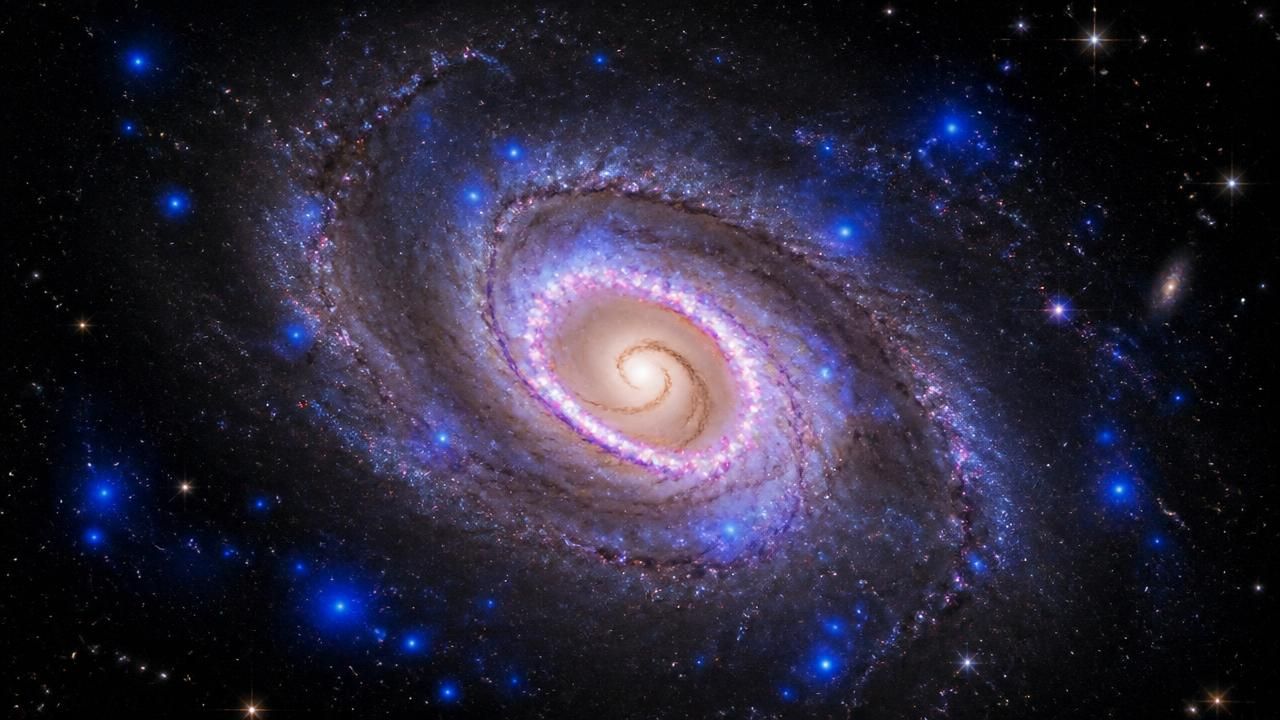
NASA's Chandra X-ray Observatory has released a stunning new multi-wavelength image and accompanying soundscape of the spiral galaxy Messier 94 (NGC 4736), offering astronomers and the public a fresh perspective on this celestial neighbor. The composite image, unveiled on June 30, 2026, layers X-ray data from Chandra with visible light observations from ground-based astrophotographers Brian Brennan and Remi Lacasse, revealing the galaxy's bright inner starburst ring in unprecedented detail.
A Galaxy with a Fiery Core
Located about 16 million light-years away in the constellation Canes Venatici, Messier 94 is a classic spiral galaxy with a distinctive bright inner ring—a region of intense star formation known as a starburst ring. This ring, visible in both optical and X-ray wavelengths, is likely fueled by gas funneled inward by the galaxy's unique oval-shaped structure. The new Chandra image highlights X-ray emissions from hot gas, supernova remnants, and stellar-mass black holes, while the optical data showcase the glowing stars and dust lanes.
“This starburst ring is a factory for new stars, and Chandra sees the high-energy aftermath,” said Dr. Kimberly Arcand, Chandra visualization scientist at the Smithsonian Astrophysical Observatory. “By combining X-ray and visible light, we get a complete picture of the galaxy's activity.”
Sonification: Listening to the Cosmos
In addition to the visual treatment, NASA has released a sonification of Messier 94, translating the image data into sound. This process, part of the Chandra X-ray Observatory's ongoing sonification project, assigns different pitches and rhythms to various wavelengths and brightness levels, allowing visually impaired audiences and the general public to experience the galaxy through hearing. The sonification maps X-ray emissions to higher-pitched sounds and optical light to lower frequencies, creating an auditory representation of the galaxy's structure.
Technical Details and Collaboration
The image processing was led by L. Frattare and K. Arcand at NASA's Chandra X-ray Center, combining X-ray data from Chandra's Advanced CCD Imaging Spectrometer with optical images captured by Brennan and Lacasse using ground-based telescopes. The X-ray data are shown in red, orange, and blue, corresponding to different energy bands, while the optical data are in red, green, and blue. This collaboration between professional and amateur astronomers exemplifies the growing trend of citizen science in astronomy.
Broader Context and Implications
Messier 94 has been studied for decades, but this new composite image provides insights into the interplay between star formation and the supermassive black hole at the galaxy's center. The starburst ring, about 5,000 light-years in diameter, is a site of intense activity, with young massive stars producing X-rays through stellar winds and supernovae. Understanding such processes helps astronomers refine models of galaxy evolution.
While the primary focus of the release is astronomical, the sonification aspect also highlights NASA's commitment to accessibility in science communication. Similar projects have included sonifications of the Milky Way's center and the Crab Nebula.
How Different Outlets Framed the Story
Coverage of the release varied across media. NASA's official press release emphasized the technical achievement and the beauty of the composite image, while TechEBlog focused on the visual spectacle of the starburst ring. Mirage News, though its content was blocked by a security check, likely provided a standard science news summary. Notably, lohud.com ran an unrelated article about the 1994 New York Rangers Stanley Cup victory, demonstrating how news aggregators can mix disparate stories under similar date references.
Looking Ahead
As telescopes like Chandra and the James Webb Space Telescope continue to observe the universe in different wavelengths, such multi-messenger approaches will become more common. The Messier 94 release not only offers a striking image but also invites the public to engage with astronomy through sound, broadening the appeal of space science.
For those interested, the full-resolution image and sonification are available on NASA's Chandra website.