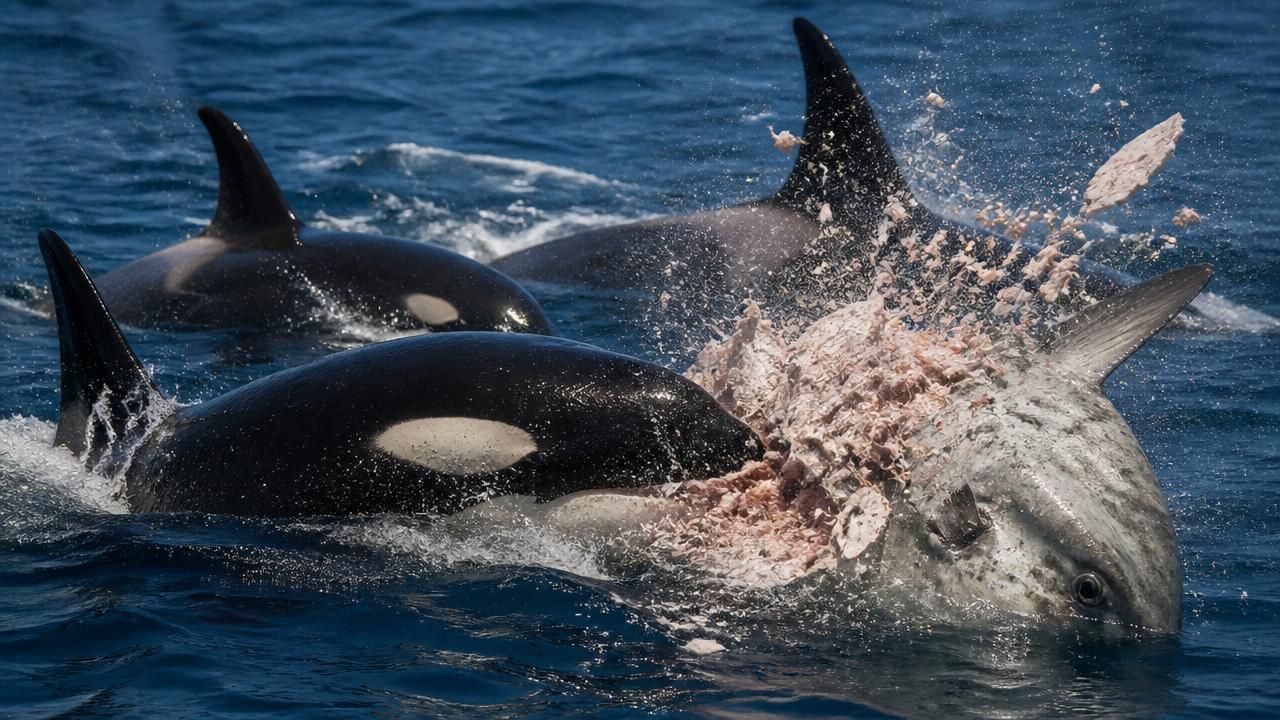
In the Gulf of California, a pod of orcas has been filmed engaging in a startling behavior: ramming ocean sunfish so violently that the fish's body explodes into thousands of fragments. The phenomenon, detailed in a new study published in Frontiers in Ethology, has left researchers both fascinated and puzzled. While orcas are known for their sophisticated hunting techniques, this particular behavior—captured on camera by a team from the nonprofit Beneath The Waves—suggests it may be more than just a feeding strategy.
The Explosive Encounter
The footage shows a group of orcas repeatedly headbutting a large sunfish, estimated to weigh up to 2,000 pounds (about 900 kg), with such force that the fish's body disintegrates. Kathryn Ayres, co-author of the study and a researcher at Beneath The Waves, described the scene as unlike anything she had witnessed before. “Oh my god!” she exclaimed as she watched an orca ram a sunfish so hard it exploded, according to a report in Live Science. The event was also covered by Ars Technica, IFLScience, and ABC News, among others.
The orcas were observed working together, with some individuals taking turns ramming the sunfish while others circled nearby. This cooperative behavior hints at a level of social coordination that orcas are famous for, but the explosive outcome is rare.
Why Explode a Sunfish?
Scientists have proposed several hypotheses for why orcas would engage in such violent behavior. One possibility is that it makes feeding easier. Sunfish, despite their size, have tough, leathery skin and relatively little nutritional value compared to other prey. By blasting the fish apart, orcas may be able to access softer tissues more efficiently. However, the researchers note that the orcas did not always consume the fragments, suggesting other motivations.
“We think this may help younger orcas feed more easily, or it could also just be for fun,” Kathryn Ayres told Ars Technica. “Orcas are known for playing with their food.” This idea of play is supported by observations of orcas engaging in similar behaviors with other prey, such as ramming whale sharks or deliberately creating waves to knock penguins off ice floes.
“We think this may help younger orcas feed more easily, or it could also just be for fun. Orcas are known for playing with their food.” — Kathryn Ayres, co-author and researcher at Beneath The Waves
The study's authors emphasize that the behavior could serve multiple purposes, including social learning. Younger orcas may learn hunting techniques by observing and participating in these explosive strikes. “Orcas engage in cooperative hunting strategies that can involve striking or killing animals—sometimes eating their prey, sometimes not—so the behavior could be described as social interaction, play, or practice as a mode of social learning,” the paper states, as reported by Frontiers in Ethology.
Historical Context and Comparisons
This is not the first time orcas have been seen using force to dismember prey. In recent years, orcas off the coast of South Africa have been observed ramming boats, a behavior that scientists believe may be a form of culturally learned play. Similarly, orcas in the Gulf of California have been documented ramming whale sharks, with one orca holding the shark steady while another strikes. The sunfish ramming, however, is unique in its explosive outcome.
Other cooperative hunting strategies observed in orcas include herding mobile rays, blocking escape paths while hunting white sharks, and producing waves to bump prey off ice. The sunfish behavior may be an extension of these tactics, tailored to a particularly large and resilient prey.
Differing Perspectives
While most sources agree on the basic facts, there are subtle differences in framing. IFLScience emphasized the shock value with a headline noting the fish exploded “into thousands of pieces,” while Discover Wildlife focused on the spectacle. ABC News highlighted the researcher's shock, quoting Ayres’ exclamation. Yahoo News (UK and Australia) reported the behavior as “freaking weird” and “gruesome,” reflecting a more sensational tone. In contrast, the scientific paper in Frontiers in Ethology takes a measured approach, discussing the behavior in the context of social learning and play.
Some outlets, like MSN and Live Science, included the detail that the sunfish can weigh up to 2,000 pounds, putting the orcas’ strength into perspective. The Ars Technica article provided the most scientific depth, linking the behavior to broader orca culture.
Implications and Future Research
The findings raise questions about the cultural transmission of behaviors among orca pods. If this ramming technique is learned, it may be passed down through generations, similar to other regional hunting traditions. The researchers plan to continue monitoring the Gulf of California orcas to see if the behavior spreads or becomes more common.
Understanding these behaviors is crucial for conservation. As human activities increasingly impact marine environments, knowing how orcas adapt their hunting strategies can inform protection measures. For now, the image of an orca headbutting a sunfish until it explodes remains a vivid reminder of the complexity and sometimes violent playfulness of these apex predators.
Conclusion
Whether for food, fun, or learning, the orcas of the Gulf of California have added a new chapter to our understanding of their intelligence and social behavior. As researcher Kathryn Ayres put it, “It was unlike anything I'd witnessed before.” The study not only documents a rare event but also opens the door to further exploration of how orcas interact with their environment and each other.