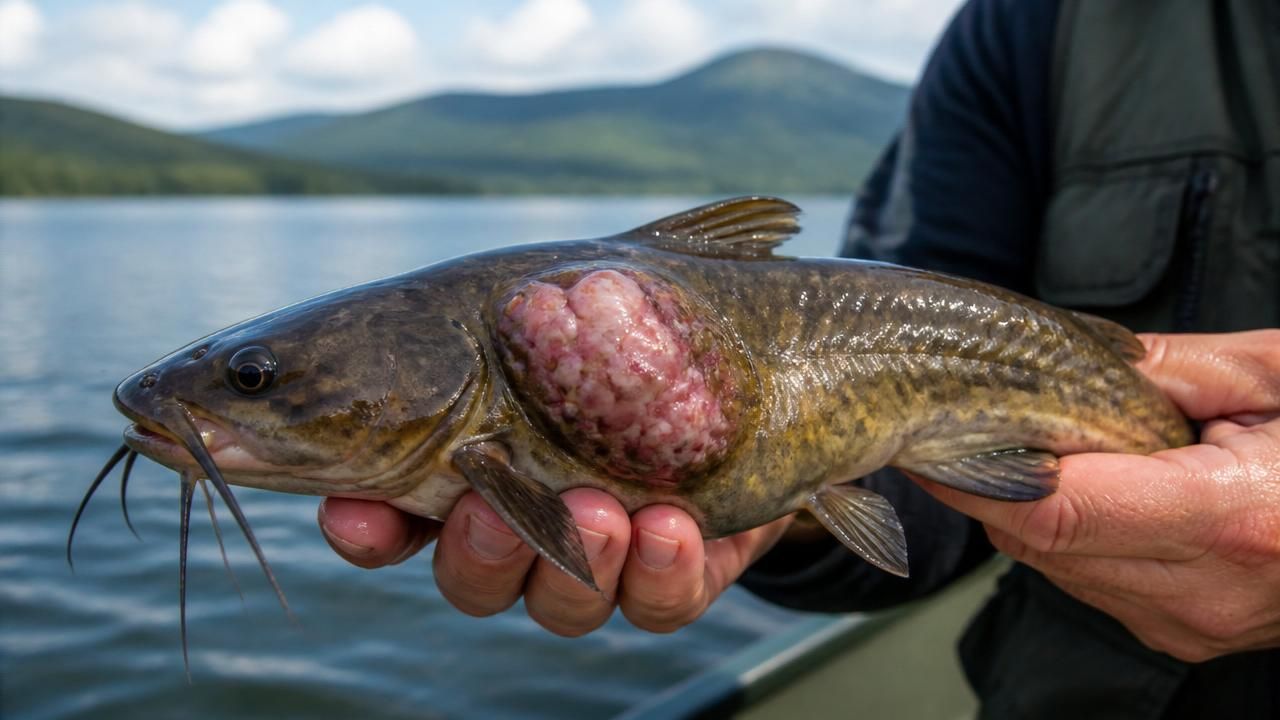
For more than a decade, something strange has been happening in the waters of Lake Memphremagog, a lake that straddles the border between Vermont and Quebec. Fishermen and researchers have noticed an unusual number of bullhead catfish with large tumors. Now, a team of scientists has confirmed the cause: a contagious cancer that spreads from fish to fish—the first known transmissible cancer in freshwater fish.
The discovery, published in the journal Nature, describes a leukemia-like cancer that has infected at least 15 bullhead catfish in the lake. Unlike typical cancers, which arise from a single animal's own cells, this one is caused by a rogue cell line that has become a parasite-like entity, capable of jumping between individuals.
A Parasite-Like Cancer
Transmissible cancers are extremely rare in the animal kingdom. Until now, only a handful have been documented: in dogs (canine transmissible venereal tumor), in Tasmanian devils (devil facial tumor disease), and in some marine bivalves. This is the first time such a cancer has been found in a freshwater fish species.
“This is a really unusual phenomenon,” said Dr. Joshua Brown, a researcher at the University of Vermont and lead author of the study. “The cancer cells themselves are the infectious agent. They don't need a virus or a bacterium; they just move from one fish to another.”
The cancer, which affects the fish's blood cells, appears to be transmitted through direct contact or possibly through water. The cells act more like parasites than traditional tumors, invading the host's body and multiplying without being rejected by the immune system.
How It Was Discovered
The story began in 2015, when a fisherman caught a bullhead catfish with a large, grotesque tumor near the mouth. He reported it to local wildlife authorities, who sent samples to the University of Vermont. Genetic analysis revealed that the tumors from different fish were genetically identical, suggesting they all came from the same original cancer cell.
“We were shocked,” said Dr. Brown. “These fish were not related—they came from different parts of the lake—yet their tumors had the same DNA. That's the hallmark of a transmissible cancer.”
Further testing confirmed that the cancer cells had evolved to evade the fish's immune system, a key trait that allows them to spread. The researchers believe the cancer may have originated from a single fish that developed a mutation, and then the mutated cells somehow escaped and infected other fish.
Implications for Cancer Research
While the discovery is fascinating in its own right, scientists say it could also provide insights into how cancers metastasize in humans. Metastasis is the process by which cancer cells spread from the original tumor to other parts of the body—a process that is poorly understood.
“Transmissible cancers are like a window into metastasis,” said Dr. Sarah Johnson, a cancer biologist at Harvard University who was not involved in the study. “They show us how cancer cells can survive outside the original host and adapt to new environments. Understanding that could lead to new treatments.”
The bullhead catfish cancer is particularly interesting because it lives in an aquatic environment, where cells might be more easily transmitted through water. This could make it a useful model for studying how cancer cells spread in liquid environments, such as blood or lymph.
Different Perspectives
Media coverage of the story has varied in focus. NPR highlighted the “fishy” nature of the discovery and its potential to reveal clues about metastasis. The New York Times emphasized the rarity of the phenomenon, while MSN articles described the cancer as “parasite-like.” Genetic Engineering & Biotechnology News (genengnews.com) focused on the scientific breakthrough, and local outlets like Cape and Islands.org provided regional context.
The study has also raised concerns about the health of the lake's ecosystem. While the cancer does not appear to pose a threat to humans—catfish are not commonly eaten raw, and cooking would destroy any cells—it could affect fish populations. “We don't know how widespread it is,” said Dr. Brown. “We've only sampled a small number of fish. It could be a localized outbreak or something more extensive.”
What's Next?
The researchers plan to continue monitoring the lake and studying the cancer's genetics. They are also exploring whether other fish species in the lake might be susceptible. “This is just the beginning,” said Dr. Brown. “We have a lot to learn about how this cancer spreads and evolves.”
For now, the bullhead catfish of Lake Memphremagog serve as a reminder that cancer is not just a human disease—it is a force of nature that can take on strange and unexpected forms.