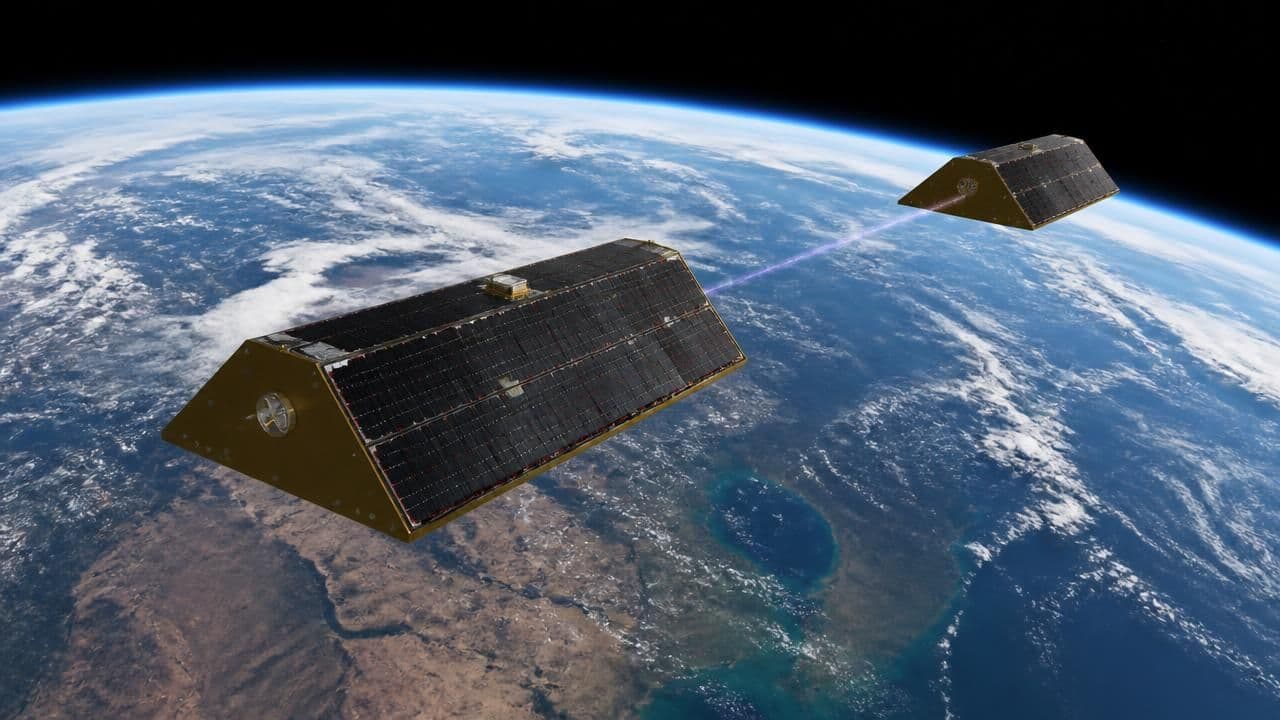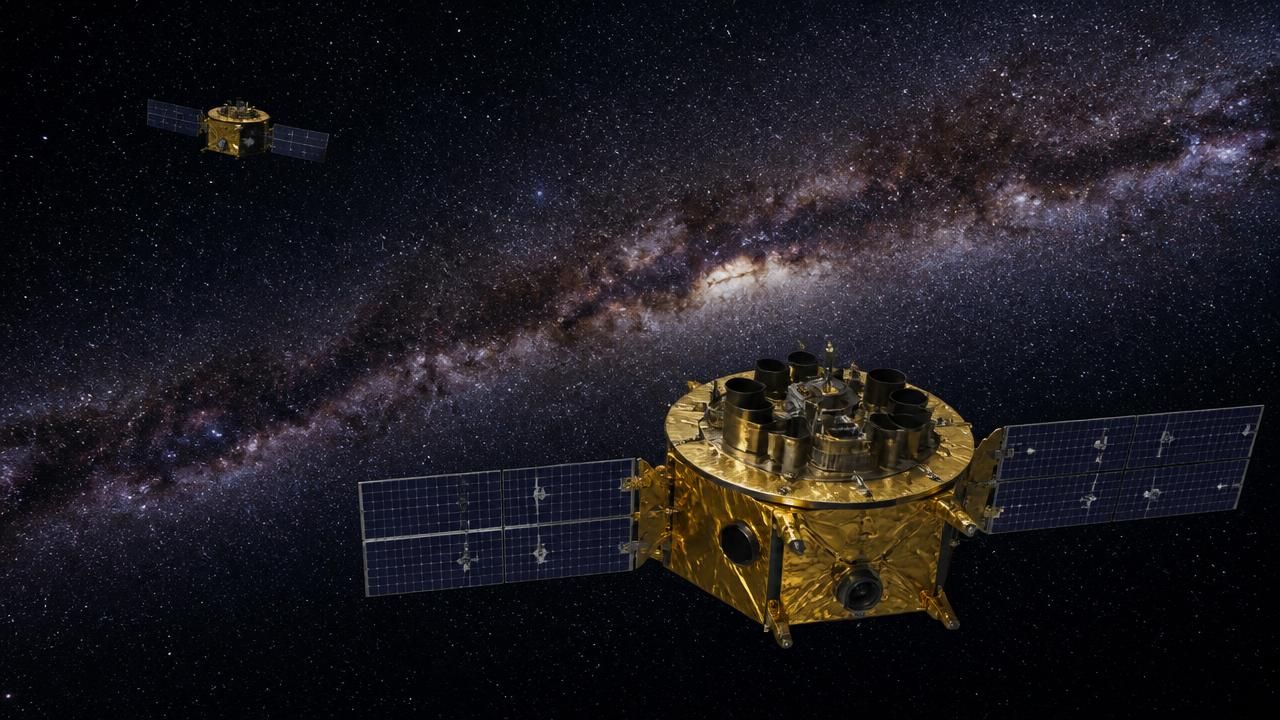
NASA has selected a groundbreaking mission concept for its 2026 NIAC (NASA Innovative Advanced Concepts) program that promises to open a new window on the universe: detecting gravitational waves at ultra-low frequencies using a precision astrometry technique based on quantum two-photon interference. Led by Paul Stankus of Brookhaven Science Associates, the proposal envisions two modest-sized spacecraft in free-fall orbits working independently—without any optical link between them—to measure the minuscule apparent motion of stars caused by passing gravitational waves.
What’s New?
While current gravitational wave observatories like LIGO and Virgo detect high-frequency waves from black hole mergers and neutron star collisions, and pulsar timing arrays probe the nanohertz regime, the micro-Hz to nano-Hz band remains largely unexplored. This frequency range is crucial for studying supermassive black hole binaries and the early formation of galaxies. The NIAC concept offers a novel approach: instead of measuring the stretching of spacetime directly via laser interferometry, it uses astrometry—the precise measurement of star positions—to detect the coordinated ‘shimmering’ of all sky objects caused by a passing gravitational wave.
“Gravitational waves passing by the Earth will cause a very small coordinated apparent motion of all sky objects,” explains Stankus. “Our innovation is to deploy a new approach to precision astrometry using quantum mechanical two-photon interference, which has the great benefit that two separate interferometric spacecraft stations can operate independently, without an optical connection between them.”
This independence drastically simplifies spacecraft requirements compared to standard space-based designs like LISA, which requires laser links spanning millions of kilometers.
How It Works
The technique leverages a recently published method for quantum two-photon interference to achieve extraordinary astrometric precision. Each spacecraft measures the positions of distant stars by correlating pairs of photons, effectively canceling out common-mode noise. By comparing the measurements from two spacecraft separated by a large baseline, the team can extract the gravitational wave signal. The concept is detailed in a 2026 NIAC selection announcement, which highlights the potential for “detection of such GW’s [to] be of great interest for galaxy formation and SM black hole physics, as well as exciting the public imagination.”
Broader Context and Perspectives
The proposal arrives at a pivotal moment in gravitational-wave astronomy. A 2023 review in Nature Reviews Physics titled “Gravitational-wave physics and astronomy in the 2020s and 2030s” outlines the field’s trajectory, emphasizing the need for new detectors to cover the entire spectrum. While LIGO and Virgo have revolutionized high-frequency observations, and pulsar timing arrays like NANOGrav have recently detected a stochastic background at nanohertz frequencies, the intermediate band remains a gap. “Current ground-based detectors are limited to frequencies above about 10 Hz, while space-based missions like LISA will cover 0.1 mHz to 0.1 Hz,” the review notes. “The micro-Hz to nano-Hz band is essentially unexplored, yet it is where signals from supermassive black hole binaries and cosmic strings are expected.”
Other sources, such as AZOQuantum, frame the mission as part of a broader effort to “uncover the secrets of the gravitational wave background,” emphasizing the synergy with existing and planned observatories. Mirage News reports that the NIAC selection includes multiple innovative concepts, but Stankus’s proposal stands out for its use of quantum technology to solve a fundamental engineering challenge.
Implications and Future Steps
If successful, the mission could detect gravitational waves from supermassive black hole mergers at the centers of galaxies, providing insights into galaxy formation and the evolution of structure in the universe. It could also probe exotic phenomena like cosmic strings or phase transitions in the early universe. The NIAC program provides seed funding for initial feasibility studies; if those prove promising, the concept could advance to a full NASA mission within a decade.
Critics note that the technology is still nascent: quantum two-photon interference at the required precision has only been demonstrated in laboratory settings, not in space. However, Stankus’s team argues that the modest spacecraft requirements—two small satellites in free-fall orbits—make the mission relatively low-risk compared to multi-spacecraft laser interferometers. “The approach has the great benefit that two separate interferometric spacecraft stations can operate independently, ie without an optical connection between them, greatly simplifying spacecraft requirements,” Stankus emphasizes.
Conclusion
NASA’s 2026 NIAC selection of the precision astrometry gravitational wave detection concept marks a bold step toward filling a critical gap in our observational toolkit. By marrying quantum optics with astrometry, the mission could unlock the low-frequency gravitational wave universe, revealing the hidden lives of supermassive black holes and the cosmic web’s formation. As the field of gravitational-wave astronomy enters its third decade, this innovative approach—alongside LISA, pulsar timing arrays, and next-generation ground detectors—promises a richer, more complete picture of the cosmos.