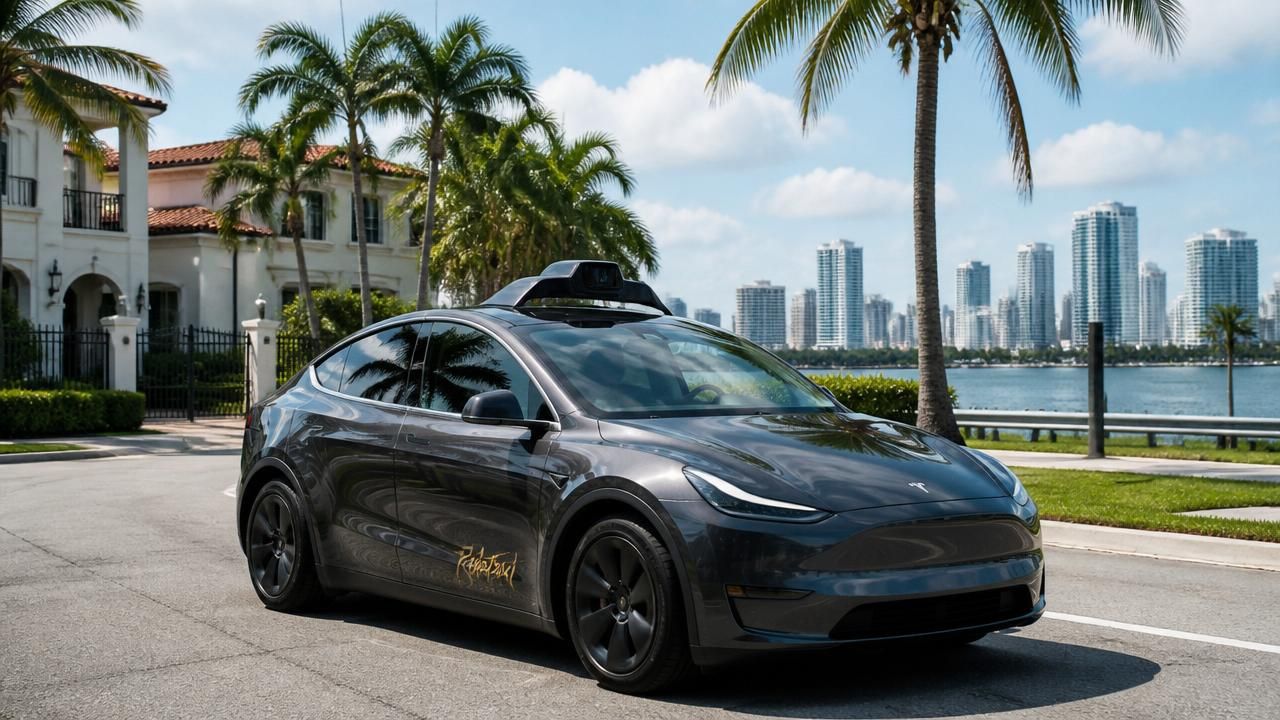
Tesla has taken a significant step forward in its autonomous vehicle ambitions, launching its robotaxi service in three Florida cities—Miami, Orlando, and Tampa—just ahead of its second-quarter earnings call. The expansion, announced via a post on X, marks the first time Tesla has deployed unsupervised robotaxis in the Sunshine State, joining existing operations in Austin, Dallas, and Houston. However, the rollout comes amid a backdrop of safety concerns, a costly Autopilot verdict, and intensifying competition from Waymo.
A Strategic Expansion on Earnings Eve
The timing of the announcement, made hours before Tesla's Q2 earnings report, was widely interpreted as a move to reassure investors about the company's progress in autonomous driving. According to The Verge, the company shared maps of service areas in Orlando and Tampa but provided no details on fleet size or immediate availability. Earlier reports from thenextweb.com confirmed that Miami operations have already begun, with no safety driver behind the wheel—a first for Tesla in that market. This aligns with CEO Elon Musk's stated goal of eliminating remote safety monitors by the end of the year, as reported by The Verge.
Despite the fanfare, the scale remains modest. Carscoops.com notes that in 2020, Musk promised 1 million robotaxis by 2020; today, Tesla operates roughly 20. Meanwhile, autoevolution.com reports that Tesla may be winding down unsupervised operations in Texas cities like Austin, Dallas, and Houston, suggesting a strategic pivot rather than a simple expansion.
Competition with Waymo Heats Up
Tesla's Florida launch overlaps with Waymo's own expansion in the region. Orlandosentinel.com reports that Waymo has begun welcoming riders in Orlando, while refreshmiami.com highlights Waymo's highway-capable service in Miami. Gulfcoastnewsnow.com notes that Waymo's presence hints at what's next for Southwest Florida, including Fort Myers and Naples. A Facebook video from Miami-Dade County shows a Waymo robotaxi blocking a condo entrance, illustrating the operational challenges both companies face.
The two companies employ radically different approaches, as outlined by Reuters. Waymo relies on high-definition maps, lidar, and extensive remote monitoring, while Tesla uses a vision-only system with neural networks and aims for full autonomy without geofencing. Reuters notes that this divergence will shape the industry's future, with Waymo currently leading in safety metrics. Statesman.com reports that Texas data shows Tesla's robotaxis crash four times more often than human drivers, a figure Musk has dismissed as part of the “acid test” of sleeping through your commute.
Financial and Legal Headwinds
Tesla's robotaxi ambitions face significant financial and legal challenges. Reuters reports that a recent Autopilot verdict—a $243 million judgment against Tesla—deals a “black eye” to the company and threatens Musk's robotaxi timeline. Insideevs.com calls the ruling a potential “open the floodgates” moment for lawsuits, while aimagazine.com asks whether it's a “black eye” or “end of the road.” The verdict stems from a fatal crash involving Autopilot, and legal experts say it could embolden more plaintiffs.
Financially, Tesla is under pressure. Reuters notes that the company faces declining sales and hopes robotaxis will offset that trend. Morningstar.com sees long-term profit growth from AI, robotaxis, and humanoid robots, but investors.com reports that Musk warned of slowing growth during the earnings call. Bizjournals.com notes a slump in net income but touts “good returns” on Austin self-driving operations. The company is also offering 30-day FSD v14 trials to HW4 vehicles in North America, as reported by teslaoracle.com, to boost adoption.
Operational Realities and Public Perception
Public reaction to robotaxis remains mixed. NBC News reports incidents in Austin that sparked confusion and concerns, including vehicles blocking traffic and making erratic maneuvers. Latimes.com observes that Musk's self-driving hype hits real-world traffic, stalling progress. Autoweek.com speculates on which cities might be next, while notebookcheck.net highlights low costs per mile as a selling point.
Former Tesla AI data trainers have delivered a crucial message on robotaxis, according to AOL.com, though details remain behind paywalls. CleanTechnica asks, “The Tesla Cybercab Is Here. Now What?” referring to the dedicated robotaxi vehicle unveiled last year. Not a Tesla App reports updated Cybercab designs and production dates, with additional cities planned.
Looking Ahead
Tesla's robotaxi push is a high-stakes gamble. With operations now in five U.S. cities, the company is testing a blueprint for rapid scaling, as The Information notes. However, the path is fraught with technical, regulatory, and legal obstacles. Reuters sums it up: Tesla faces a difficult road ahead as it hopes robotaxis will offset declining sales. Meanwhile, Waymo continues to expand, and legacy automakers are watching closely.
For now, Florida residents can hail a Tesla robotaxi in Miami, Orlando, or Tampa—but whether the service will expand to other states, as KTAR.com suggests for Arizona by end of 2025, remains uncertain. Musk's vision of a million-robotaxi fleet may still be a distant dream, but the company is inching closer, one city at a time.