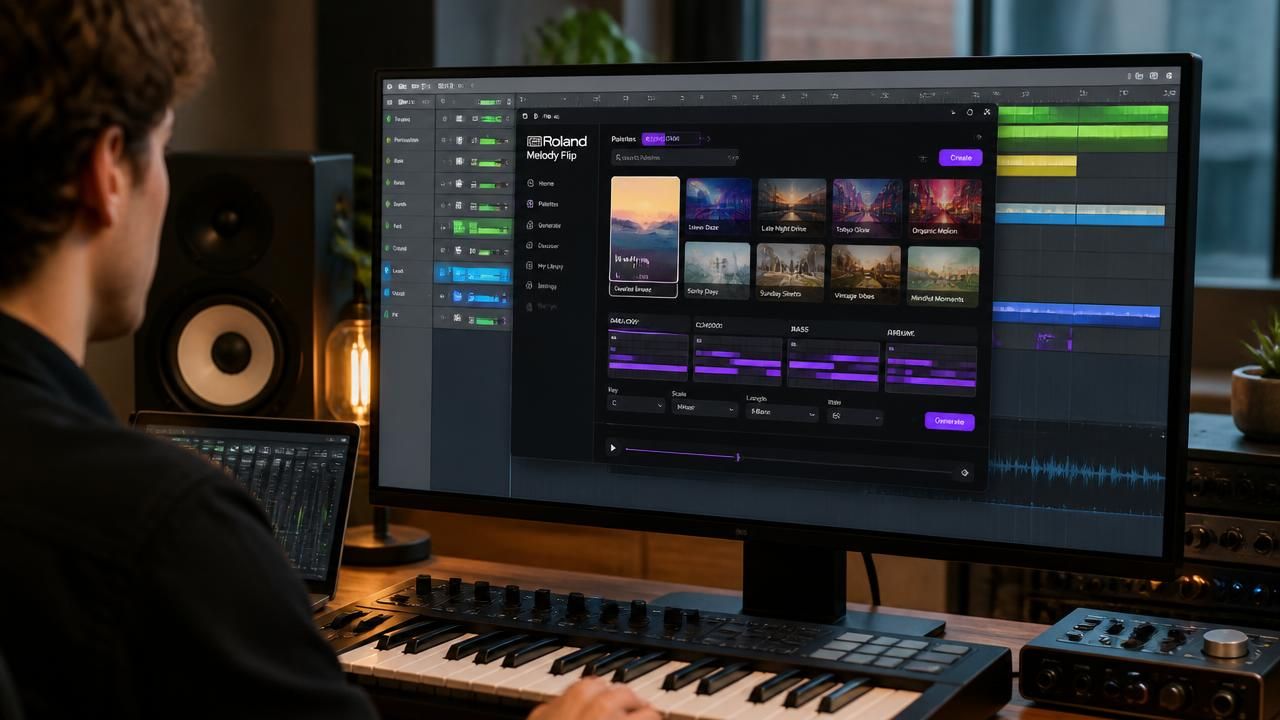
Roland, the iconic electronic musical instrument manufacturer behind decades of synthesizers and drum machines, is making a deliberate entry into the generative AI music space. The company has unveiled Melody Flip, a new plug-in for digital audio workstations (DAWs) that serves as an AI-powered creative co-writer, generating melodic and harmonic ideas based on user input or existing reference tracks.
A New Palette for Musical Ideas
Melody Flip centers on a library of approximately 250 “Palettes” — themed collections of musical ideas organized by genre and style. Musicians can start from a completely blank session and ask the tool to generate any combination of melody, chord progression, bassline, or drums. Alternatively, they can feed it a reference audio track, and Melody Flip will extrapolate melodic ideas built on that source material.
This workflow is a significant departure from other AI music generators. As The Verge notes, Melody Flip does not aim to produce fully polished, Suno- or Udio-style songs with vocals and complete arrangements. Instead, it offers musical building blocks that a producer can arrange, modify, and integrate into their own work — a distinction that places the tool squarely in the “creative assistant” category rather than the “song machine” category.
Human Intent at the Core
Roland has been emphatic about its philosophy regarding AI. In promotional and press materials, the company strikes a distinctly human-centric tone. MusicRadar quoted Roland's stance directly:
“These tools should not replace the artist, but support a workflow where human intent, taste and creativity remain at the core.”
That framing is reinforced by the product’s design. By generating individual musical components — a verse progression, a bass groove, a percussive pattern — Melody Flip is meant to fill the intimidating blank page rather than hand over a finished work. Mixdown Magazine’s headline described the tool as “a co-writer for the blank page,” underscoring its role as an ideation engine that leaves the final artistic judgment in the hands of the user.
How Melody Flip Sits in a Broader AI Music Wave
The launch of Melody Flip comes at a time when generative AI is quickly reshaping music production. Services like Suno and Udio have demonstrated that AI can produce listenable, even radio-ready tracks from a single text prompt. But that level of automation has also triggered fears among working musicians about the devaluation of human creativity. Roland’s approach appears intentionally calibrated to navigate that tension.
- Suno and Udio: AI systems that generate complete audio tracks, often including vocals, from text prompts. They are impressive for consumer-facing song generation but less suited for granular studio work.
- Melody Flip: A DAW-integrated tool that offers discrete, tweakable MIDI-style melodic and harmonic fragments. It leaves arrangement, orchestration, mixing, and production decisions to the artist.
That distinction matters for professionals who use a DAW as their primary instrument. Rather than extracting a static audio file generated externally, Melody Flip operates inside the producer’s existing environment and offers data that can be edited immediately — each note, chord, and bassline remains fluid and controllable.
Framing from Different Outlets
The press reaction to Roland’s announcement is a useful study in how one product can be viewed through different editorial lenses:
- The Verge contextualized Melody Flip as Roland’s formal introduction to generative AI, highlighting what it does not do (full-song generation) as much as what it does.
- MusicRadar focused almost exclusively on the human-centered design ethos, using Roland’s own words to frame the tool as a supporter of workflow rather than a replacement for artistry.
- Unite.ai positioned the product as an AI melody-generation plug-in for DAWs, emphasizing the technical deliverable.
- Mixdown Magazine adopted a songwriter-centric language, calling it a co-writer that helps overcome creative block.
Implications for Music-Making
For Roland, Melody Flip represents more than a software curiosity. The company, whose hardware instruments helped define electronic music, is clearly looking to maintain relevance in an era where software and AI play an ever-increasing role in music production. By introducing a tool that engages with the existing producer workflow rather than bypassing it, Roland is arguing that AI should be incorporated into the craft rather than treated as a shortcut.
Of course, the deeper question is whether AI-assisted ideation actually results in better music or simply reshapes how ideas are generated. Proponents argue that tools like Melody Flip remove the barrier of technical friction, allowing a songwriter to audition dozens of possibilities in minutes. Critics worry that creative decisions may become outsourced to algorithmic pattern-matching, narrowing the range of musical expression.
Roland’s response to that concern is embedded in the very structure of the product: the synthetic output isn’t a finished piece of art. A sound engineer in a studio may use Melody Flip to spark a riff, then take it in an entirely different direction. The final result still depends on the artist’s taste, judgment, and skill. As the company puts it, the tool is intended to support a workflow where “human intent, taste and creativity remain at the core.”
What Comes Next
As generative AI continues to penetrate music hardware and software, products like Melody Flip will serve as real-world test cases for how deeply machine intelligence should be embedded in creative work. The question is no longer whether AI will be part of music-making; it is whether the industry can design tools that amplify human imagination rather than dilute it.
Roland’s first answer is Melody Flip: a middle ground that offers the magic of raw musical material from the AI, while keeping the final say firmly in the hands of the artist.