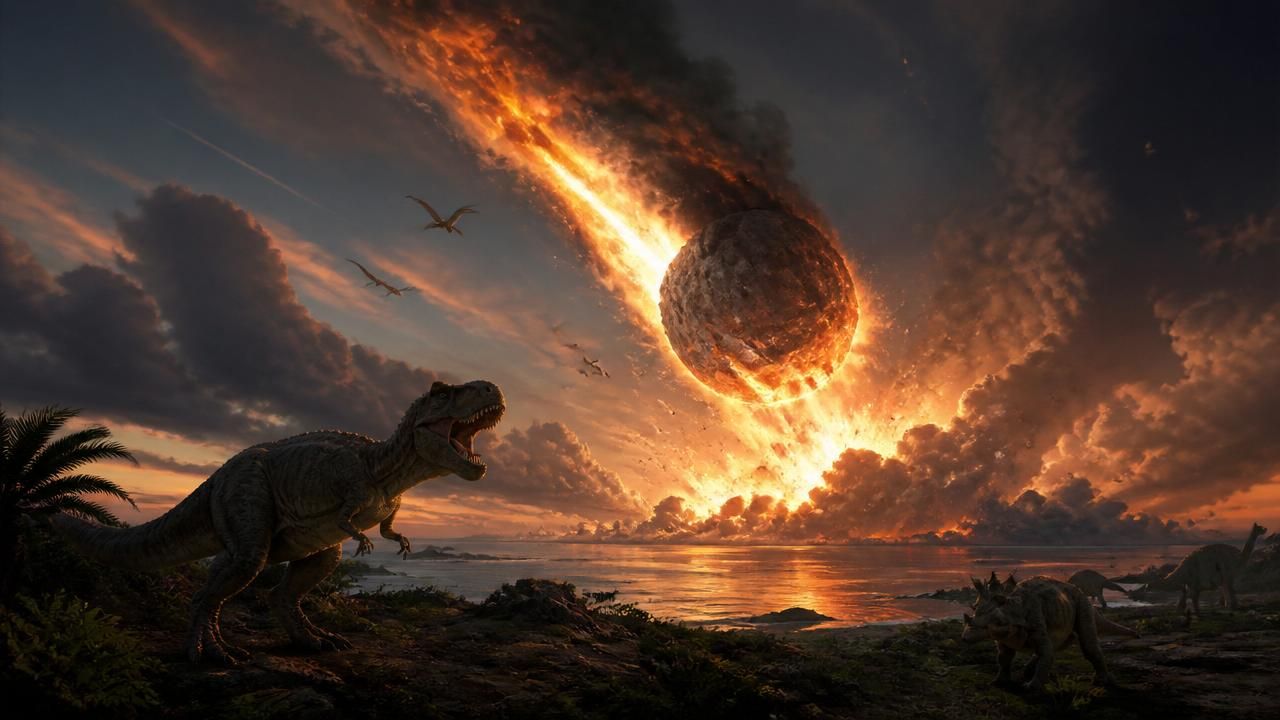
In a breakthrough that rewrites the final chapter of the dinosaurs, an international team of researchers has identified the specific type of meteorite that struck Earth 66 million years ago, triggering the fifth mass extinction. The object, which carved out the 180-kilometer-wide Chicxulub crater in present-day Mexico, was a rare carbonaceous chondrite known as a CO chondrite—a primitive, carbon-rich asteroid from the outer reaches of the solar system.
The findings, published in a series of papers from institutions including the Vrije Universiteit Brussel (VUB), the University of Cologne, and the Natural History Museum in London, provide the most detailed chemical fingerprint of the impactor yet. By analyzing sediment samples from the Cretaceous-Paleogene (K-Pg) boundary layer—a global layer of iridium-rich clay—scientists were able to isolate the unique isotopic signature of the asteroid.
An 'Oddball' Meteorite from the Edge of the Solar System
Unlike most meteorites that fall to Earth, which are ordinary chondrites from the inner asteroid belt, the Chicxulub impactor belonged to a rare class called carbonaceous (C-type) chondrites, specifically the CO subtype. CO chondrites are among the most primitive materials in the solar system, containing abundant carbon, water, and organic compounds. They originate from the outer main belt, beyond the orbits of Mars and Jupiter, where volatile-rich planetesimals formed.
“This is a cosmic oddball,” said Dr. Steven Goderis, a geochemist at VUB and lead author of the study. “CO chondrites are extremely rare in our meteorite collections—less than 1% of all known meteorites. Finding that the dinosaur-killer was one of them changes our understanding of where such large impacts come from.”
The team used a novel technique to measure isotopes of ruthenium, a platinum-group element that is extremely rare in Earth’s crust but abundant in meteorites. Ruthenium isotopes act like a fingerprint, allowing scientists to differentiate between different types of asteroidal material. The signature from K-Pg boundary samples matched that of CO chondrites almost perfectly, ruling out comets or other asteroid types.
The Deadliest Blow: Dust Over Sulfur
For decades, the prevailing theory held that the mass extinction was caused by sulfur-rich gases released from the impact site, which would have triggered acid rain and a prolonged “impact winter.” However, the new chemical analysis suggests a different kill mechanism. The CO chondrite is rich in carbon and volatile elements, and when it vaporized on impact, it would have released vast amounts of fine dust and soot into the stratosphere.
Computer simulations by co-author Dr. Natalia Artemieva of the Planetary Science Institute show that the dust from a carbonaceous asteroid would have been more efficient at blocking sunlight than sulfur aerosols. “The dust would have lingered in the atmosphere for years, causing a global drop in temperature and shutting down photosynthesis,” she said. “This explains why the extinction was so severe, wiping out 75% of all species.”
The discovery also aligns with evidence from the Tanis fossil site in North Dakota, where scientists have found fossils of fish and a dinosaur leg that appear to have been buried by the impact’s aftermath. At Tanis, the sediment layers contain tiny glass beads (tektites) with a chemical composition consistent with a CO chondrite impactor.
Context: A Long-Sought Answer
The Chicxulub impact has been a focus of scientific inquiry since the crater was discovered in the 1970s. Over the years, researchers have debated whether the impactor was an asteroid or a comet, and what its composition might have been. Earlier studies relied on bulk measurements of elements like iridium, which indicated a chondritic composition but could not distinguish between subtypes. The ruthenium isotope technique, pioneered by the VUB team, finally provides the resolution needed to identify the exact meteorite class.
“This is the first time we have a definitive match,” said Prof. Mario Fischer-Gödde of the University of Cologne, a co-author. “The ruthenium isotopic composition is unique to carbonaceous chondrites, and within that group, only CO chondrites fit the data.”
The findings also have implications for planetary defense. Understanding the composition of potentially hazardous asteroids helps scientists predict the effects of an impact and plan mitigation strategies. “If a future threat is a carbonaceous asteroid, we now know that dust loading could be a major factor,” said Dr. Goderis.
Broader Perspectives: What About the Dinosaurs?
While the new study settles the type of asteroid, other research continues to explore the state of dinosaur populations before the impact. A recent analysis of fossils from New Mexico suggests that dinosaurs were not in decline prior to the asteroid strike, contradicting earlier claims of a long-term downturn. Instead, they appear to have been thriving, making the sudden extinction even more catastrophic.
Meanwhile, scientists at the Natural History Museum in London have used the new chemical data to trace the asteroid’s origin to the outer solar system, possibly beyond Jupiter. “The CO chondrite parent body likely formed in the same region as the dwarf planet Ceres,” said Dr. Ashley King, a meteorite expert at the museum. “This tells us that large impacts can come from much farther out than we thought.”
The research also raises questions about the role of such impacts in Earth’s history. The K-Pg extinction was not the only mass extinction linked to a major impact; the Permian-Triassic extinction 252 million years ago may also have been triggered by a large asteroid. Identifying the type of impactor for each event could reveal patterns in solar system dynamics.
What Comes Next
The team plans to apply the ruthenium isotope technique to other impact events, including the Permian-Triassic boundary and smaller impacts like the one that created the Ries crater in Germany. They also hope to analyze samples from the asteroid Ryugu, returned by Japan’s Hayabusa2 mission, to compare with the Chicxulub impactor.
For now, the identification of the dinosaur-killing asteroid as a CO chondrite stands as a landmark achievement in planetary science. It closes a 40-year-old mystery and opens new avenues for understanding the cosmic forces that shape life on Earth.