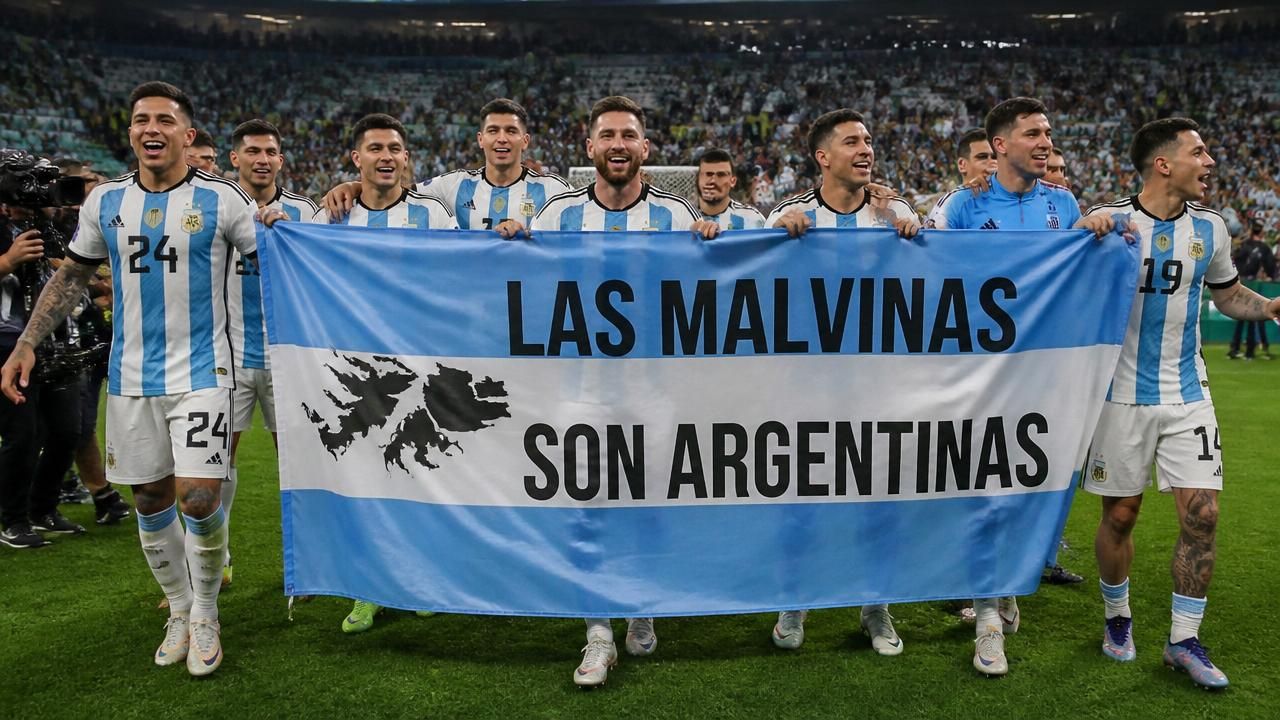
Argentina's national football team is facing potential disciplinary action from FIFA after players displayed a banner asserting the country's claim to the Falkland Islands following their World Cup semi-final victory over England. The incident, which occurred after Argentina's win at the 2026 World Cup, has reignited tensions over the long-standing territorial dispute between the two nations.
What Happened
After defeating England in the semi-final, Argentine players unfurled a banner reading "Las Malvinas son argentinas" (The Malvinas are Argentine) on the pitch. The banner was seen by millions worldwide and quickly drew condemnation from British officials and football authorities. FIFA, world football's governing body, is now investigating the incident and could impose a fine or other sanctions on the Argentine Football Association (AFA).
Differing Perspectives
British media outlets, including the BBC and The Guardian, have framed the banner as a political provocation that breaches FIFA's rules against political statements at matches. The Guardian reported that FIFA's disciplinary code prohibits "political, religious or commercial messages" and that Argentina could face a fine. Meanwhile, Argentine media have portrayed the display as a legitimate expression of national sovereignty. The banner references the Falklands, known in Argentina as the Malvinas, which have been under British control since 1833 but are claimed by Argentina.
Historical Context
The Falklands/Malvinas dispute has deep roots. Argentina claims the islands based on proximity and historical inheritance from Spain, while Britain bases its claim on continuous administration since 1833. The conflict escalated into a brief but bloody war in 1982, when Argentina invaded the islands and Britain sent a task force to retake them. The war lasted 74 days and resulted in the deaths of 649 Argentine and 255 British servicemen, as well as three Falkland Islanders. The 40th anniversary of the conflict was marked in 2022, with commemorations on both sides.
Reactions and Implications
British politicians condemned the banner. A UK government spokesperson said: "It is completely inappropriate for political messages to be displayed at sporting events. The Falkland Islands are British, and their sovereignty is not up for debate." Argentine officials defended the gesture, with President Alberto Fernández tweeting: "Las Malvinas son argentinas. Our players proudly carry our flag." The incident also sparked debate on social media, with some praising the players' patriotism and others criticizing the politicization of sport.
FIFA's disciplinary committee will review the case. Under FIFA's regulations, the AFA could face a fine of up to several hundred thousand Swiss francs. A source close to FIFA told the BBC that the organization aims to keep politics out of football and will take the matter seriously. However, some experts argue that a fine alone may not deter future displays, as such gestures resonate strongly with domestic audiences.
Broader Context
The Falklands banner is not the first political statement at a World Cup. In recent tournaments, players and teams have displayed messages on armbands, t-shirts, or banners supporting various causes, from LGBTQ+ rights to anti-racism. FIFA has often struggled to enforce its neutrality rules consistently, leading to accusations of double standards. This case is particularly sensitive given the history between Argentina and England, who also faced each other in the 1986 World Cup quarter-final, where Diego Maradona scored the infamous "Hand of God" goal.
The 2026 World Cup semi-final itself was a high-stakes match, with Argentina emerging victorious in a closely contested game. The banner incident has overshadowed the sporting achievement, drawing attention away from the players' performance. For England, the loss was disappointing, but the team's manager Gareth Southgate declined to comment on the banner, focusing instead on his players' efforts.
What's Next
FIFA is expected to announce its decision within weeks. The AFA may argue that the banner was a spontaneous gesture by players rather than an official team policy, which could mitigate sanctions. However, given FIFA's zero-tolerance stance on political messages, a fine seems likely. Some observers suggest that a symbolic punishment, such as a warning or a small fine, may be imposed to avoid inflaming tensions further.
Meanwhile, the Falklands dispute remains a potent political issue in Argentina, where successive governments have maintained the claim. The banner incident has revived memories of the 1982 war and the ongoing diplomatic impasse. For the Falkland Islanders, who overwhelmingly voted to remain British in a 2013 referendum, the display was a reminder of the persistent challenge to their sovereignty.
As the World Cup moves toward the final, Argentina's players will hope to focus on football, but the banner controversy is likely to follow them. Whether FIFA's action will deter future political gestures remains to be seen, but one thing is clear: sport and politics are often inseparable, especially when national identity is at stake.