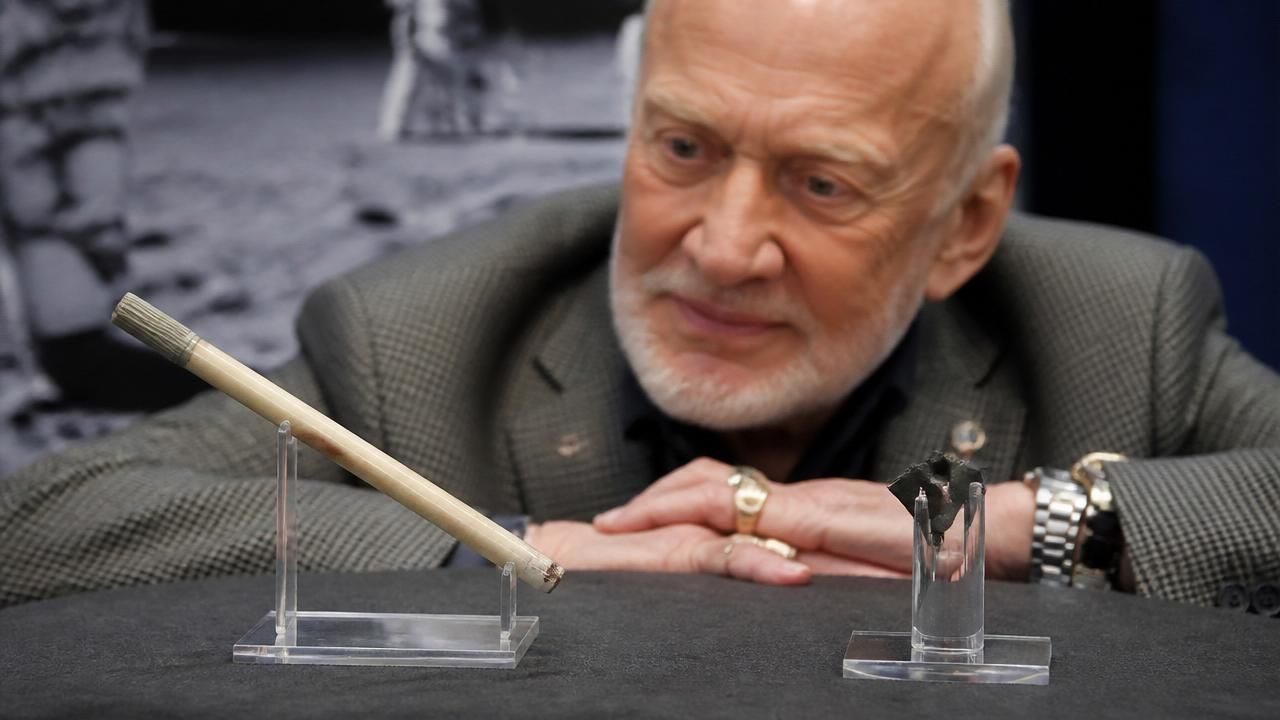
On Wednesday, a dried-out felt-tip marker and a snapped-off piece of molded black plastic sold for $857,600 at a Sotheby's auction. What might otherwise have been worthless bits of trash commanded the highest bids due to where the two items were 57 years ago—lifting off aboard NASA's Apollo 11 spacecraft on humanity's first mission to land astronauts on the Moon. More than flown odds and ends, one was the problem that almost stranded Neil Armstrong and Buzz Aldrin on the lunar surface, and the other was the simple solution to saving the mission.
The auction, conducted by Sotheby's, drew global attention as collectors and space enthusiasts vied for a piece of history that epitomizes human ingenuity under pressure. The items, sold by Buzz Aldrin, were part of a larger collection of Apollo 11 memorabilia. According to Ars Technica, the felt-tip pen and the broken circuit breaker switch fragment were the star lots, fetching a combined sum that far exceeded pre-auction estimates.
The Crisis on the Moon
The story begins on July 20, 1969, after Neil Armstrong and Buzz Aldrin had completed their historic moonwalk. As they prepared to leave the lunar surface, they discovered a critical problem: the circuit breaker switch that would activate the ascent engine—essential for liftoff and return to Earth—had been accidentally broken off. The switch, located on the control panel, was designed to be pulled out to arm the engine circuit. But in the cramped confines of the Eagle lunar module, either Armstrong or Aldrin had inadvertently snapped off the top of the switch, leaving only a small stub.
In a tense radio exchange with Mission Control, Aldrin reported: "Houston, Tranquility. Do you have a way of showing the configuration of the engine arm circuit breaker? The reason I'm asking is because the end of it appears to be broken off. I think we can push it back in again. I'm not sure we could pull it out if we pushed it in, though."
The situation was dire. Without the ability to arm the engine, the astronauts would be stranded on the Moon indefinitely. NASA engineers on the ground scrambled for a solution, but it was Aldrin who came up with a low-tech fix: using a felt-tip pen to depress the tiny switch. The pen, which he had stowed in a pocket of his spacesuit, was just the right size to push the switch in, activating the circuit and allowing the engine to fire.
The Simple Solution
As reported by multiple sources including MSN and Inkl, Aldrin's quick thinking with the felt-tip pen saved the mission. The pen itself was a standard Duro Felt Tip pen, later described as a "Duro Pen" in some accounts. It had a black plastic barrel and a felt tip that had long since dried out. The broken switch fragment, a piece of molded black plastic, was also preserved as a reminder of the near-disaster.
After the successful return to Earth, Aldrin kept both items as personal mementos. Over the decades, they became symbols of the Apollo program's triumphs and the resourcefulness of its astronauts. The pen, in particular, has been celebrated as an example of problem-solving under extreme pressure—a theme that resonates with both space enthusiasts and the general public.
Auction Details
The auction, which took place on Wednesday, saw the pen and switch fragment sold together as a single lot. Sotheby's had estimated the lot would fetch between $400,000 and $600,000, but final bids soared to $857,600. The buyer's identity was not immediately disclosed. In a statement, Aldrin said he was pleased that the items would find a new home where they could continue to inspire future generations.
Other sources, such as Newser and Asatunews.co.id, highlighted the historical significance of the sale. Newser noted that the pen "prevented lunar disaster," while Asatunews.co.id described it as a "historic Apollo 11 pen." The coverage varied slightly in tone: some outlets focused on the dramatic rescue narrative, while others emphasized the monetary value and collector interest.
Differing Perspectives
While the core story is consistent across sources, there are subtle differences in framing. Ars Technica provided the most detailed technical account, including the exact radio transcript and the engineering context. MSN articles, on the other hand, leaned into the human-interest angle, with headlines like "Pen that saved moon landing astronauts' lives up for auction" and "Buzz Aldrin gives up pen that prevented lunar disaster." Inkl's coverage highlighted the record-breaking price, calling it "one small pen for one giant fee." Newser echoed the theme of disaster averted. The Indonesian source, asatunews.co.id, offered a more succinct report, though its page required JavaScript and cookies to view fully.
These varied angles reflect the multifaceted nature of the story: it is at once a tale of technological problem-solving, a personal memoir from a legendary astronaut, and a high-stakes auction event.
Historical Context and Legacy
The Apollo 11 mission remains one of humanity's greatest achievements. The moonwalk, watched by millions on television, was a defining moment of the 20th century. But the mission was fraught with risks, and the circuit breaker incident is just one of many critical moments that could have ended in tragedy. The fact that a simple pen—an everyday object—could play such a pivotal role underscores the importance of adaptability and ingenuity in space exploration.
Experts have noted that the pen's sale is part of a broader trend of space memorabilia fetching high prices at auction. Items from the Apollo era, in particular, are highly sought after as tangible connections to a heroic age of exploration. The $857,600 price tag places the pen among the most expensive space artifacts ever sold, though it still trails items like the Apollo 11 lunar module's checklist or a Soviet space capsule.
For Aldrin, the sale represents a final parting with a cherished keepsake. Now 94, the second man on the Moon has been gradually auctioning off his personal collection, with proceeds often donated to charitable causes. The pen and switch fragment will likely end up in a museum or private collection, where they will continue to tell the story of how a simple tool saved a historic mission.
Implications for Future Exploration
The story of the felt-tip pen also carries lessons for modern spaceflight. As NASA and private companies like SpaceX plan missions to the Moon and Mars, the need for flexible problem-solving remains paramount. Astronauts today are trained to handle a wide range of emergencies, but the Apollo 11 incident shows that sometimes the simplest solutions are the most effective.
In interviews, Aldrin has reflected on the incident with characteristic humility. "It was just a pen," he said. "But it was the right tool at the right time." The auction of that pen ensures that this small but significant piece of history will not be forgotten.