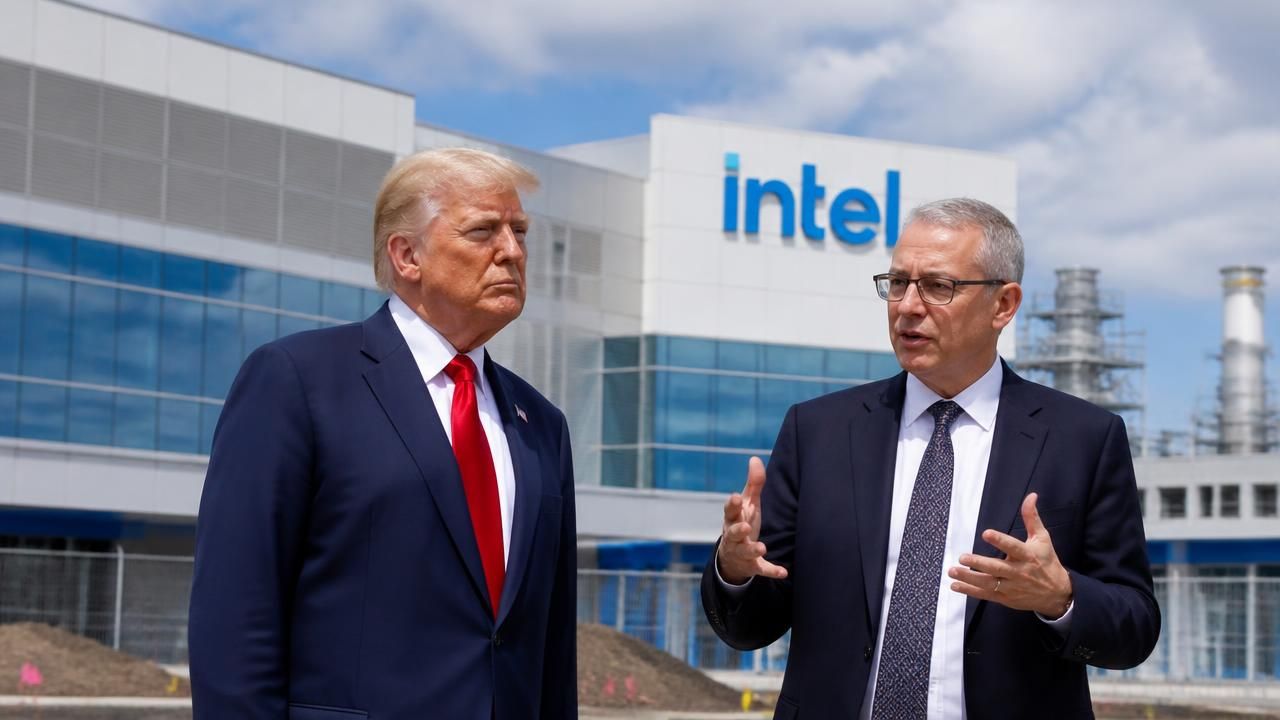
When the Trump administration wanted a piece of Intel, it did not send a term sheet. It sent a deadline. According to internal company notes described in a federal lawsuit, a Commerce Department lawyer told Intel's chief financial officer in August 2025 that the government expected to take a roughly 10 percent ownership stake in the semiconductor giant — and that the board should not mistake the arrangement for a bargain.
"Do not make the mistake of thinking that this is a negotiation," Commerce Department lawyer David Shapiro told Intel's CFO, according to a summary of his remarks prepared for Intel's directors and contained in the litigation. He added that "the President is expecting to announce a deal on these terms on Friday."
The account, first reported by Ars Technica and subsequently picked up by Wired and other outlets, offers a rare, verbatim window into how the administration converted a strategic interest in America's most important chipmaker into an equity position — and how quickly the company's board was expected to comply.
'A choice' with only one viable outcome
Shapiro, per the notes, did not pretend the board lacked formal options. He acknowledged that "the Board could choose not to accept the offer." But the same summary records that the administration official "noted that rejection will have consequences that [Shapiro] cannot predict."
"The Board could choose not to accept the offer... rejection will have consequences that [Shapiro] cannot predict."
That phrasing — an explicit refusal to rule out retaliation while declining to specify it — is the crux of the story. Ars Technica framed it as a binary: give the government 10 percent of the company, or face consequences the company could not foresee and could not negotiate. The headline over that reporting was blunt: Intel faced a choice, and the alternative was worse.
Other outlets compressed the sequence further. Attack of the Fanboy, aggregating the reporting, characterized the episode as a board that faced threats before agreeing to hand Washington a 10 percent stake — language that emphasizes the sequence (pressure first, consent second) rather than the legal mechanics Ars Technica dwelt on.
'Not just Nvidia': the wider takeover frame
Wired's treatment placed the Intel stake in a larger pattern, under the framing "Not Just Nvidia: Inside Team Trump's Takeover of Intel." That headline is doing analytical work: it signals that Intel is not an isolated transaction but one node in a broader administration posture toward the semiconductor sector — the same industry whose GPUs and fabrication capacity underpin the artificial intelligence boom, and whose largest names have become strategically indispensable to Washington.
The difference in emphasis across outlets is instructive. Ars Technica foregrounded the primary documents — the call notes, the lawsuit, the lawyer's exact words — treating the story as a governance and legal accountability question. Attack of the Fanboy foregrounded the coercive flavor, aiming at readers who want the plain version: the government leaned on a board and the board folded. Wired foregrounded pattern and precedent, aiming at readers asking what happens to the next company.
How Intel got here
Intel is not a random target. Once the undisputed leader in semiconductor manufacturing, the company has spent years losing process-technology ground to overseas rivals, watching its market capitalization erode, and depending on federal support to build out advanced fabrication capacity in the United States. That dependence is the leverage.
The CHIPS and Science Act of 2022 established the modern template: Washington writes checks to semiconductor firms in exchange for domestic plants and national-security assurances. An equity stake is a different instrument entirely. Subsidies are a transaction between a sovereign and a supplier; ownership is a claim on the enterprise itself, carrying voting interests, board influence, and a say in strategy.
- What changed: The U.S. government moved from granting money to holding equity in a flagship chipmaker.
- How it happened: A Commerce Department lawyer conveyed terms and a Friday announcement deadline, per notes cited in federal litigation.
- Why it matters: It sets a precedent for state ownership in strategically critical private firms.
- What's unresolved: The precise structure of the stake, the government's governance rights, and what Intel received in return.
The implications
For Intel, the deal buys political cover and continued federal backing at the cost of an ownership structure no major American chipmaker has carried before. For the administration, it delivers a visible win: a direct stake in the supply chain that Washington says it needs for economic and national security.
For everyone else, the open question is deterrence. If a Friday deadline and an unspecified threat of "consequences" can produce a 10 percent stake in Intel, what does that signal to other firms whose cooperation the government considers essential? Corporate boards weigh precedent carefully, and the precedent here is that a refusal is not treated as a negotiating position but as a risk.
The notes also underscore a quieter point: the board was told it could decline. Formal consent existed. Whether meaningful consent existed is the question the lawsuit, and the public, will keep returning to.
Editor's note: One item in the aggregated feed for this story returned an unrelated page and contained no material relevant to this report.