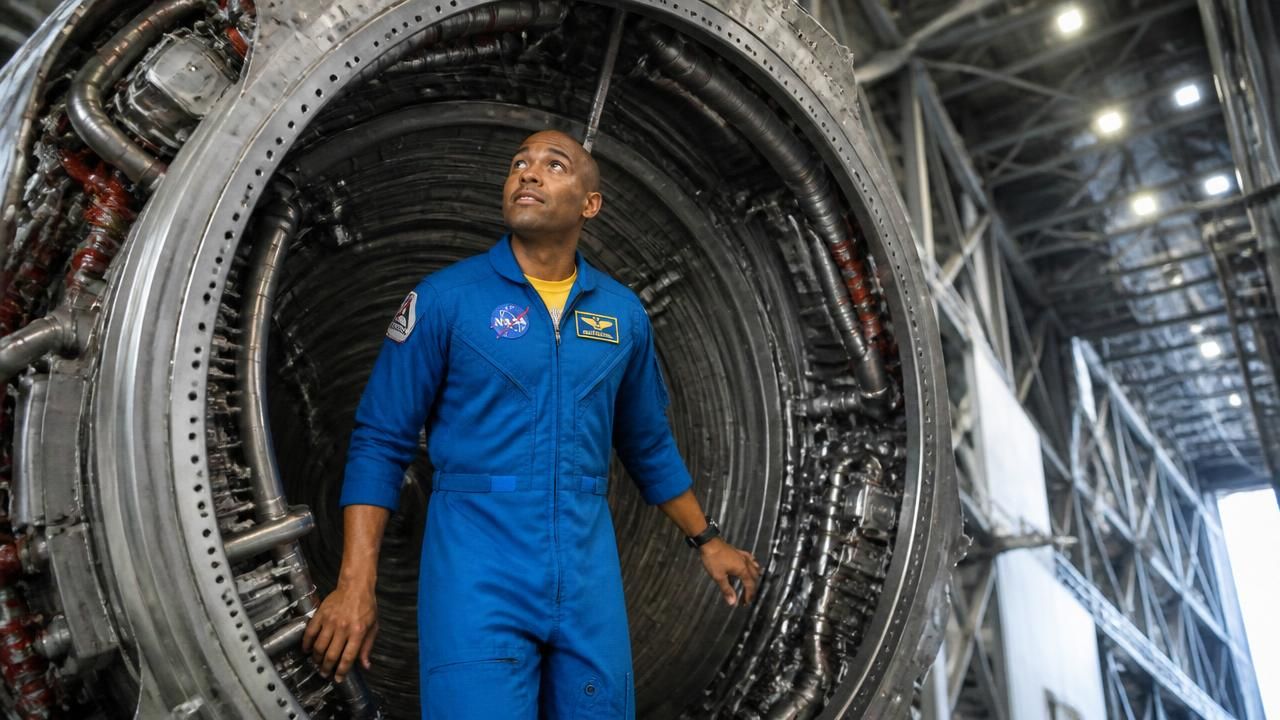
NASA astronaut Andre Douglas, a mission specialist assigned to Artemis III, toured the Vehicle Assembly Building at the agency's Kennedy Space Center in Florida on Nov. 17, 2026, standing inside an RS-25 engine test article as assembly work on the mission's rocket core stage continues. The visit, documented in an official NASA photograph credited to Kim Shiflett, offered a rare look at the hardware and the human side of a mission that has been quietly reconfigured since it was first announced.
Coverage of the visit rippled across outlets with markedly different emphases. NASA's own release framed the moment as a photo essay, using the astronaut's walk-through to explain what the mission will do. Ukrainian outlet Expert.com.ua reported the visit as a straightforward news item about the astronaut touring NASA's spacecraft assembly center. MSN featured imagery of the Artemis III astronauts meeting their spacecraft as its space photo of the day for Nov. 27, 2026. Meanwhile, auto industry and aerospace site autoevolution focused not on the crew but on the machinery, reporting that the Artemis III mega rocket is being fitted with four RS-25 engines as the launch date nears. News13, a Central Florida broadcaster with a large Space Coast audience, promised viewers a broader update on the mission's status.
A checkout inside the VAB
Douglas's stop inside the engine test article was as much symbolic as technical. The Vehicle Assembly Building is where the SLS core stage, solid rocket boosters and Orion spacecraft are stacked into their launch configuration. For a mission specialist, familiarity with that hardware is part of the job: astronauts routinely walk the assembly flow to understand the machinery they will ride, and to translate engineering diagrams into physical intuition.
What Artemis III actually is
The visit also clarified a mission architecture that has shifted substantially from earlier public expectations. As NASA describes it, Artemis III will send the Orion spacecraft to low Earth orbit to conduct critical rendezvous and docking tests with lunar lander systems. It is a proving ground, not a landing.
During Artemis III, four RS-25 engines will power the SLS (Space Launch System) rocket core stage to send the Orion spacecraft to conduct critical rendezvous and docking tests with lunar lander systems in low Earth orbit, advancing the capabilities needed before astronauts return to the lunar surface on Artemis IV.
That sequencing is the heart of the story, and it is the detail most easily lost in caption-level coverage. Rendezvous and docking between Orion and a human-rated lander is arguably the single most complex choreography in the return-to-the-Moon plan. Practicing it in low Earth orbit, where abort options and contingencies are more forgiving, allows NASA and its partners to validate procedures, software and crew training before the same operations are attempted in the lunar environment.
Four engines with a shuttle pedigree
The RS-25 is the engine that powered the Space Shuttle for three decades, and the SLS core stage carries four of them. Reusing that heritage buys NASA an enormous body of flight data — and a set of well-understood maintenance procedures — though it also ties the program to a legacy supply chain. After the shuttle retired, production restarted under Aerojet Rocketdyne, now part of L3Harris, to build new engines alongside refurbished flight-proven ones. The autoevolution headline captured the industrial reality: much of the near-term schedule risk in Artemis III lies not in astronaut training but in getting four engines integrated, tested and certified on the core stage.
Why the mission matters
Artemis III sits at a hinge point in the program's history. Artemis I flew uncrewed in 2022, sending Orion around the Moon and back to validate its heat shield and life support. Artemis II was designed to carry astronauts on a lunar flyby. Artemis III, in its revised form, becomes the in-space rehearsal — the step where the crew learns to fly Orion in proximity to another vehicle.
- For NASA: the mission is a gate. Slippage in Artemis III compresses the runway toward a crewed landing on Artemis IV.
- For international partners: the docking demonstrations involve lander systems whose development schedules are outside NASA's direct control.
- For the Space Coast: stacking work in the VAB translates directly into launch employment and local attention, which explains why regional outlets like News13 are tracking the mission closely.
- For the crew: Douglas and his colleagues must be proficient in procedures that will be invented and revised up to launch.
Reading the coverage
The divergence in framing is instructive. NASA's release is institutional and explanatory, using a single photograph to teach the mission profile. Specialist outlets zoom in on propulsion and hardware integration. International outlets treat the visit as a diplomatic and scientific milestone worth a brief. Local broadcasters treat it as a community story. None of these framings is wrong, but only together do they convey the shape of the moment: a mission that is simultaneously a photo opportunity, an engineering milestone and a schedule variable.
NASA has not publicly committed to a precise launch date, and the agency has said it will update the timeline as core stage integration and lander testing progress. What the Nov. 17 visit made visible is the part of the program that rarely makes headlines — the slow, deliberate assembly of hardware, and the astronauts who walk its corridors long before they ride it.