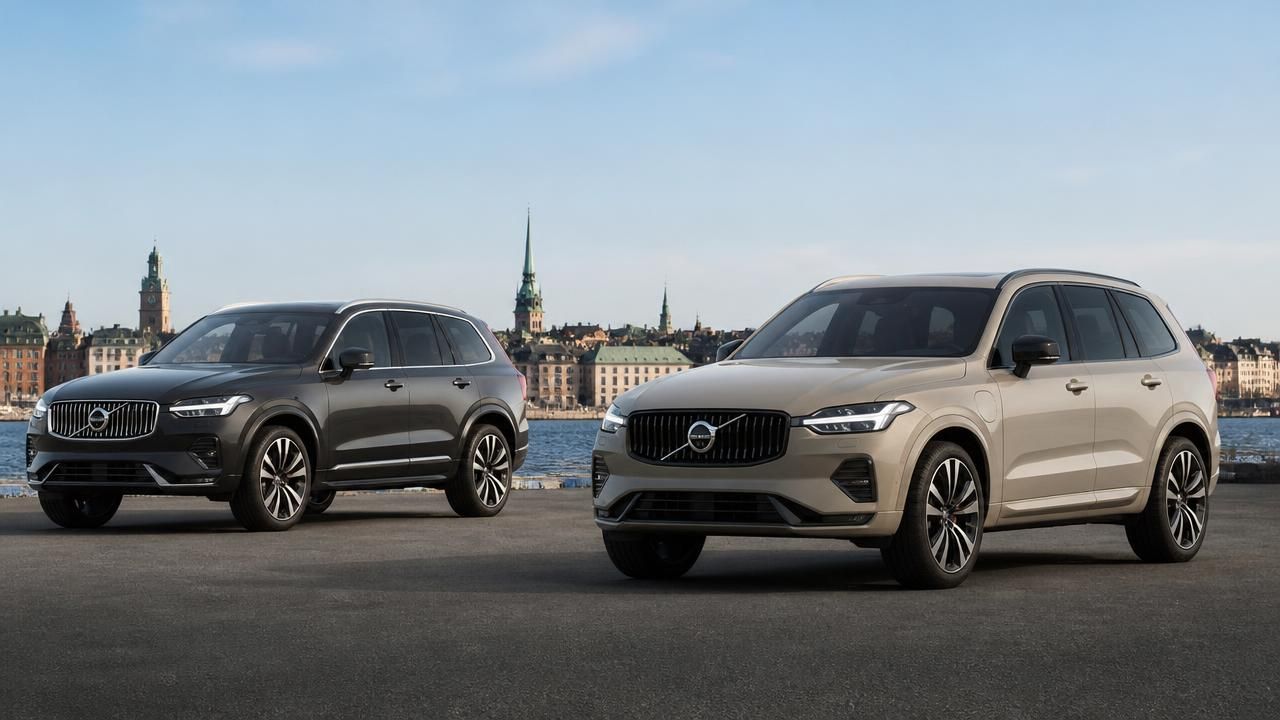
COPENHAGEN, Denmark — A decade ago, Volvo's product planners assumed the current-generation XC90, launched in 2015, and the smaller XC60 that followed in 2017, would be the last of their kind: handsome, gasoline-burning SUVs destined to be replaced by an all-electric lineup. The future, as it turns out, arrived unevenly. Instead of retiring the pair, Volvo has handed both models another lifecycle refresh for model year 2028 — and put the bulk of its investment not into new sheetmetal, but into batteries.
The headline change is a dramatically larger plug-in hybrid battery pack that roughly doubles the electric range of both SUVs, a move Volvo is marketing as a "best of both worlds" answer for buyers who want to electrify their commute without committing to a full EV.
What Actually Changed
Externally, the updates are deliberately subtle. The three-row XC90 already received a visual once-over last year; the XC60 now adopts a similar grille and the same matrix LED headlights. Both remain, in the assessment of Ars Technica, "handsome shapes that are popular with Volvo's customer base" — a polite way of saying there was little reason to meddle with a successful design.
The substance is underneath and inside. Volvo's engineers fitted a substantially larger battery to the T8 plug-in hybrid powertrain, enough capacity that, in the company's telling, most owners can cover several days of daily driving before plugging in. Interiors and infotainment have also been brought up to 2028 standards, addressing one of the most common criticisms of the aging platforms.
The Numbers, and Why They Differ
Range figures have become the story, and the coverage illustrates how the same vehicle can look wildly different depending on the test cycle being quoted:
- XC90 T8: Rated at 73 miles of electric range on the US EPA cycle — a figure MSN's first-drive review framed as "a 73-mile answer to going fully electric."
- XC60 T8: Quoted at up to 124 miles of electric range under Europe's WLTP protocol, per Forbes, which described the SUV as taking on the emerging class of "super hybrids."
- Both models: Roughly double the electric range of the outgoing versions, according to AutoWeek and InsideEVs.
Road & Track called the XC60's figure a "monster electric range for a PHEV," while Guide de l'Auto's review focused on the long-range variant's real-world stamina. The gap between US and European figures is a reminder that WLTP and EPA ratings are not directly comparable — a nuance that tends to get lost in headline-writing.
"In the crowded three-row SUV segment, Volvo is betting on a 'best of both worlds' approach."
Why Volvo Is Hedging
The refresh is a pragmatic response to a market that has not electrified on the schedule many automakers predicted. Europe and China continue to push aggressively toward battery-electric vehicles, but the US — still the most profitable market per unit for many legacy brands — has seen EV adoption growth cool, driven by high interest rates, charging anxiety, and a retreat in federal incentives.
That divergence creates an awkward calculus: developing an all-new electric XC60 or XC90 could mean spending billions on models with an uncertain eight-year lifespan in key markets. Extending the life of two proven nameplates with a bigger battery, meanwhile, costs far less and directly targets the segment of buyers who are EV-curious but not yet EV-ready.
Car and Driver framed the XC90's new powertrain bluntly: it "will save you money," a nod to the fact that a PHEV with 73 miles of electric range can function as a de facto EV for most weekday driving while still offering a gas engine for road trips. CleanTechnica, which covers the transition to electric transport, characterized the upgrade as a significant increase in fully electric range — a positive read for a technology some EV advocates regard as a stopgap.
The Competitive Squeeze
Volvo is not alone in this strategy. Chinese automakers have been selling plug-in hybrids with 100-plus miles of electric range for several years, and European brands are following suit as they try to meet tightening fleet-emissions rules while keeping combustion-engine options alive. Forbes' headline — asking whether we still need plug-in hybrid SUVs — captures the tension at the heart of the segment: PHEVs are either a sensible bridge or a costly distraction, depending on whom you ask.
The Verge's take was simpler: the XC60 and XC90 "can really go the distance," a consumer-facing verdict that Volvo will happily take. For a brand that has staked its identity on sustainability, the pitch is that a PHEV driven mostly on electricity is meaningfully greener than a conventional hybrid — provided owners actually plug them in, a caveat that has dogged the category for years and one that fleet data from Europe suggests is only sometimes borne out.
What It Means
Volvo has not announced US pricing for the 2028 models, though the refresh is expected to keep the SUVs positioned in the premium mid-size and three-row segments. The bigger question is strategic: by doubling down on plug-in hybrids rather than accelerating its EV transition, Volvo is signaling that the road to electrification will be longer and less linear than its 2015-era planners assumed.
For buyers, the refreshed XC60 and XC90 now offer something genuinely rare in the premium SUV market — enough electric range to cover a normal week of commuting without burning a drop of gasoline, with a gas tank for the holidays. Whether that is a bridge to the electric future or a comfortable detour from it, Volvo is betting a substantial chunk of its near-term product cycle that most customers will see the former.