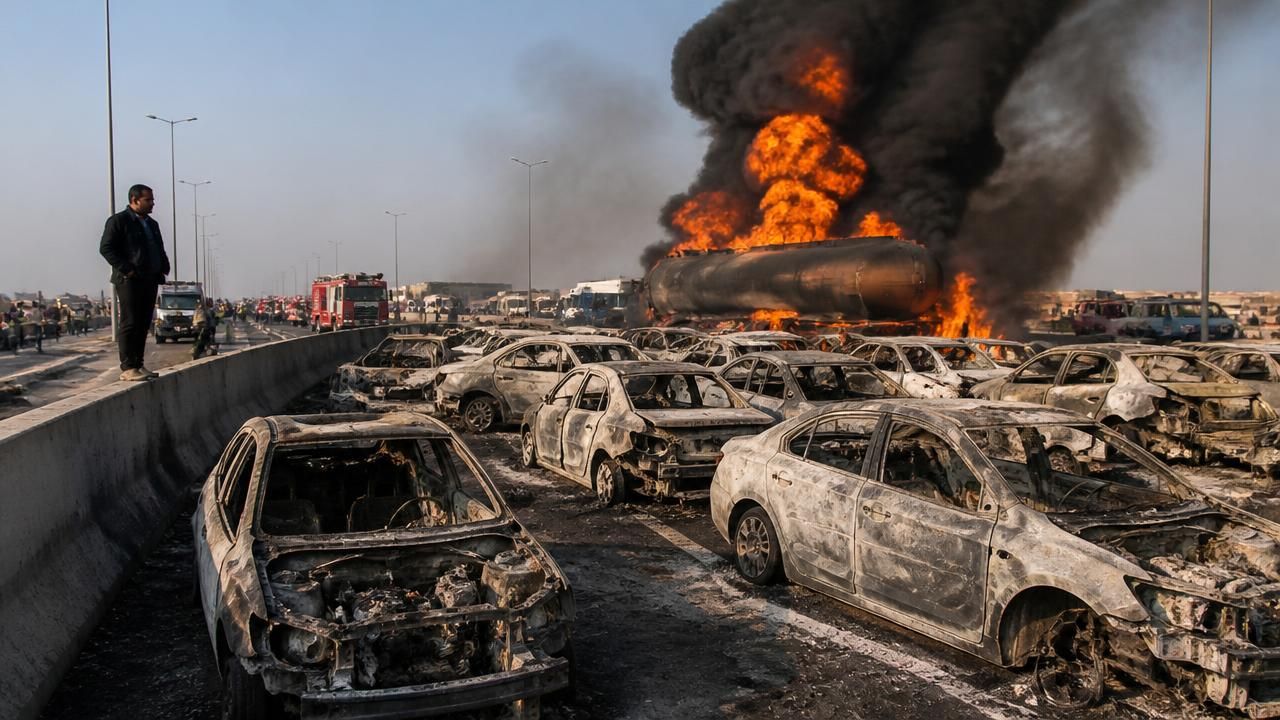
A fuel tanker crashed and burst into flames on the ring road encircling Cairo on Wednesday, killing at least 30 people and injuring at least 25 others in one of the deadliest traffic disasters to strike the Egyptian capital in recent memory. The blaze consumed more than two dozen cars and motorcycles, leaving a charred stretch of asphalt on a highway that serves as one of the city's most heavily used arteries.
The public prosecutor's office announced the toll in a statement, saying the collision had set off a large fire along the roadway. Egypt's Health Ministry, cited in later reports, put the number of dead at 31 — a discrepancy of a single fatality that reflects the fluid nature of casualty counts in the hours after a mass-casualty incident, as officials reconcile figures from multiple hospitals and field teams.
What Happened
According to the accounts relayed by authorities, a tanker carrying fuel crashed on the ring road and ignited, sending fire across multiple lanes. The flames spread to surrounding traffic, trapping drivers and passengers in vehicles and motorcycles caught in the immediate vicinity. More than two dozen vehicles were left charred, according to the prosecutor's statement, and the injured were transported to nearby hospitals.
Video and images circulating after the crash showed a column of thick black smoke rising above the roadway, visible from a distance — a hallmark of fuel-fed fires, which burn hotter and spread faster than ordinary vehicle blazes and leave rescue crews with narrow windows for extraction.
Anatomy of a Chokepoint
The ring road is a multi-lane beltway designed to let traffic bypass central Cairo, connecting the city's sprawling outskirts with its airport, industrial zones and satellite cities. In practice, it functions as the capital's circulatory system — and, critics say, as a bottleneck where heavy goods vehicles share crowded lanes with private cars, minibuses and the motorcycles that are a ubiquitous feature of Egyptian commuting.
That mix is a recurring source of danger. Fuel tankers are among the most consequential vehicles on any road: a single rollover or collision can release thousands of litres of flammable liquid, and the resulting fire can spread faster than emergency services can respond. Egypt has seen serious tanker incidents before, and road safety specialists have long pointed to a combination of factors — dense traffic, variable vehicle maintenance standards, long working hours for commercial drivers, and variable enforcement of load and speed rules — that raises risk on high-volume corridors.
Differing Accounts, Shared Facts
Coverage of the disaster across outlets converged on the essentials but diverged on the arithmetic. The Guardian, citing Egyptian authorities, reported at least 30 dead and at least 25 injured, with more than two dozen vehicles destroyed. Al-Monitor carried the same headline figure of at least 30 killed. MSN, aggregating wire reports, published two versions: one citing the Health Ministry's figure of at least 31 dead, and another describing a "massive fire" with a toll of at least 30.
The variation is routine in breaking news. Health ministries typically count deaths recorded at hospitals, while prosecutors and interior ministry officials may include victims declared dead at the scene. Final tallies often rise — or, occasionally, are revised downward — as identifications are completed.
The public prosecutor's office said the blaze on the ring road had also injured at least 25 people and left more than two dozen cars and motorcycles charred.
Response and Investigation
Egyptian authorities opened an investigation into the crash, with the public prosecutor's office issuing the initial accounting of casualties and damage. Such inquiries typically examine vehicle condition, driver conduct, road design and the circumstances of the collision, and can result in criminal referrals where negligence is established.
Emergency crews worked to extinguish the fire and clear the roadway, a process complicated by the volume of burned-out vehicles and the structural damage intense heat can inflict on asphalt and barriers. The full reopening of the corridor is likely to take time, and the economic ripple effects of closing a key ring-road segment are felt quickly in a metropolis of more than 20 million people.
Broader Context
The disaster draws attention to a persistent public-health issue that rarely receives sustained scrutiny: road traffic deaths in Egypt and across the Middle East and North Africa. The World Health Organization has estimated that the region carries a disproportionate share of global road fatalities relative to its vehicle fleet, with vulnerable road users — pedestrians, motorcyclists and passengers in older or poorly maintained vehicles — bearing much of the burden.
- Casualties: At least 30 killed, per the public prosecutor; 31 per the Health Ministry. At least 25 injured.
- Damage: More than two dozen cars and motorcycles charred; a section of the Cairo ring road closed.
- Location: The ring road, a key artery encircling the Egyptian capital.
- Cause: A fuel tanker crash that ignited a large fire; under investigation.
For families of the dead, the dispute over whether the toll is 30 or 31 is beside the point. What remains is a stretch of highway blackened by fire, a set of unanswered questions about how a single vehicle could produce so many casualties, and a familiar demand from safety advocates: that the lessons of such disasters be applied before the next tanker leaves its depot.