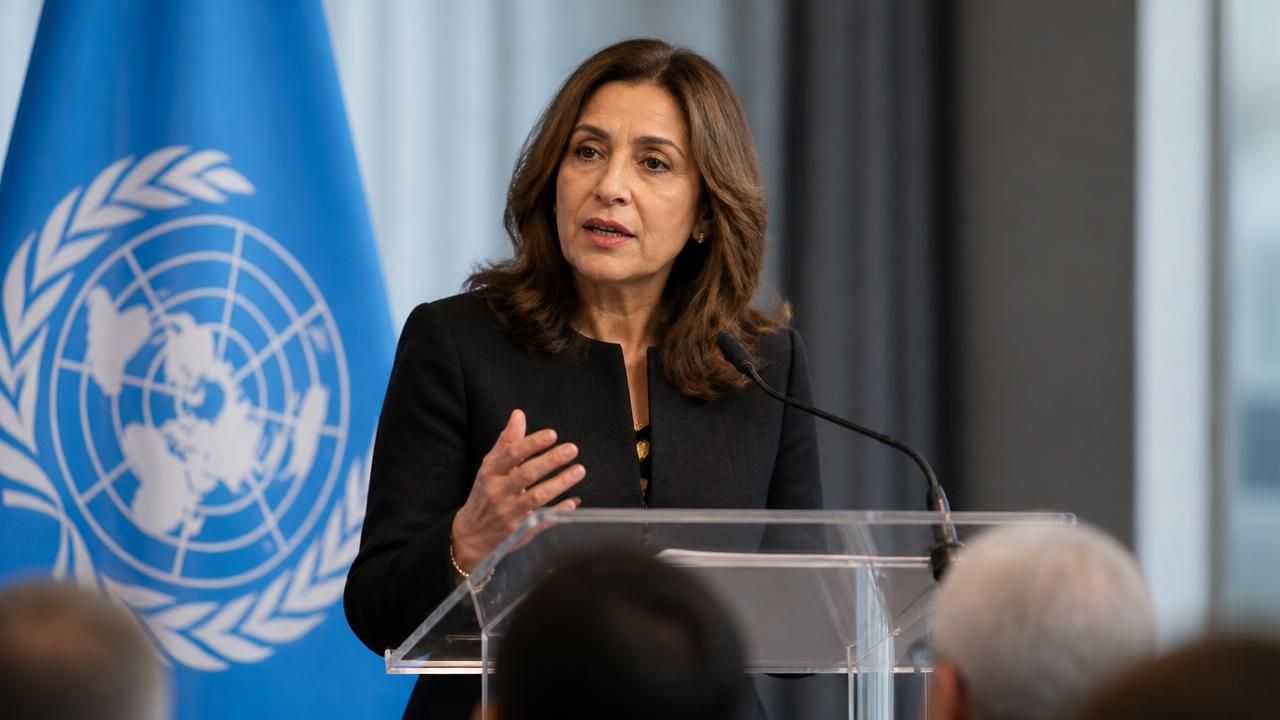
Lana Nusseibeh arrived in London this week with a carefully calibrated message: she is no longer a spokesperson for the United Arab Emirates, but a candidate for the world. The veteran Emirati diplomat, nominated by Abu Dhabi to succeed António Guterres as United Nations secretary-general, spent the week meeting ministers, MPs and academics and appearing at a public event with the UN Association in an effort to convert a résumé built in the service of one state into a case for leading all of them.
It is a high-risk strategy, and the questions she faces are not abstract. They concern Sudan, where a four-year civil war between the Sudanese Armed Forces and the Rapid Support Forces (RSF) has produced what UN investigators and Western governments describe as war crimes and genocide — and where the UAE stands accused of arming the very militia at the centre of those atrocities. The allegation, which Abu Dhabi denies, follows Nusseibeh from New York to London.
“I'm no longer a UAE official,” Nusseibeh said during her UK visit, in a line that has become the organising principle of her campaign — and, her critics argue, its central vulnerability.
A charm offensive with a hard edge
Coverage of the visit split sharply along the fault lines of the story. Gulf-friendly outlets such as MSN foregrounded her pledge of “relentless diplomacy,” presenting a seasoned multilateralist promising continuity and energy at a time when the UN is stretched by conflict, funding shortfalls and declining great-power confidence. Muslim Mirror framed the candidacy more philosophically, arguing that “a UN chief must be more than a symbol” and casting the bid as a “test of power and principle” — a reminder that the office's authority rests less on rhetoric than on whether its holder will confront the permanent members who appoint them.
The Guardian, by contrast, led with the effort to “shake off” her Sudan record, noting that as UAE ambassador she publicly denied her country's role in arming a militia accused of atrocities. That framing reflects the central difficulty of her candidacy: the same decade of service that gives her fluency in Security Council procedure also binds her to the foreign policy she would now be expected to referee.
The Sudan question
The war in Sudan, which erupted in April 2023 out of a power struggle between Gen. Abdel Fattah al-Burhan and RSF commander Mohamed Hamdan Dagalo, has displaced more than ten million people and pushed parts of Darfur into famine conditions. UN experts have documented systematic killings and sexual violence by the RSF and allied militias. The UAE has been repeatedly accused — in UN expert reports, in Western capitals and by Sudanese officials — of channelling weapons to the RSF through Chad. Abu Dhabi denies the charge categorically, describing its role as humanitarian.
The UK's position is not incidental. Britain is a permanent Security Council member and the council's longstanding “penholder” on Sudan, wielding a veto that could end Nusseibeh's ambitions before a formal vote is ever held. London's resistance, flagged in the Guardian's reporting, is precisely the sort of quiet obstacle that has sunk secretary-general candidates in the past.
A selection process in deadlock
Nusseibeh's nomination did not emerge in a vacuum. According to The Yeshiva World, the informal search had already run through six rounds of voting without producing consensus — a signal of how deeply divided the Security Council's five permanent members remain over the world body's direction. The Guardian's characterisation adds a striking wrinkle: it describes Washington and Moscow as effectively behind her candidacy. If accurate, that alignment is remarkable in an era of renewed great-power rivalry, and it suggests both capitals see in Nusseibeh a figure they can work with — or, her detractors would say, one neither fears.
The secretary-general is chosen by the General Assembly on the Security Council's recommendation, meaning any of the P5 can veto a candidate in a private straw poll. Regional rotation has become an informal convention, with the Eastern European group's turn producing Guterres in 2016 after a historically open campaign. Pressure from civil society for a more transparent, publicly interviewed process has grown since, and Nusseibeh's public appearances — including her London event — are calibrated to that new expectation of a visible, campaign-style selection.
What she is promising
In her public remarks, Nusseibeh has avoided re-litigating Sudan, offering instead a broad pledge of relentless, unglamorous diplomacy: shuttle mediation, quiet crisis management, and a re-energised focus on the Sustainable Development Goals and reform of the Security Council itself. Her supporters point to her role in negotiating the Pact for the Future, adopted in 2024, as evidence she can bridge divides in a polarised institution.
- The case for her: a decade at the UN, deep procedural knowledge, and support from both Washington and Moscow, per the Guardian.
- The case against: unresolved questions about UAE conduct in Sudan, and the perception that she would defend rather than scrutinise powerful states.
- The stakes: a UN facing record humanitarian need financing gaps and a Security Council paralysed on Gaza, Ukraine and Sudan alike.
Nusseibeh's gamble is that a charm offensive — conducted in the language of reform and bridge-building — can outrun a war thousands of miles away. Her critics' wager is that in a selection process decided behind closed doors by the very governments whose conduct a secretary-general is supposed to judge, the record always catches up.