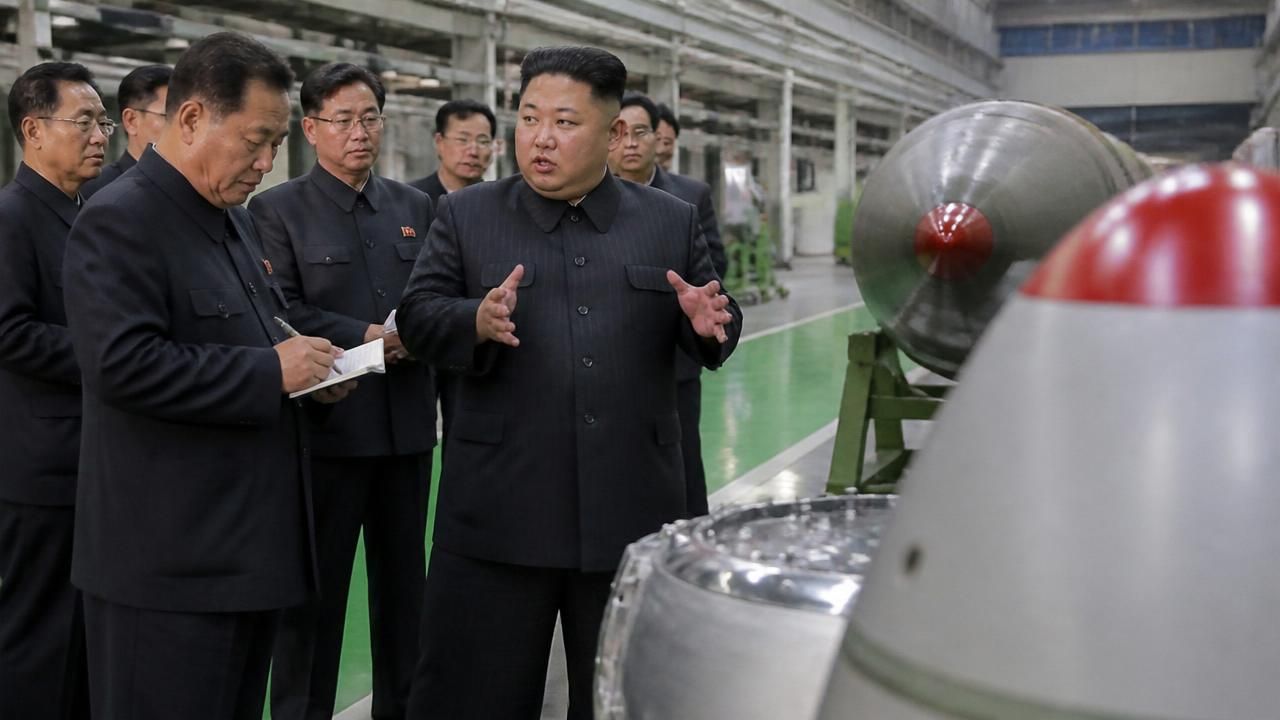
North Korean leader Kim Jong Un has ordered an expansion of his country's nuclear arsenal and a wider deployment of tactical nuclear weapons, according to state media reports that accompanied unusually candid photographs of Kim touring facilities that produce the raw ingredients for atomic bombs. The disclosure, carried by the state-run Korean Central News Agency and reported widely on Tuesday, came days after Pyongyang pointedly ignored an offer of talks from US President Donald Trump — a silence that now reads less as indecision than as a statement of intent.
Kim used the visits to declare that North Korea's status as a nuclear-armed state is permanent and non-negotiable, vowing to build what he called the world's strongest military to counter what Pyongyang describes as existential threats from the United States and South Korea.
What Pyongyang showed — and what it said
Photographs distributed by KCNA showed Kim walking through production halls and standing before hardware that outside analysts have identified as components of the country's nuclear weapons enterprise. Bloomberg characterized the release as a "rare show of nuclear warheads," a notable departure for a government that has generally guarded the details of its stockpile even while boasting about its existence.
NPR reported that Kim visited facilities producing nuclear ingredients and explicitly called for building more weapons to cope with perceived threats from Washington and Seoul. CNN, meanwhile, focused on Kim's call for a "wider tactical nuclear deployment," a phrase that points toward battlefield-scale weapons intended for use against military targets in the region rather than long-range strategic strikes against the US mainland.
"The permanent ... status of our country as a nuclear weapons state will never change," Kim was reported to have said, according to accounts of the KCNA dispatch — language Pyongyang has used increasingly to foreclose the possibility of denuclearization talks altogether.
The dailytimes.com.pk headline captured another strand of the message: Kim's call to build the "world's strongest military." Taken together, the imagery and the rhetoric amount to a coordinated package — a visual claim of capability paired with a verbal rejection of diplomacy.
Tactical weapons: shifting the threat closer to home
The emphasis on tactical nuclear weapons is significant. Strategic weapons are designed to deter by threatening catastrophic retaliation; smaller, shorter-range systems are often framed by their possessors as usable instruments of warfighting. For South Korea and Japan, that distinction matters enormously. A doctrine that contemplates using nuclear weapons on the Korean Peninsula or in the waters around it lowers the threshold at which deterrence might fail.
North Korea has spent years refining short-range ballistic missiles capable of carrying nuclear warheads, deploying systems such as the KN-23 and KN-25 that are designed to evade missile defenses and strike South Korean and US military installations in the region. Kim's latest directive appears to formalize an operational role for such weapons, rather than treating the arsenal as a purely political deterrent.
The timing: a message aimed at Washington
The most telling element may be the sequencing. Trump has repeatedly signaled openness to a return to personal diplomacy with Kim, harking back to their 2018 summit in Singapore and the exchange of effusive letters that followed. That outreach appears, for now, to have been declined.
Newser's framing — that Kim "disses Trump, then makes a promise" — captures how Western outlets read the pairing: the rejection of the American overture and the nuclear pledge are not separate stories but a single act of positioning. By demonstrating that his arsenal has grown since the summit years, Kim is signaling that any future talks would begin from a much stronger North Korean starting point.
Domestic politics in Washington complicate the picture further. Any resumption of summitry would confront a skeptical Congress, allies in Seoul and Tokyo unnerved by the prospect of a deal that trades recognition for partial freezes, and the long-standing American demand for complete denuclearization that Pyongyang has flatly rejected.
How outlets framed the story
- NPR led with the policy substance: Kim's vow to build more weapons amid US and South Korean threats, attributing the imagery to KCNA.
- Bloomberg emphasized the visual novelty — the rare public display of nuclear warheads — and the diplomatic snub embedded in the timing.
- CNN highlighted the tactical dimension, underscoring calls for wider battlefield deployment during the facility inspections.
- Newser framed the news through the Trump relationship, treating the dismissal of US outreach as the story's hook.
- Daily Times and MSN aggregated the harder-line rhetoric, including the pledge to field the world's strongest military.
Context: from summit diplomacy to a permanent arsenal
The trajectory is familiar. The 2018 Singapore summit produced a vague commitment to denuclearization; the 2019 Hanoi talks collapsed without agreement; and by 2022 Pyongyang had codified a nuclear doctrine authorizing preemptive use in certain scenarios, later enshrining its nuclear policy in the constitution. Satellite imagery has repeatedly shown expansion at the Yongbyon complex and other enrichment sites, including centrifuge halls unveiled in 2024.
Parallel to this, North Korea has deepened its alignment with Russia, concluding a mutual defense treaty and reportedly supplying munitions and troops for Moscow's war in Ukraine. That relationship offers economic lifeline and diplomatic cover, reducing Pyongyang's incentive to trade its arsenal for sanctions relief.
What comes next
For Seoul and Tokyo, the immediate concern is verification and readiness: an expanding, increasingly diversified arsenal complicates missile defense planning and intelligence assessment. For Washington, the strategic problem is structural — a nuclear-armed North Korea that no longer seeks legitimacy through negotiation, but claims it as an accomplished fact.
The practical question is whether Kim's declaration signals intent to test or deploy new systems in the near term, or is primarily a bargaining posture for a future round of diplomacy. History suggests both readings can be true at once. What is clear is that Pyongyang wants the world — and particularly the occupant of the White House — to understand that the era of trading nuclear programs for summits is over.