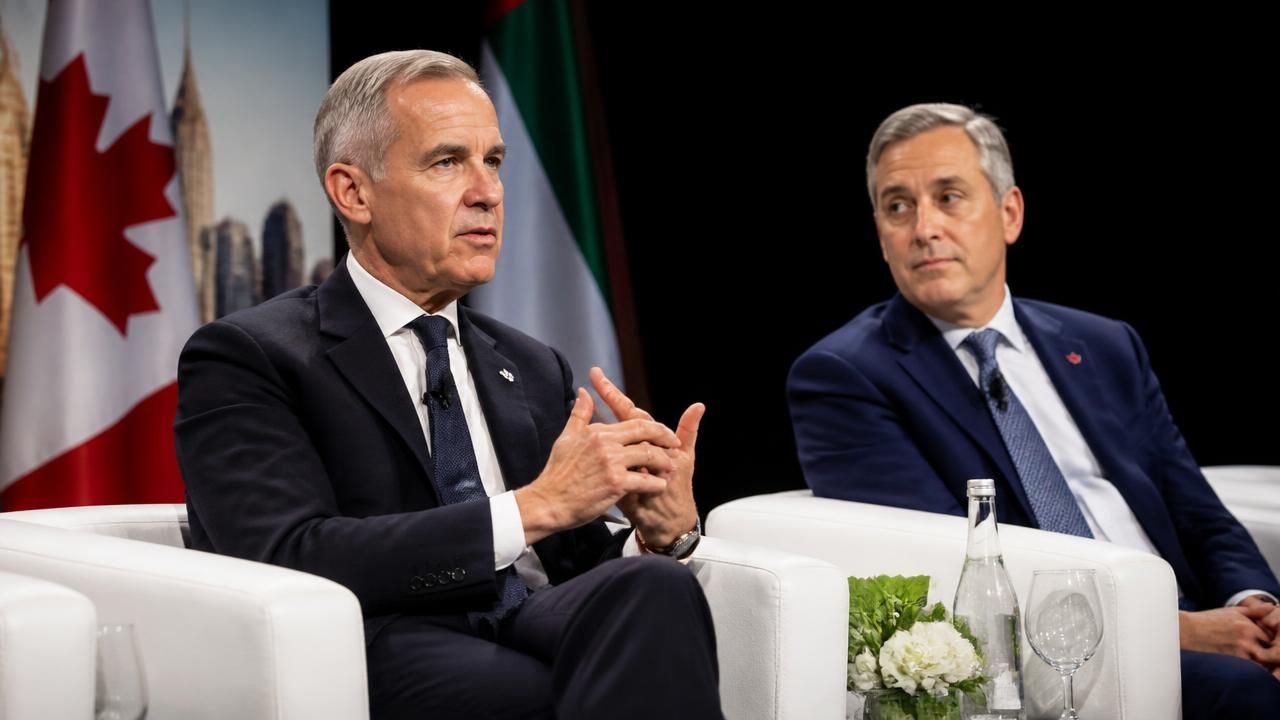
Canada has launched a concerted push to court global investment giants, with Prime Minister Mark Carney and Finance Minister François-Philippe Champagne making the case that the country offers a stable, long-term destination for capital at a moment when the United States is aggressively trying to pull investment south of the border. The pitch, delivered to sovereign wealth funds and institutional investors in the Gulf and beyond, comes as Ottawa finds itself locked in a bruising trade war with the Trump administration.
Two Voices, One Message
Champagne, speaking to Bloomberg Television in Dubai, framed Canada's position in almost bullish terms, arguing that the country is arriving at a reshaped global economic order from a position of strength rather than vulnerability. He urged Middle Eastern investors to deploy long-term capital into Canada's infrastructure plans — a portfolio of projects that Ottawa hopes will anchor decades of productive investment and reduce the country's dependence on any single trading partner.
"Canada is entering a shifting global order from a position of strength," Champagne told Bloomberg TV, according to Bloomberg Markets.
Carney, meanwhile, has taken the same message to a broader audience of global investment titans, positioning Canada as a haven for investors precisely because of the turbulence emanating from Washington. Where Champagne's remarks emphasized infrastructure and long-horizon capital, Carney's pitch leaned on the broader macro story: rule of law, energy security, a skilled workforce and a currency and fiscal framework that investors can underwrite through a period of trade disruption.
How the Outlets Framed It
The story looks subtly different depending on where you read it. Bloomberg Markets led with the infrastructure angle — the mechanics of attracting sovereign capital into concrete projects — and treated Champagne's Dubai remarks as the news hook. The New York Times framed the same trip as Carney pitching Canada as a "haven" for investors amid a U.S. trade war, emphasizing the geopolitical contrast with the Trump administration. PBS News foregrounded the trade war itself, framing the investor courtship as a direct response to Washington's efforts to redirect capital toward the United States. Aggregators such as MSN carried the Carney headline — that he is pitching Canada to global investors "as Trump tries to pull investment south" — a framing that makes the competitive dynamic explicit.
Taken together, the coverage describes a single coordinated campaign rather than isolated appearances: the prime minister supplying the strategic narrative, the finance minister supplying the deal-level detail.
Why Now: The Trade War Context
Canada's economy is unusually exposed to U.S. policy. Roughly three-quarters of Canadian goods exports go south of the border, and the tariff regime imposed by the Trump administration has injected uncertainty into sectors from autos and steel to agriculture and energy. That dependence has become a political liability in Ottawa, and the government has responded by pursuing what officials describe as a deliberate diversification of trade and capital relationships.
The Gulf is a logical target. Sovereign wealth funds in the region control trillions of dollars in assets and have been steadily increasing allocations to infrastructure, renewables and critical minerals — all areas where Canada claims comparative advantage. Canadian officials have also been courting pension funds and institutional investors in Europe and Asia with a similar message.
The Infrastructure Angle
Champagne's pitch was notably specific: long-term capital for infrastructure. Canada has for years struggled to close a gap between the projects it wants to build — housing, transmission lines, ports, critical-minerals processing — and the domestic capital available to finance them. Successive governments have talked about creating a pipeline of bankable projects to attract foreign institutional money, with mixed results.
Selling that story in a period of tariff uncertainty is harder than it sounds. Investors prize predictability, and the current environment offers little of it. The Canadian argument, in effect, is comparative: whatever Canada's flaws, it offers a rules-based legal system, a stable banking sector that weathered the 2008 crisis better than most, and a government publicly committed to welcoming foreign capital at a time when other jurisdictions are turning inward.
The Risks and the Skeptics
- Trade exposure: No amount of Gulf capital can quickly offset the damage a prolonged tariff war would do to Canadian exporters.
- Productivity and competitiveness: Investors have long cited Canada's lagging productivity, interprovincial trade barriers and lengthy project-approval timelines as deterrents.
- Political risk: A change in government could alter the investment climate, and foreign investors are sensitive to regulatory reversals on energy and mining projects.
- Competition from Washington: The Trump administration is actively courting the same pools of capital, offering tax incentives and deregulation as counterarguments.
What to Watch
The immediate test is whether the Gulf roadshow produces tangible commitments — memoranda of understanding, anchor investments in specific projects, or co-investment vehicles with Canadian pension funds. Champagne's language suggested Ottawa is seeking long-horizon partners rather than short-term portfolio flows, which would make any deals slow to materialize and harder to measure.
The broader test is strategic. Canada's pitch rests on the claim that it is a stable port in a stormy world. If the trade war escalates or spills into new sectors, that claim will be tested — and the investors now being courted in Dubai and elsewhere will be watching closely to see whether Canada can deliver the predictability it is promising.