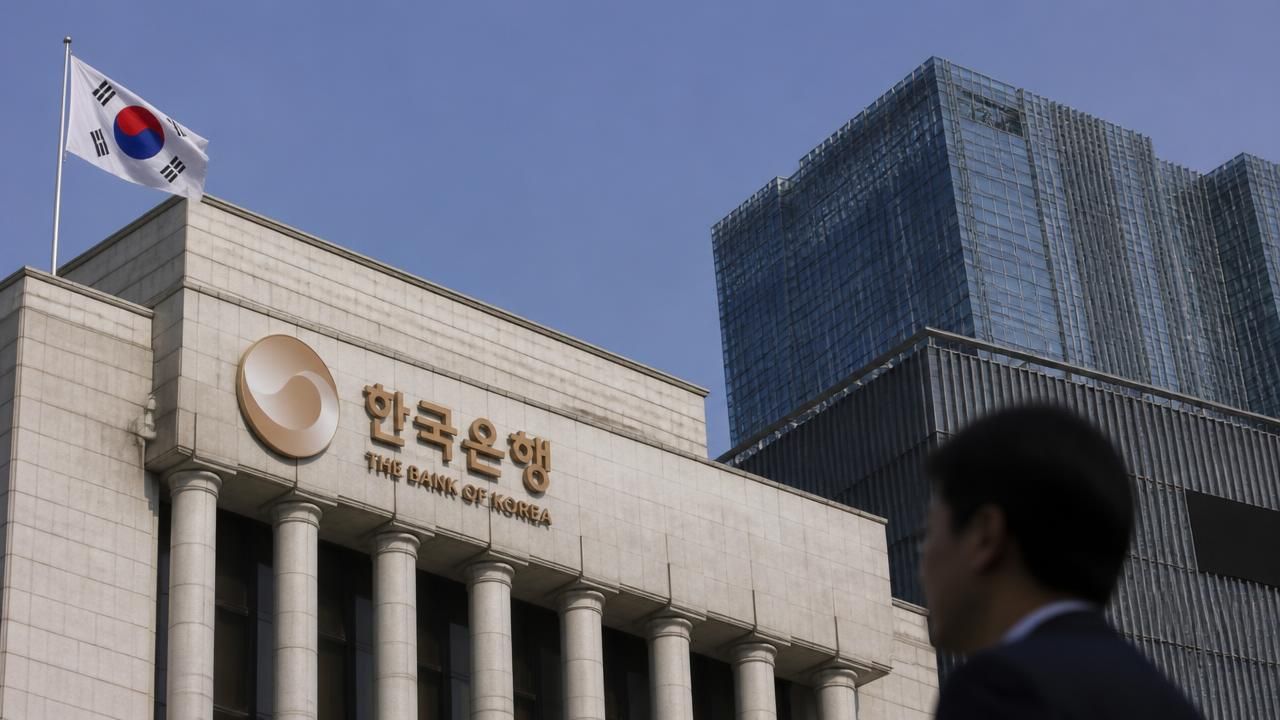
SEOUL — South Korea’s central bank raised its benchmark interest rate by 25 basis points to 3.25% on Thursday, resuming a tightening campaign after a one-meeting pause and taking borrowing costs to their highest level in two years. The Bank of Korea’s decision was reported by Bloomberg, Yonhap News Agency, SBS and MoneyToday, and came as inflation remained above target and growth proved more resilient than expected, helped by a semiconductor export boom.
A pause ends and a tightening cycle resumes
The BOK had held rates in October after back-to-back increases in July and August. Bloomberg’s Denny Thomas framed the move as a resumption of tightening, with the central bank lifting its benchmark by a quarter percentage point.
Bloomberg reported: “The hike follows a pause in October after back-to-back increases in July and August.”The decision puts the benchmark at 3.25%, the highest in two years, according to MSN and Yonhap. It also restores a restrictive policy stance at a time when several major central banks are debating how quickly to ease.
Growth, chips and the inflation calculus
The BOK’s case rests on two forces: inflation that has not returned sustainably to target, and an economy buoyed by semiconductors. SBS framed the decision as a response to a semiconductor boom and inflation pressures. Yonhap said the bank acted amid strong growth and inflation. MSN emphasized that the rate is now the highest in two years as inflation remains above target.
The central bank also upgraded its growth outlook. Yonhap reported that the BOK revised up its 2027 growth forecast to 4.1%. MoneyToday described the same 4.1% figure as next year’s growth forecast, while other MSN headlines referred to an upgraded GDP growth forecast and a higher 2027 outlook. The horizon was labeled differently across outlets, but the direction was consistent: South Korea’s economy is expected to expand faster than previously thought, reinforcing the case for keeping policy tight.
That forecast upgrade cuts both ways. Stronger growth can sustain demand and keep inflation sticky, requiring higher rates. But much of the optimism rests on the global chip cycle, which can turn quickly. A semiconductor-led expansion also complicates the BOK’s communication: it must avoid sounding complacent about inflation while acknowledging that export strength may not translate into broad domestic demand.
Markets: a muted won and a ‘final hike’ debate
Financial markets took the decision in stride. Yahoo Finance’s Asia FX coverage said the won was muted after the BOK hike while the dollar stayed steady, suggesting the move had been largely priced in. SBS reported that foreign investors were heavy buyers of Treasury futures, a positioning that can reflect a bet that the BOK is nearing the end of its hiking cycle. Bond futures tend to rally when investors expect rate increases to stop or reverse.
That view is not unanimous. A Reuters poll ahead of the meeting had projected the BOK would raise rates on Thursday and once more next quarter. ING’s Asia week ahead preview also flagged the BOK decision as a key regional event, alongside data from China, Taiwan and Japan. The split between the Reuters poll and the futures positioning captures the central debate: is 3.25% the peak, or is there one more move?
Conflicting headlines and the limits of a single snapshot
Not every headline matched. A Korea Herald headline referenced a BOK rate of 3.00% and a revised 2026 forecast of 3.3%, figures that were inconsistent with the 3.25% decision reported by Bloomberg, Yonhap, SBS and MoneyToday. The discrepancy appears to reflect an earlier decision, a syndication or publishing error, or a headline tied to a different meeting; it was not corroborated by the main reports. Several other outlets—thehawk.in, thestar.com.my and Yahoo Finance’s page—were inaccessible or returned errors, leaving only headlines and partial context. The clearer picture comes from the wires and broadcasters that reported the 25-basis-point move and the 4.1% growth upgrade.
Why it matters beyond Seoul
South Korea is a bellwether for global trade and technology demand. Its central bank is one of the first in Asia to confront a chip-driven recovery alongside persistent inflation. A higher benchmark rate affects household borrowing, corporate investment and the won, and it shapes expectations for other export-heavy economies. The BOK’s move also signals that policy normalization in Asia may not follow a straight line: pauses can end, forecasts can shift, and markets can misread the peak.
For now, the BOK has chosen vigilance over relief. The central bank resumed hiking because the data—strong growth, above-target inflation and a semiconductor boom—did not justify an extended pause. Whether this is the final hike will depend on the next inflation prints, the durability of the chip cycle and how quickly household demand cools. Foreign investors are already betting on the end. The BOK has not yet confirmed it.