NASA is asking amateur astronomers to point their telescopes at some of the most violent events in the universe. The agency's Kilonova Catcher project, described this week in a science feature from NASA's Science Activation program, connects backyard observers around the world into a rapid-response network designed to catch the brief, brilliant aftermath of colliding neutron stars — and, in doing so, to help trace the cosmic origins of gold and platinum.
The call to volunteers arrives alongside a separate and more speculative headline: reports circulating via MSN describe astronomers having spotted an "explosion inside an explosion," a signal that may represent the first known superkilonova — a hypothesized event even more energetic than the kilonovae the citizen-science network is built to chase.
What is a kilonova?
Neutron stars are the ultra-dense, city-sized leftovers of dead stars. When two of them spiral together and merge, they can release a short-lived flash of light called a kilonova. These events are believed to forge much of the universe's heavy elements — the gold, platinum and other metals that make up everything from wedding rings to catalytic converters.
"Neutron stars are the ultra-dense, city-sized leftovers of dead stars. When they collide, they can release a brief flash of light called a kilonova. These immensely powerful events forge much of the universe's gold, platinum and other heavy elements." — NASA's Kilonova Catcher project description
The problem is timing. A kilonova fades within days, sometimes within hours of becoming visible. No single observatory can watch the whole sky at once, and professional telescopes are heavily oversubscribed. That creates a narrow, unforgiving window in which astronomers must first find the fading glow and then track it before it disappears.
A network of 150 volunteers on several continents
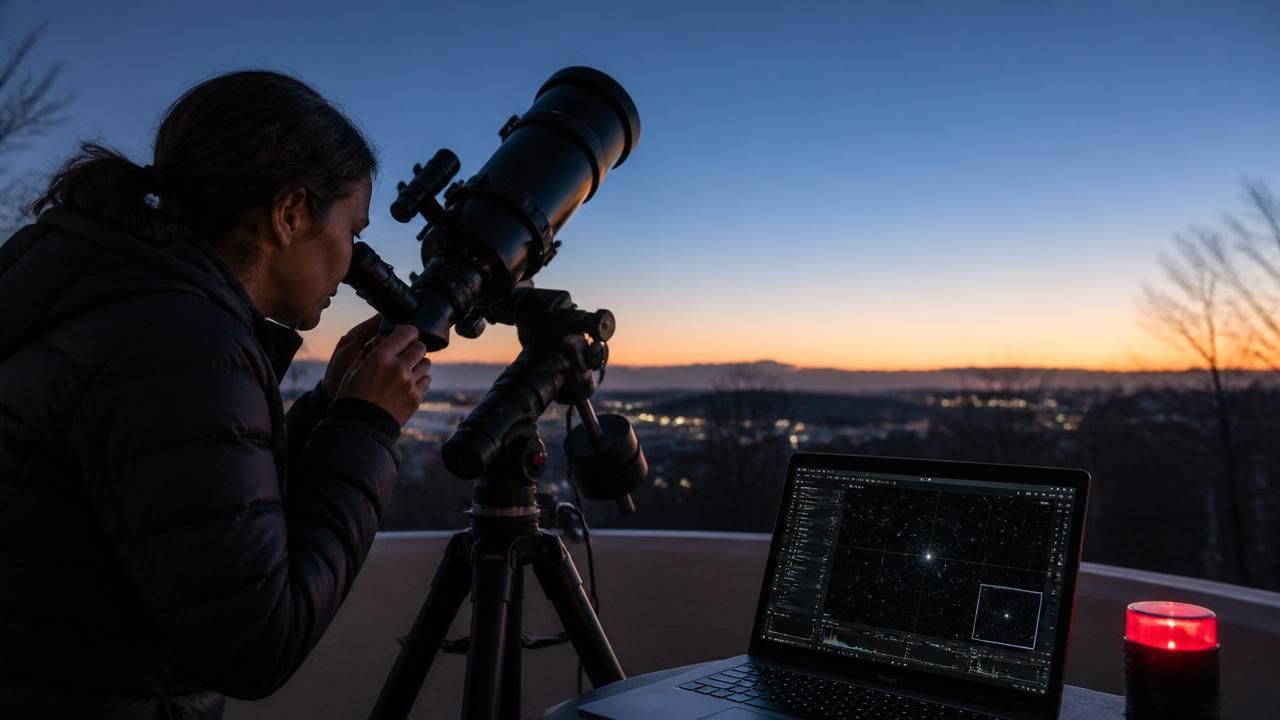
Kilonova Catcher aims to solve that bandwidth problem by distributing the work. When gravitational-wave detectors or space telescopes issue an alert, volunteers point their own telescopes — or instruments they have access to — at the suspected location and help find and follow the fading light. The network also responds to gamma-ray bursts, the most powerful explosions known, and seizes other opportunities to catch short-lived cosmic events when they arise.
According to NASA, the network now has more than 150 registered members across several continents. Volunteers work side by side with professional astronomers and observatories, and they have already contributed to more than 64 official reports shared through NASA's General Coordinates Network (GCN), the real-time system scientists use to circulate discoveries.
- Who: Amateur astronomers with telescope-and-camera setups, working with professional observatories and NASA.
- What: Rapid follow-up of kilonovae, gamma-ray bursts and other transient events.
- How: Alerts from gravitational-wave detectors and space telescopes trigger volunteer observations, which feed into GCN reports.
- Why it matters: Kilonovae fade in days; sky coverage and telescope time are scarce.
NASA frames the project primarily as citizen science: a way to plug hobbyists into the machinery of multi-messenger astronomy and give them a role in the discovery chain rather than a seat on the sidelines. The agency's overview emphasizes accessibility — participants need only a telescope with a camera, or access to one — and the chance to collaborate directly with professional researchers.
The superkilonova question
The reports relayed through MSN take a different angle. Headlines describing an "explosion inside an explosion" suggest observers may have identified a nested or sequential event, where one energetic outburst is detected within the envelope of another. Such a finding, if confirmed, could point to a distinct and rarer class of merger — the superkilonova — involving more extreme masses, different remnant outcomes, or a longer-lived central engine than the standard kilonova model predicts.
Details in those reports remain thin, and the framing differs sharply by outlet: NASA's material is procedural and participatory, explaining how volunteers can join and what the network has accomplished; the MSN dispatches are discovery-driven, leading with novelty and rarity. Both perspectives, however, converge on the same underlying science — that merging compact objects produce observable, information-rich transients that reward fast, widespread follow-up.
Historical anchor
The modern kilonova era began in August 2017, when gravitational-wave detectors and telescopes worldwide jointly observed a neutron-star merger in the galaxy NGC 4993. That event, GW170817, produced the first unambiguous kilonova and provided the strongest evidence yet that such mergers synthesize heavy elements via the rapid neutron-capture process. It also demonstrated the power of combining gravitational-wave alerts with electromagnetic follow-up — the exact workflow Kilonova Catcher is built around.
Why amateur telescopes matter
Small telescopes are not a stopgap; they are a genuine asset in time-domain astronomy. Networks of modest instruments can cover large swaths of sky quickly, monitor a fading target for weeks, and catch brightness variations that larger facilities, competing for limited nights, cannot continuously track. The trade-off is coordination: alerts must be fast, positions precise, and data standardized so that volunteer measurements are useful to professionals.
The GCN report count is the clearest evidence that this coordination is working. By routing volunteer observations into the same infrastructure professionals use, the project turns scattered backyard observations into citable contributions — and gives amateurs a measurable stake in the science.
What to watch
Two questions will shape the next phase. First, whether the reported superkilonova survives scrutiny — independent follow-up, detailed light-curve analysis and peer review will determine whether it represents a truly new class of event or an unusual instance of a known one. Second, whether the citizen-science model can scale. A network of 150 observers can do what a single observatory cannot, but a sky full of rapid transients will demand more instruments, better automation and tighter coordination between amateurs and major facilities.
For now, NASA's message is simple: if you have a telescope and a camera, you can help catch cosmic fireworks. And if the superkilonova reports hold up, the volunteers chasing fading glows may soon be hunting something even stranger.