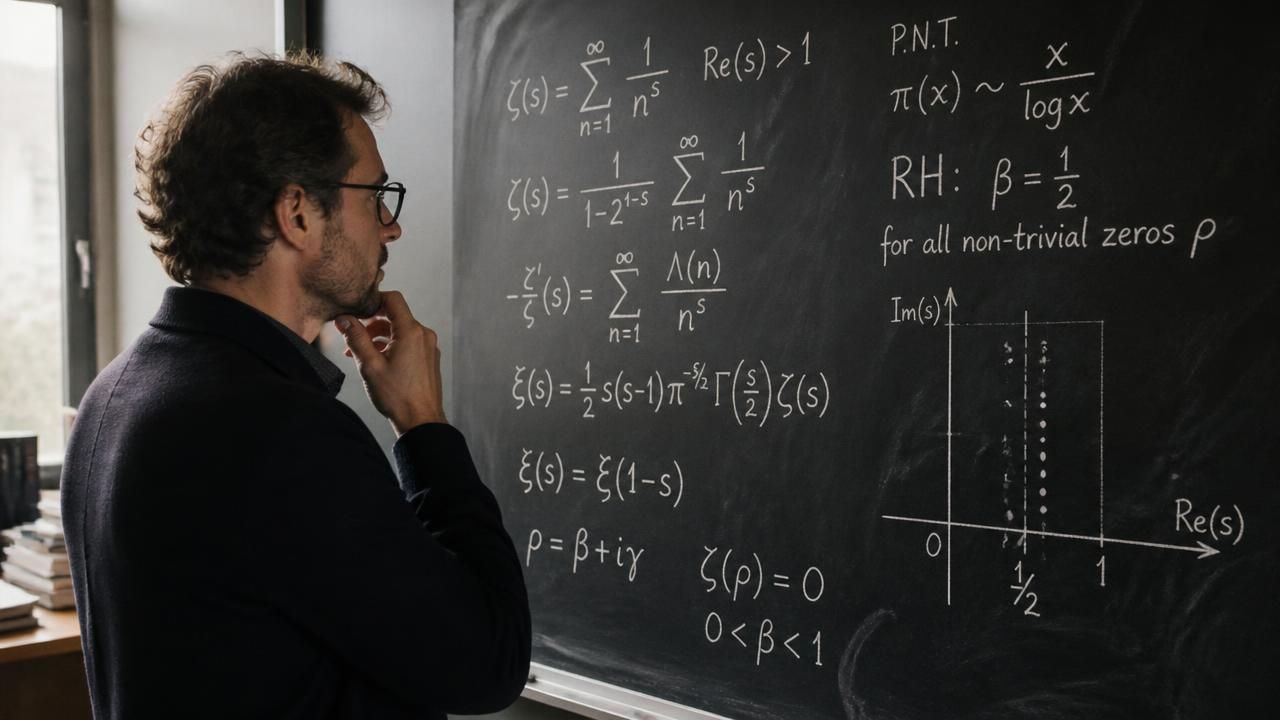
For 167 years, the Riemann hypothesis has stood as pure mathematics' most celebrated unsolved problem — a deceptively simple statement about the distribution of prime numbers that has resisted every assault since Bernhard Riemann formulated it in the mid-1800s. Last week, it appeared to fall twice in a single day.
On one side stands a mathematician at Anthropic who says the company's Claude model helped produce a proof, a document reportedly running to some 17 million lines. On the other: a proof billed as “all human, no AI,” published the same day, according to The Hindu. The coincidence has turned a technical milestone into something closer to public spectacle — a human-versus-machine showdown staged, remarkably, on the day Anthropic rang the Nasdaq bell.
A problem about primes
The hypothesis concerns the Riemann zeta function and, through it, the rhythm in which prime numbers appear along the number line. As Ars Technica notes, there is no simple way to state the hypothesis itself, but its consequences ripple outward from number theory into cryptography and beyond. Wikipedia's assessment, quoted by Ars, is blunt: “It is considered by pure mathematicians to be one of the most important problems in the field.”
That stature is why the news landed so hard. New Scientist described mathematicians as “amazed” by a “holy grail” proof; Nature reported them “astounded” by the twin AI and human-written results. Ars Technica, more soberly, observed that the episode follows several other major breakthroughs either enabled by or managed entirely by large language model-based systems — a development that has left the field “in a state of upset.”
Two claims, one day
The timing was hard to ignore. Anthropic, the AI lab behind Claude, was marking a corporate milestone — ringing the Nasdaq bell, as India Today and KuCoin both noted — when its mathematician went public with the claim that Claude had assisted in proving the hypothesis. Coverage of the announcement quickly fixated on scale: Smithsonian Magazine reported the proof at 17 million lines, while Newsbytes recorded the mathematician joking that the document ran to 250,000 pages.
Within hours, the human counterclaim appeared. The Hindu framed it as an “all human, no AI” proof released on the same day as Claude's claim, and MSN's coverage leaned into the drama, describing “dueling claims” and a “race” that had become a human-versus-AI showdown.
The juxtaposition raises an uncomfortable question for the field: if a machine-assisted proof and a purely human one arrive simultaneously, which one carries authority — and who is equipped to adjudicate?
The Tao prediction, overturned
Perhaps the most striking context comes from timing. Only a month before the announcements, the mathematician Terence Tao had said that AI could solve the Riemann hypothesis only by around 2050, according to OfficeChai. Whether or not either new proof survives scrutiny, the apparent gap between that forecast and this news captures how quickly expectations inside mathematics have shifted.
Ars Technica cautions that it is far too early to say much about the proofs themselves; mathematicians are still in the process of digesting them. That caveat matters. A 17-million-line argument is not something a referee can read in an afternoon, and the discipline's verification machinery — peer review, seminars, proof assistants — was not built for artifacts of that size.
What it does not break
One early fear appears overstated. A proof of the Riemann hypothesis would sharpen understanding of prime distribution, but it would not, by itself, shatter modern encryption. Both Scientific American and Yahoo published explainers under nearly identical headlines making the point: solving the hypothesis won't break encryption. The result is foundational rather than an immediate cryptographic break.
The field after the proof
Nature's framing of the broader moment is the starkest of the coverage:
AI is “the end of mathematics as we know it” — where does the field go next?
That question now hangs over several unresolved issues:
- Verification. Neither proof has been formally validated; the mathematical community is only beginning its review.
- Attribution. If a model generated millions of lines, what does authorship mean for the mathematician who directed it?
- Trust. Proof assistants can check machine-generated arguments, but only if the arguments are formalized — a monumental task at this scale.
- Culture. The “human versus AI” framing may prove less important than the collaboration it obscures.
Ars Technica's read is that the field is unsettled not because a single problem fell, but because the method of falling has changed. Mathematics has absorbed computer-assisted proofs before — the four-color theorem in 1976, the Kepler conjecture in the 1990s — each time provoking arguments about elegance and legitimacy that eventually faded. What is different now is the sheer volume and the speed.
For the moment, the honest summary is the one Ars offers: too early to say. Two proofs, one historic problem, and a discipline still digesting. Whether the Riemann hypothesis has truly been cracked — by a machine, by a human, or by the strange partnership between them — will be settled not by press releases but by the slow, unglamorous work of checking 17 million lines.