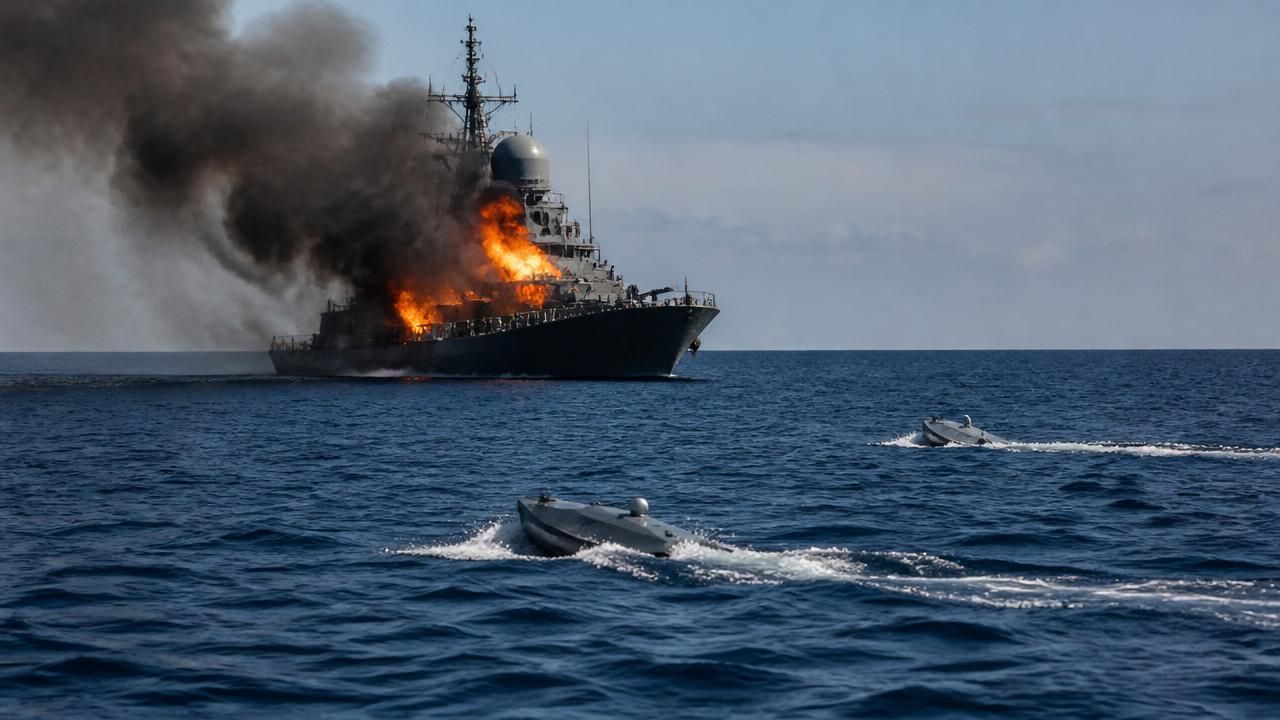
Ukraine said its naval drones struck and sank a Russian warship and damaged a second, sanctioned cargo vessel off the coast of Libya, an operation President Volodymyr Zelenskyy described as “exemplary” and one that carries the war far beyond the Black Sea. The claim, announced by Ukraine’s security services and amplified by Zelenskyy, marks the first known Ukrainian strike on Russian naval assets in the central Mediterranean and immediately raised questions about Moscow’s logistics, Libya’s sovereignty and the geographic limits Kyiv is now willing to test.
Video distributed by Ukraine’s SBU security service and carried by outlets including Reuters, Bloomberg, The Guardian, CBS News, DW and The New York Times showed drones closing on the vessels. Russia’s defense ministry did not immediately comment, and the claims could not be independently verified.
What Ukraine says happened
According to Ukrainian accounts, multiple sea drones attacked the Russian warship Merkury — described in Kyiv’s statements as a corvette — and a second vessel that has been subject to international sanctions, off the coast of eastern Libya. Ukrainian officials said the warship was sunk and the cargo vessel damaged. Several reports placed the attack near the Libyan port of Benghazi, a stronghold of eastern commander Khalifa Haftar.
Zelenskyy framed the operation as a direct answer to Russia’s invasion, saying Kyiv had demonstrated it could reach Russian military assets wherever they operate.
“An exemplary operation” — President Volodymyr Zelenskyy, describing the drone strike on Russian vessels off Libya as a response to Moscow’s war.
Ukrainian outlets and international wires diverged only slightly in their descriptions: some called the Merkury a warship, others a corvette; some emphasized a naval base, others a commercial port. What is consistent across coverage is the core claim — two Russian-linked vessels hit by Ukrainian naval drones in the Mediterranean, far from the Black Sea theater where Kyiv has waged its most celebrated maritime campaign.
Why Libya matters to Moscow
The location is the story. Russia’s Mediterranean posture was built around its naval facility at Tartus and its air base at Hmeimim in Syria. The collapse of Bashar al-Assad’s government in December 2024 upended that arrangement, forcing Moscow to evacuate or redeploy assets and search for alternative footholds along the southern Mediterranean littoral.
Eastern Libya, run by Haftar’s Libyan National Army and long cultivated by Moscow, has emerged as the most plausible substitute. Russian naval visits to Tobruk and Benghazi, expanding military ties and the movement of equipment and personnel have all been tracked by Western officials and open-source analysts. Eurasia-based defense publications, including the Eurasian Times, have argued the Benghazi strike is less about a single hull than about severing Russia’s naval logistics chain beyond the Black Sea — the supply spine that sustains its Mediterranean squadron and its Africa Corps presence.
If Ukraine can credibly threaten that spine, the strategic cost to Moscow compounds: reinforcement, repair and resupply routes that once looked safe now require escorts, dispersal and new basing assumptions.
The weapons and the reach
Ukraine’s naval drone campaign is well documented. Magura V5 and Sea Baby platforms have been used to sink or damage Russian vessels including the cruiser Moskva early in the war, the patrol ship Sergei Kotov and numerous landing craft and tankers around Crimea and Novorossiysk. What is new is range. Striking off Libya requires either a dramatically extended drone capability or clandestine launch from a third-party coastline or a mother ship — options Ukrainian officials have not detailed.
The ambiguity is itself part of the message. Kyiv benefits from Moscow’s uncertainty about where such launches could occur next, whether in the Mediterranean, the Red Sea or along Africa’s Atlantic seaboard, where Ukrainian special forces have reportedly operated against Russian-linked targets.
How the story is being framed
Coverage splits along familiar lines. Anglo-American outlets — Reuters, Bloomberg, The Guardian, The New York Times, CBS — led on escalation, stressing that the conflict has “spread beyond Europe” and confirming the use of naval drones. Ukrainian and diaspora-facing outlets foregrounded Zelenskyy’s “exemplary operation” framing, presenting the strike as evidence of growing reach and ingenuity.
Arab and Gulf media, including Egypt’s Ahram and Saudi Gazette, emphasized that Moscow is weighing a response, treating Libya as a newly live arena rather than a backdrop. Asian outlets such as The Japan Times and the Indian Express kept the focus on the mechanics — sea drones, a sunk warship — while Australian tabloids leaned into the drama of a “new Russian warship” going down.
The strike also raises uncomfortable questions about Libyan sovereignty. The internationally recognized Government of National Unity in Tripoli has repeatedly objected to foreign military activity on Libyan soil and water, and the United Nations arms embargo has been widely violated by multiple outside powers. A Ukrainian attack inside what Libya considers its maritime domain — however welcome in Western capitals — complicates that diplomatic line.
Markets, sanctions and the shadow fleet
For financial markets, the immediate channel is shipping risk. War-risk insurance premiums in the Black Sea remain elevated; a demonstrated ability to strike sanctioned vessels in the Mediterranean could push underwriters to reprice routes that have so far been treated as low-risk. That matters for Russia’s so-called shadow fleet, the aging tanker and cargo network Moscow uses to move oil and military materiel around sanctions.
The damaged vessel’s sanctioned status is significant: it suggests the target set was chosen not just for military value but to disrupt sanctions evasion and the logistics of Russia’s African operations. Traders and analysts will now be watching whether insurers, flag registries and port authorities in the Mediterranean tighten scrutiny of Russian-linked shipping, and whether grain and energy flows through the region’s chokepoints see any premium.
What to watch
- Moscow’s response: retaliation against Ukrainian ports, energy infrastructure or Western interests, and whether the Kremlin confirms any losses.
- Independent verification: satellite imagery of the Merkury and the damaged cargo ship, and confirmation of their identities and cargoes.
- Haftar’s reaction and whether Russia accelerates or pauses its Libyan basing plans.
- Reaction from Tripoli and the UN, amid an already battered arms embargo.
- Insurance and shipping data for the central Mediterranean over the coming weeks.
For now, the strike stands as one of Ukraine’s most audacious maritime operations of the war — a demonstration that the conflict’s geography is no longer confined to the Black Sea, and that Kyiv intends to make Russia’s search for warm-water footholds as expensive as possible.