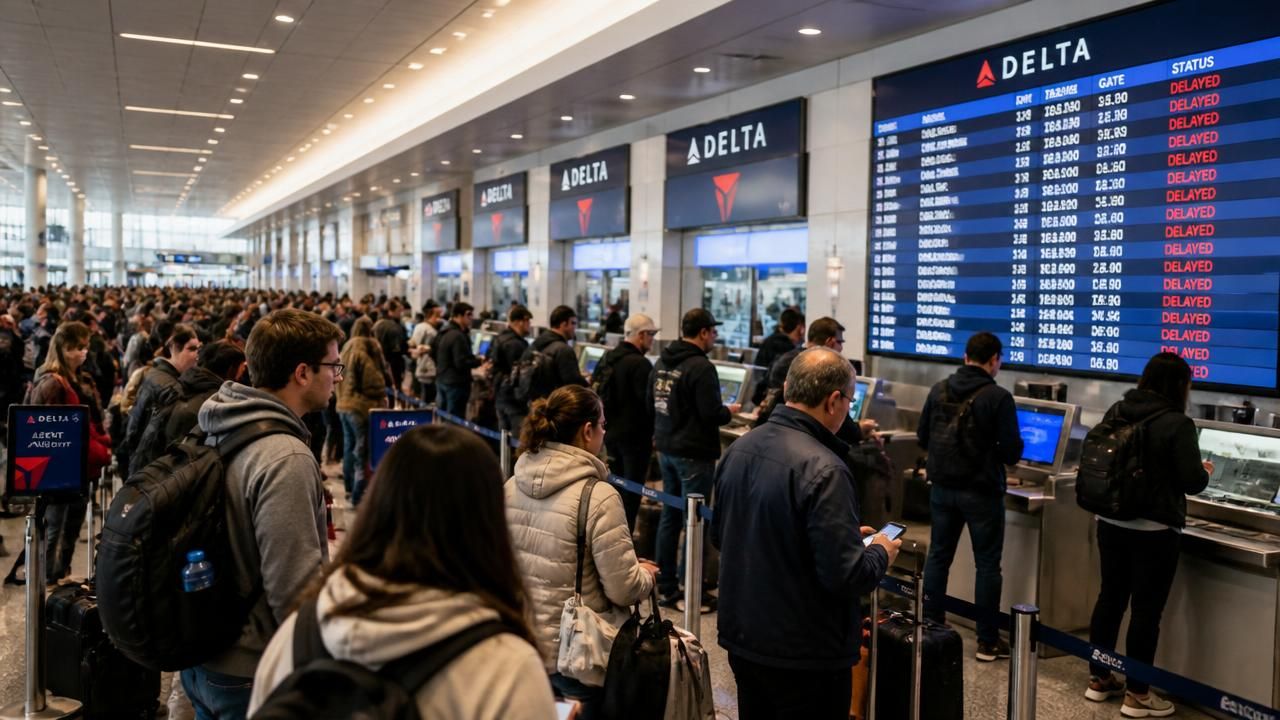
Delta Air Lines suffered a sweeping automation failure on Sunday that left more than half of its scheduled flights delayed, stranding and rebooking passengers at the start of one of the busiest travel weeks of the year. The disruption centered on Hartsfield-Jackson Atlanta International Airport — Delta's largest hub and the busiest airport in the world — but ripple effects quickly spread to airports across the country.
The culprit was not a cyberattack, a weather system, or a staffing shortfall, but a piece of back-office software that most passengers never think about: the automated system that calculates an aircraft's weight and balance before departure.
What went wrong
Every commercial flight requires dispatchers and load planners to compute exactly how much the aircraft weighs and where that weight sits — passengers, bags, cargo, fuel. The figures determine engine thrust settings, runway speeds, and how cargo is distributed in the hold. Regulators require the calculation to be completed and signed off before a plane can push back from the gate.
When Delta's automation for that task went offline Sunday morning, the airline could no longer process load data at normal speed. The Federal Aviation Administration issued a ground delay for flights inbound and outbound from Atlanta, effectively throttling the hub's throughput while Delta worked the problem.
The airline shifted to what one report described as a "manual workaround" — dispatchers and load agents computing figures by hand, a slower, more labor-intensive process that sharply limits how many aircraft can be turned at once. Delta later confirmed the underlying system issue had been resolved and that operations were recovering, though residual delays persisted into the evening as aircraft and crews fell out of position.
Delta said the system issue affecting weight-and-balance calculations "has been resolved," crediting teams that worked through the day to restore normal processing and clear the backlog.
How big was the disruption?
Estimates varied by outlet and by the hour the count was taken, and the divergence itself illustrates how quickly the picture shifted:
- The Boston Herald and other outlets reported that more than half of all Delta flights were hit by delays on Sunday.
- Several trackers put the tally at over 1,100 delayed flights by mid-afternoon.
- By evening, silive.com and other outlets reported more than 1,300 flights delayed, while one aggregation cited figures approaching 2,000.
- The Verge noted that while only Delta was directly impacted, congestion at Hartsfield-Jackson could spill over to other carriers if delays continued to accumulate.
Notably, the episode produced delays rather than mass cancellations — a meaningful distinction. Cancellations cascade for days as crews time out and aircraft end up in the wrong cities. Delays, painful as they are, are easier to absorb.
The timing could hardly be worse
The failure landed as the Thanksgiving travel period was ramping up, traditionally the year's heaviest stretch for U.S. airlines. The New York Times framed the story around that collision — holiday volume meeting a carrier-specific technical breakdown — while the Financial Times positioned it as part of a broader set of "concerns about US air travel system" reliability. Trade and regional outlets, including the Detroit News, the Milwaukee Journal Sentinel and masslive.com, localized the story for readers whose own flights were affected.
For Delta, the operational math is unforgiving: Atlanta is not just a hub but the hinge of its domestic network. When the airport slows, connecting traffic across the eastern half of the country slows with it.
One week, two system failures
The Delta incident came barely a week after a separate and far larger breakdown: an FAA system outage that triggered a nationwide ground stop and thousands of cancellations. In that episode, Transportation Secretary Sean Duffy blamed contractor L3Harris, and officials said there was no indication of a cyberattack.
Two unrelated failures in quick succession — one at a regulator, one at a private carrier — point to a shared vulnerability. Much of the architecture underpinning U.S. aviation is decades old and heavily interdependent, and carriers have spent years consolidating load planning, crew scheduling and dispatch onto centralized software platforms to save costs and speed up turnarounds. That efficiency carries a single point of failure.
"The system that went offline" — the automated weight-and-balance calculator — is one of dozens of invisible dependencies that must all work for a single flight to depart on time.
What it means for travelers
Delta advised customers to check flight status before heading to the airport and to use its app for rebooking. Under U.S. Department of Transportation rules, passengers whose flights are significantly delayed or canceled for airline-caused reasons are generally entitled to a refund if they choose not to travel, and Delta has historically offered waivers in the Atlanta market during large disruptions.
The larger question is structural. Aviation analysts have repeatedly warned that legacy carriers and regulators alike are running critical functions on systems that predate the smartphone era, with redundancy plans that often boil down to manual fallbacks. Those workarounds held on Sunday. Whether they hold through the holiday crush — and through the next unplanned outage — is the question now hanging over the busiest week of the year.