Two developments in laser science — one anchored in the Arctic permafrost, the other unfolding inside a few centimetres of ionized gas — illustrate how far photonics has travelled since researchers first bounced a pulse of light off a satellite more than six decades ago.
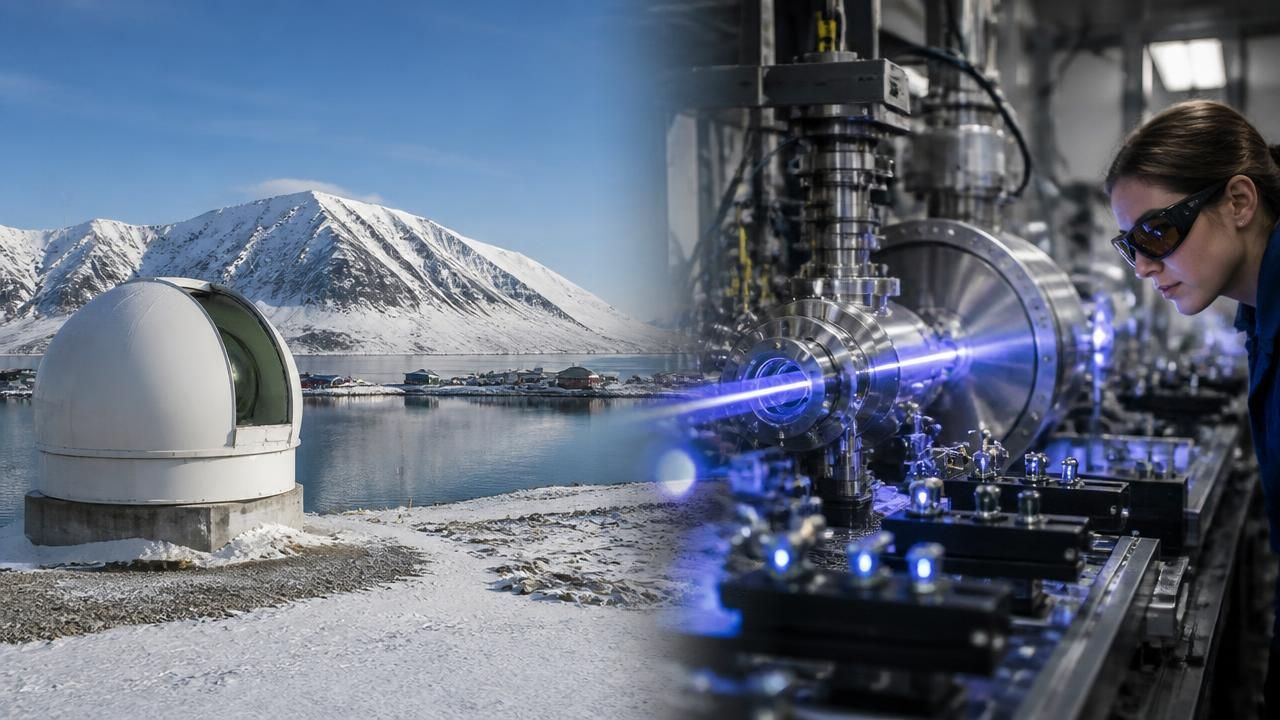
NASA's Earth Observatory this week highlighted the Ny-Ålesund Geodetic Observatory, a satellite laser ranging (SLR) station on the west coast of Spitsbergen, the largest island in Norway's Svalbard archipelago. The agency published an image of the site acquired by the Operational Land Imager on Landsat 9 on July 30, 2026.
The Ny-Ålesund Geodetic Observatory is located on the west coast of Spitsbergen, an island in Norway's Svalbard archipelago.
A technique born at Goddard
Satellite laser ranging works on a deceptively simple principle. A station fires a short pulse of laser light at a satellite carrying special retroreflectors; by timing the round trip to within picoseconds, operators can determine the spacecraft's distance to within a few millimetres.
NASA traces the method to its own laboratories. More than 60 years ago, scientists at the agency's Goddard Space Flight Center aimed a laser skyward at an orbiting satellite fitted with reflectors and, by measuring the return time, demonstrated a new and more precise way to track spacecraft.
The work was pioneered at the Goddard Optical Research Facility, now known as the Goddard Geophysical and Astronomical Observatory. According to NASA, laser ranging is now performed at more than 40 stations worldwide, and the technique underpins much of modern Earth observation — validating satellite orbits, mapping subtle changes to Earth's surface, and contributing to measurements of tectonic motion, sea-level rise and the planet's gravity field.
In 2026, NASA says, the next generation of the technology is arriving. The choice of Ny-Ålesund is not incidental. At 79 degrees north, the station sits beneath the convergence of many polar-orbiting satellites, giving it an unusually dense stream of targets. The Arctic location also places the instrument in a region where the cryosphere is changing fastest — a vantage point where millimetre-level geodesy has direct consequences for climate monitoring.
'Flying focus' and the accelerator problem
If laser ranging represents the mature face of photonics, a second line of research reported by Phys.org represents its frontier. Researchers describe a so-called "flying focus" laser that overcomes a key limitation in plasma-based particle accelerators.
In these devices, an intense laser pulse is fired into a plasma, excavating a wake of charge that can accelerate electrons to high energies over distances of centimetres rather than the hundreds of metres required by conventional radiofrequency machines. The promise is a tabletop accelerator; the obstacle is that electrons quickly outrun the accelerating wave, a phenomenon known as dephasing, which caps the energy gain.
The flying focus approach addresses this by decoupling the laser's focal point from the pulse's propagation. By moving the focus through the plasma at the same speed as the accelerated electrons, the accelerating structure can be sustained over far longer distances — in principle allowing the machine to keep pushing particles to higher energies instead of stalling.
Why the two stories belong together
Both advances rest on the same underlying capability: precise, programmable control of light in space and time. The Svalbard station depends on ultrashort pulses timed to picoseconds; the flying focus depends on pulses whose focal geometry is sculpted mid-flight. As lasers have become more stable, more powerful and more controllable, they have migrated from specialized optics benches into geophysics, medicine, manufacturing and, increasingly, the search for cheaper routes to high-energy physics.
The economic argument matters. Plasma wakefield acceleration is one of several approaches competing to shrink the cost and footprint of particle accelerators, a field dominated by machines such as CERN's Large Hadron Collider, whose 27-kilometre ring represents billions of euros of civil engineering.
Elsewhere in the science cycle
Laser work was not the only science story moving through the news cycle. Wikinews published interviews with archaeologist Dr Naomi Martisius on her findings about Neanderthal behaviour — research arguing that Neanderthals were deliberate, knowledgeable toolmakers rather than the reflexive brutes of popular imagination — and with Dr Michael Mazilu of the University of St Andrews on creating the world's fastest spinning manmade object, work that also relies on tightly focused light to trap and rotate microscopic particles.
The same outlet reported that a "bright" idea had won a NASA contest, another reminder that the agency's portfolio spans both deep-space engineering and speculative public competitions. Separately, an interview with the author Augusten Burroughs, on addiction and his new book, rounded out the outlet's output — a reminder that the wires carry many threads at once.
What to watch
- Commissioning at Ny-Ålesund: Whether the next-generation station meets its millimetre-level targets in Arctic weather, where snow, ice and atmospheric turbulence complicate ranging.
- Scaling the flying focus: Whether the technique can be demonstrated at energies relevant to real experiments rather than proof-of-concept gains.
- Data continuity: SLR is a long-running series; gaps in the record degrade models of sea-level and plate motion.
The through-line is measurement. Whether the target is a satellite 800 kilometres overhead or an electron bunch a few micrometres wide, the ambition is the same — to move light with enough precision that the universe's small print becomes legible.