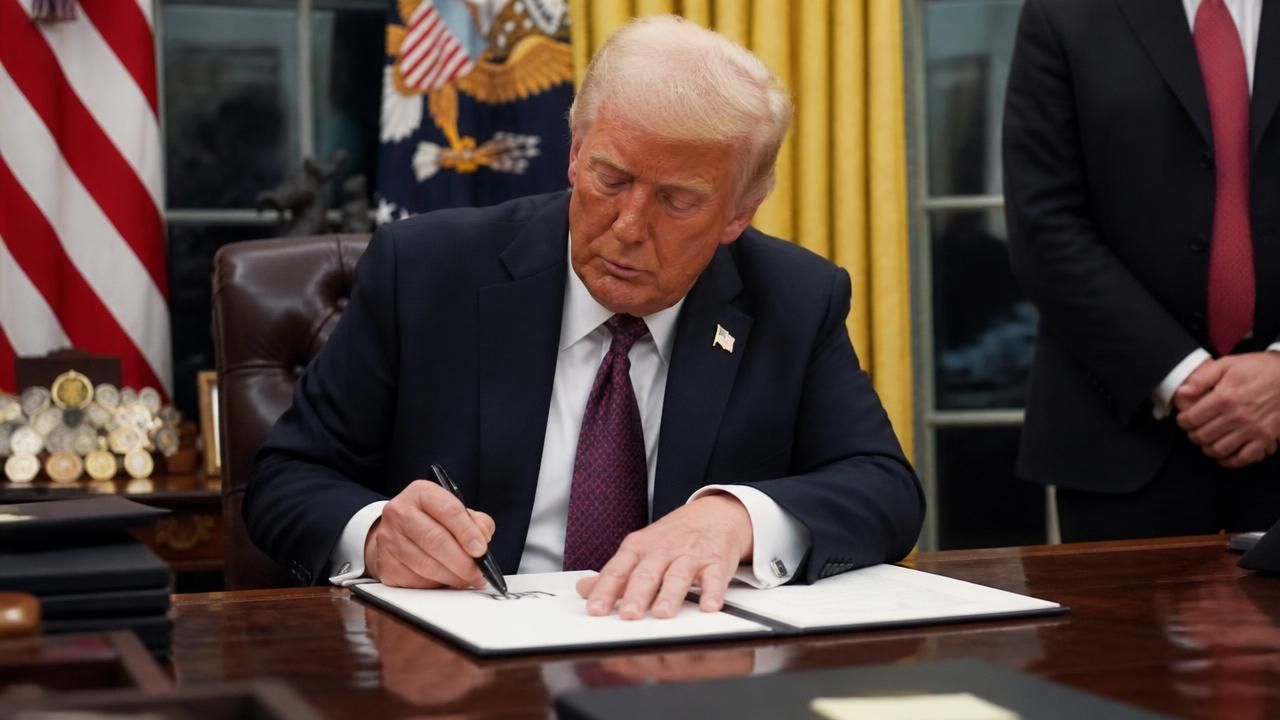
President Donald Trump signed an executive order directing companies that hold federal contracts to check with the White House before responding to inquiries from Congress, and to withhold any communications his administration considers privileged. The directive, reported simultaneously by NPR, CBS News, The Guardian, UPI, Yahoo News, MSN and The Globe and Mail, marks one of the most direct attempts by a modern president to insert the executive branch between lawmakers and the private firms that do business with the federal government.
Under the order, contractors would be required to notify the administration when members of Congress or their committees seek information, and to defer to the White House on whether and how to answer. Material the executive branch classifies as privileged would not be released to Capitol Hill without approval — effectively extending the president's assertion of executive privilege beyond his own agencies and into the corporate entities that contract with the government.
A Direct Challenge to Congressional Oversight
The practical effect, critics argue, is to convert thousands of federal contractors into an extension of the executive branch's communications apparatus. Congressional committees routinely rely on contractor testimony and documents to examine everything from defense procurement and intelligence programs to pandemic response, disaster relief and immigration enforcement. If contractors must first clear their answers with the White House, those investigations could be slowed, narrowed or blocked outright.
"This is a president telling private companies that they answer to him before they answer to the people's representatives," one Democratic oversight aide said, describing the order as an unprecedented constraint on legislative authority.
Legal scholars have pointed to the long-standing tension between executive privilege — a doctrine rooted in the separation of powers and the need for candid internal advice — and Congress's constitutional power to investigate and legislate. Privilege has traditionally applied to deliberations inside the executive branch, not to the records of private firms. Extending the concept to contractors raises novel questions about whether a company can be compelled to assert a privilege it does not itself hold.
How Different Outlets Framed It
Coverage varied in emphasis. NPR and CBS News framed the order as a procedural directive — contractors must "check with" the White House before responding to Congress — stressing the notification requirement. The Guardian and The Globe and Mail cast it more sharply as an assertion of presidential control, with the Globe describing an order that tells U.S. contractors to seek approval before communicating with lawmakers at all. UPI's headline went furthest, declaring that Trump had effectively barred contractors from speaking to Congress without approval. MSN's coverage emphasized the political dimension, describing an order that "pulls federal contractors into [the] fight over Congress requests" — a framing that situates the move within a broader confrontation between the White House and Democratic-led committees.
The divergence is partly technical: the order's text appears to require notification and consultation in some provisions and withholding of privileged material in others. Whether that amounts to a consultation requirement or an outright gag depends on how aggressively the administration enforces it — and on how contractors, many of whom depend on federal revenue for a large share of their business, choose to interpret the risk.
Why Contractors Are Vulnerable
Federal contractors occupy an unusually exposed position. Companies that derive significant revenue from government work must weigh compliance with congressional subpoenas against the threat of losing contracts, debarment or retaliatory action from the agency that funds them. Industry groups have privately warned that the order could create an impossible set of obligations: a company that declines to answer a committee's request risks contempt, while one that answers without White House sign-off risks retaliation from the administration.
Watchdog organizations note that contractors have historically been a critical source of independent information about federal programs, precisely because they are not subject to the same message discipline as agency employees. Whistleblower protections for contractor employees — already uneven — could become harder to exercise if firms are required to route internal concerns through the White House first.
A Broader Pattern of Aggressive Executive Action
The contractor order lands amid a flurry of related administration moves. MSN also reported that the administration has warned 1,579 contractors over E-Verify compliance, signaling a willingness to use the federal contracting pipeline as a lever for policy enforcement. Separately, questions have swirled around the tenure of Homeland Security Secretary Markwayne Mullin, and the White House has faced a fact-checking battle over who bears responsibility for a disruption to air travel — with both parties trading blame over the freeze.
Taken together, the items sketch an administration comfortable with testing the boundaries of executive power and with using the government's purchasing power as an instrument of political pressure. For Congress, the contractor order may prove the most consequential of the group, because it targets the information supply on which oversight depends.
What Comes Next
- Legal challenges: Democratic committee chairs are expected to explore litigation and to consider subpoenas that test whether contractors can invoke a privilege asserted by the White House.
- Contractor pushback: Industry associations may seek clarification on what counts as a "congressional inquiry" and whether routine communications with staff are covered.
- Legislative response: Lawmakers could attach language to appropriations bills restricting the administration's ability to condition contracts on communications approval.
- Enforcement ambiguity: The order's real reach will depend on how agencies write implementing guidance over the coming weeks.
For now, the order stands as a notable expansion of presidential authority over the private sector's dealings with the legislative branch — and as the latest front in a long-running struggle over who controls the information the government generates and pays for.