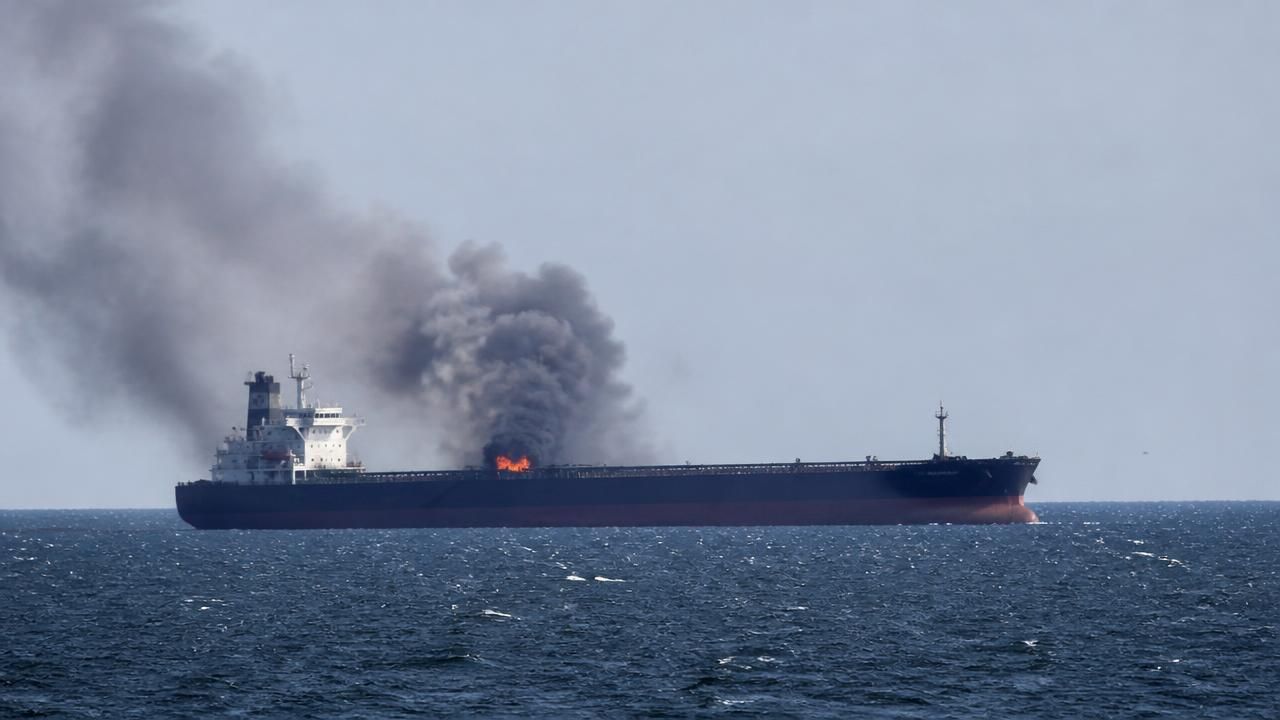
A Russia-bound cargo vessel was struck by drones in international waters in the Gulf of Finland while traveling to the Kaliningrad exclave, according to Russian authorities, in an attack that Finland says it detected and that has prompted tighter security around one of Europe’s most sensitive maritime corridors. Reports from Finnish, Russian, Ukrainian and international outlets described a vessel catching fire and drifting toward Finnish waters after the strike, although accounts differed on the ship’s cargo, the attackers and the severity of the damage.
The ship was headed for Kaliningrad, the Russian territory sandwiched between Poland and Lithuania on the Baltic coast. The Gulf of Finland is bordered by Finland, Estonia and Russia and has become a front line of sorts since Finland joined NATO in 2023, turning much of the Baltic into a NATO lake and sharply increasing the alliance’s surveillance of Russian shipping and military movements.
What happened
Russia’s government said the cargo ship was targeted in international waters, according to Bloomberg Markets and The Moscow Times. Finland said it detected the drone attack, and Finnish authorities tightened security in response, according to MSN, Yahoo and The Brussels Times. Several outlets reported that the vessel caught fire and began drifting toward Finnish waters. Some tabloid and specialist outlets described it as a ship linked to Russia’s defense ministry or one carrying military supplies, but those claims were not independently confirmed in the immediate reporting and should be treated with caution.
Finland also said a Russian helicopter may have breached its airspace hours after the drone hit, according to reports carried by MSN. The alleged airspace violation, if confirmed, would add a second security flashpoint at a moment when NATO members are already monitoring Russian naval and air activity in the Baltic with heightened vigilance.
Competing accounts
The public framing of the incident varied sharply by outlet. Russian state and Moscow-based media emphasized that a Russian cargo vessel had been attacked, casting the ship as a civilian target in international waters. Finnish and Baltic outlets focused on the security response, the ship’s drift toward Finnish waters and the possible airspace breach. Ukrainian outlets described the strike as the work of Ukrainian drones, while Sky News reported that the strike was “likely carried out by Kyiv.” None of those attributions was immediately confirmed by Ukrainian officials in the material reviewed.
The cargo question is equally contested. Some outlets described the vessel as carrying military or war supplies; others linked it to Russia’s defense ministry; still others treated it simply as a Kaliningrad-bound cargo ship. Such distinctions matter because they shape how the attack is classified under international law and how shipping insurers, NATO navies and Baltic governments assess risk. A strike on a purely commercial vessel in international waters would raise one set of legal and market questions; an attack on a military-linked shipment would raise another.
Why the Baltic matters
For markets, the incident is a reminder that the Baltic Sea is not just a NATO security space but a critical artery for Russian trade. Bloomberg Markets framed the attack as evidence of growing risks to Russia’s energy and food exports through Baltic shipping routes. Even before this strike, war-risk premiums, rerouting costs and surveillance burdens had been rising for vessels moving through the region. Kaliningrad-bound traffic is especially sensitive because the exclave depends on sea and land links to mainland Russia, and any disruption can quickly become a political and logistical issue for Moscow.
The economic stakes extend beyond Russia. Finland, Estonia, Poland and Lithuania are all NATO and EU members with major ports and energy infrastructure along the Baltic. Insurance markets watch attacks on shipping closely because a single confirmed drone strike can push up premiums across a route, especially when the attacker’s identity and intent remain unclear. Commodity traders also monitor whether such incidents become a pattern rather than a one-off, since repeated attacks could force rerouting, delay grain and fertilizer shipments, and complicate compliance for Western shipowners and insurers.
A wider escalation
The maritime attack came amid a broader surge in violence. Separately, a Russian ballistic missile attack on Ukrainian President Volodymyr Zelensky’s hometown in central Ukraine killed two people and wounded scores, with reports putting the injured at around 60, according to The New York Post and The Inquirer. The juxtaposition underscored how the war is increasingly being fought across multiple fronts: in Ukraine’s cities, in the Black Sea, and now in the Baltic’s northern reaches.
The Gulf of Finland strike also fits a pattern of drone warfare spreading to new theaters. Ukraine has used sea and air drones to challenge Russia’s Black Sea Fleet and to strike targets deep inside Russian-held territory. Extending that campaign to the Baltic would represent a significant strategic and symbolic shift, bringing the war closer to Finland and the Baltic states and testing NATO’s ability to distinguish between commercial traffic and military-linked vessels.
What comes next
Finnish authorities are likely to face pressure to explain what they detected, when they detected it and whether the vessel was escorted or monitored as it drifted toward Finnish waters. NATO allies will also be watching whether the reported helicopter airspace violation was accidental, a probing action or a signal tied to the ship attack. Russia, for its part, has an interest in portraying the strike as an attack on civilian shipping, while Ukraine and its supporters have an interest in demonstrating that Russia’s logistics and export routes are vulnerable.
The immediate financial question is whether insurers and shipowners treat the Gulf of Finland incident as an isolated event or as the start of a new risk zone. The broader strategic question is whether the Baltic, already transformed by Finland’s NATO accession, is becoming another active front in the war. For now, the only points all sides appear to agree on are that a Russia-bound cargo ship was hit by drones in the Gulf of Finland, that Finland responded with tighter security, and that the incident has made an already fragile maritime corridor even more uncertain.