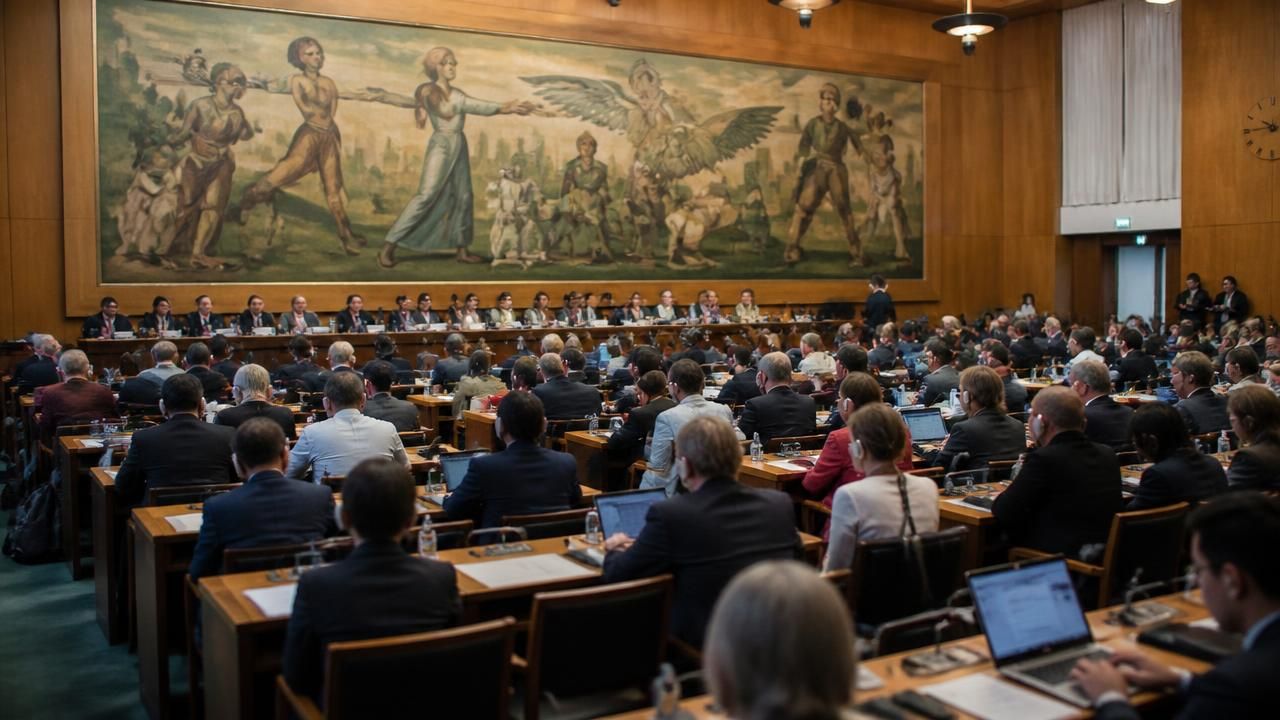
Two years of diplomacy over the future of artificial intelligence on the battlefield ended over the weekend in Geneva with a promise to keep talking — and little else. Delegations gathered under the United Nations Convention on Certain Conventional Weapons (CCW) agreed on Saturday to extend their discussions on lethal autonomous weapons systems for another two years, but stopped short of any firm commitment to restrict or ban the technology.
The outcome, which came after negotiations spilled past their scheduled deadline into overtime, leaves one of the most consequential questions in modern warfare — whether machines should be permitted to select and kill human targets without human involvement — effectively unresolved for at least another two years.
What happened in Geneva
The talks, formally conducted through the CCW's Group of Governmental Experts on lethal autonomous weapons systems, have been running in various forms since 2014. This session was viewed by campaigners and several member states as a critical test of whether the forum could move from years of deliberation toward binding rules.
It could not. Reporting across multiple outlets converged on the same picture: a negotiating process that ran down the clock, with the closing session dragging deep into overtime as delegations haggled over language. The final landing zone — an agreement to convene further talks over the next two years — was characterized in several dispatches as a bare minimum outcome that postpones hard choices rather than making them.
NPR described the result bluntly: nations "agree to more talks but no firm commitment to rein them in." Other reports framed the news as a race against the clock — "Talks on 'killer robots' in race against the clock," as one headline put it — that ended with time running out and divisions intact.
A familiar obstacle: Russia
The one consistent villain across coverage was Russia. Headlines from Yahoo and MSN attributed the logjam directly to Moscow — "UN talks on restricting use of 'killer robots' hampered by Russia," read one; "Russia stalls UN bid to regulate AI killer robots as talks near deadline," read another.
The CCW operates by consensus, meaning any single member state can block progress. That procedural structure has long been the central grievance of arms-control advocates, who argue it grants an effective veto to the very states investing most heavily in autonomous military systems. Russia's delegation has historically questioned whether existing international humanitarian law is already sufficient to govern autonomous weapons — a position critics say functions as a delaying tactic rather than a legal argument.
The UN chief's warning
Against that backdrop, UN Secretary-General António Guterres has repeatedly pressed member states to act, calling on countries to rein in what has been described as "merciless" killer robots. He has argued that the decision to take a human life should never be delegated to a machine.
"Machines with the power and discretion to take lives without human involvement are politically unacceptable, morally repugnant and should be prohibited by international law."
His interventions reflect a widening gap between the urgency voiced by the UN leadership and the pace at which its member states are willing to move. Civil-society groups, including the Stop Killer Robots coalition and human rights organizations that have campaigned alongside it, have warned that the window for pre-emptive regulation is closing as autonomous capabilities move from testing grounds to active deployment.
Why the delay matters
Lethal autonomous weapons are not speculative. Loitering munitions and AI-assisted targeting systems are already in use in conflicts from Ukraine to the Middle East, and militaries worldwide are investing heavily in autonomy for drones, naval vessels and ground vehicles. The core dispute is not whether the technology exists, but where the line should fall between human-supervised systems and fully autonomous ones that decide whom to kill.
Supporters of a binding instrument — a group that includes a large bloc of African, Latin American and non-aligned states, alongside advocacy organizations — want a legally binding treaty, ideally negotiated outside the consensus-bound CCW if necessary. Major military powers, including the United States, Russia and others, prefer non-binding "guidelines" and "best practices" that preserve flexibility.
How the story is being framed
- Procedural failure: Several outlets emphasized the deadline being missed and talks "dragging into overtime," framing the outcome as dysfunction rather than disagreement.
- Russian obstruction: Others made Moscow the story, casting the deadlock as the work of a single spoiler state.
- Moral urgency: Coverage anchored in the UN Secretary-General's statements cast the issue in ethical terms — a global body pleading with its members to draw a red line.
- Diplomatic incrementalism: Some reports treated the two-year extension as modest progress, noting that keeping the conversation alive is itself an achievement in a forum that requires unanimity.
What comes next
The extended mandate gives governments two more years to converge on a framework, but it does not commit them to adopt one. Campaigners are likely to shift emphasis toward "coalitions of the willing" — treaties negotiated outside the CCW, similar to the processes that produced the bans on landmines and cluster munitions — while pressing states that have not yet staked out a position.
For now, the world's only multilateral forum dedicated to governing autonomous weapons has produced what it has produced for the better part of a decade: another meeting. Whether the next two years yield rules or merely another extension may depend less on the technology's advance than on whether governments are willing to let a single dissenting voice set the pace for everyone else.