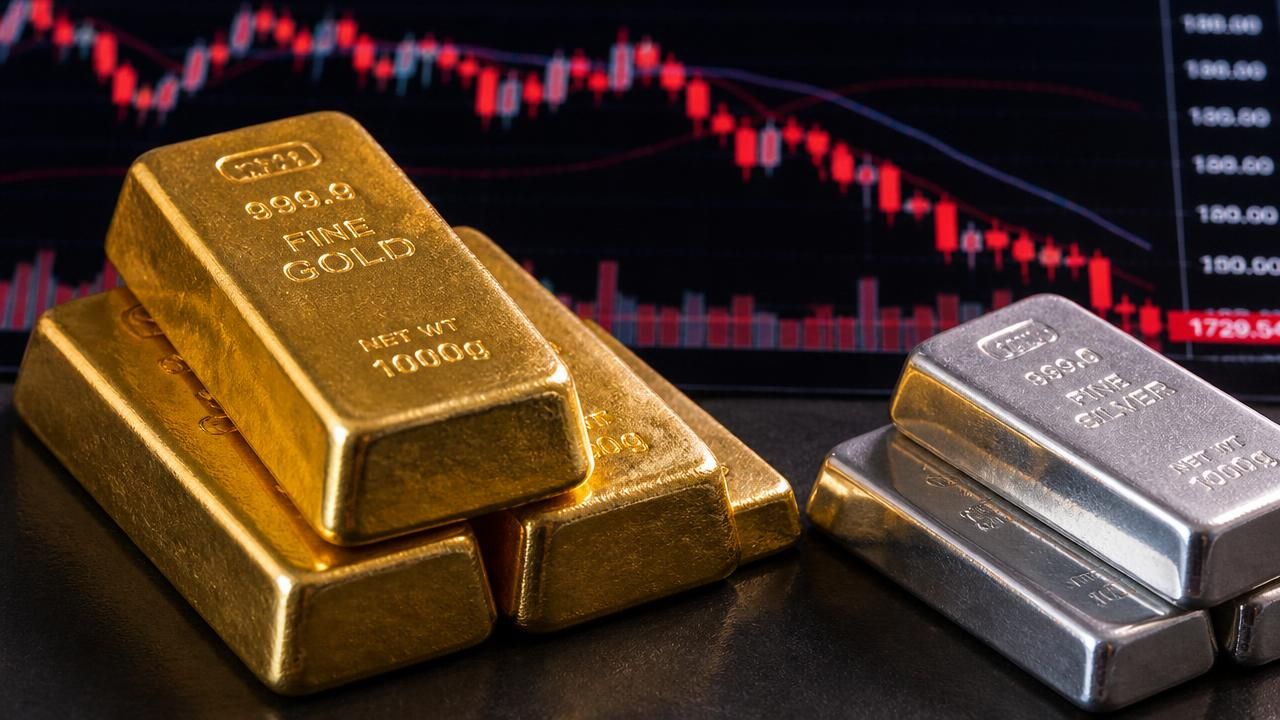
Gold capped its worst week since March, tumbling for a fifth consecutive session as a hawkish Federal Reserve signaled additional interest-rate increases and a violent selloff in artificial-intelligence stocks forced investors to liquidate positions across the metals complex.
Bullion fell nearly 9% over the week, according to coverage from MSN and Bloomberg Markets, marking its steepest five-day decline in eight months. Silver fared even worse in relative terms, with both precious metals sinking to 14-month lows as hawkish Fed commentary powered a broad rally in the U.S. dollar.
The move rippled through every major financial wire and aggregator within hours. Bloomberg's original report — headlined "Gold Logs Worst Week Since March on Hawkish Fed, AI Selloff" — was syndicated virtually verbatim to livemint.com and surfaced on MSN, while CNBC ran its own version under the headline "Gold's slide deepens as AI rout, rate hike bets hurt bullion." The near-identical framing across outlets underscores how quickly a single macro narrative can become the market's consensus story.
A Five-Day Slide Built on Two Forces
The retreat was not the product of a single catalyst but of two pressures converging on the same week.
The first was monetary policy. Policymakers struck a decidedly more aggressive tone than investors had positioned for, signaling that further rate hikes remain on the table rather than the pause or pivot many had bet on. Because gold pays no yield, higher rates raise the opportunity cost of holding it and typically strengthen the dollar — the currency in which the metal is priced — creating a double headwind.
The second was equity-market contagion. A sharp unwind in AI-linked stocks, which had been among the year's most crowded trades, triggered margin calls and forced selling across asset classes. When leveraged investors need cash, gold — a highly liquid, easily sold position — is often among the first assets to go.
"Gold slid for a fifth day — notching its biggest weekly decline since March — as a hawkish Federal Reserve signaled more interest-rate hikes and a rout in AI stocks spurred selling across metals markets." — Bloomberg Markets
The AI Trade Cracks
The AI selloff deserves particular attention because it represents a reversal in market psychology rather than a change in fundamentals. For much of the year, enthusiasm around artificial intelligence had concentrated capital in a narrow band of semiconductor and cloud-computing names, pushing valuations to levels that left little room for disappointment.
When that trade began to unwind, the damage was not confined to equities. Precious metals, which had benefited from the same risk appetite and, in some quarters, from the same retail-investor flows, gave back gains rapidly. The episode is a reminder that in a leveraged, cross-asset market, correlation spikes precisely when diversification is most needed.
Silver's Sharper Fall
Silver's slide to 14-month lows alongside gold highlights the metal's dual identity as both a monetary hedge and an industrial input. Silver typically amplifies gold's moves in both directions, and its heavier weighting toward industrial demand — including electronics and solar manufacturing — makes it more sensitive to growth fears of the kind a hawkish central bank can provoke.
- Gold: Down nearly 9% on the week, its worst performance since March and fifth straight daily decline.
- Silver: Sunk to 14-month lows alongside gold as the dollar strengthened.
- Dollar: Strengthened on hawkish Fed commentary, pressuring dollar-denominated commodities.
- Equities: An AI-led rout forced cross-asset deleveraging, adding to metals selling.
What the Coverage Reveals
The near-uniform headlines tell their own story about how financial news travels in 2026. Bloomberg's report, distributed through syndication partners including livemint.com and MSN, set the framing that most retail investors encountered: a record of the decline anchored to two named causes — the Fed and AI.
CNBC's version emphasized the same two drivers but foregrounded the dollar's role, reflecting a television-and-digital outlet's tendency to lead with the currency angle that moves intraday futures. MSN's aggregation carried both the Bloomberg wire copy and a more dramatic headline — "Gold Plunges Nearly 9% In Worst Week Since March" — that traded precision for urgency, a hallmark of aggregator optimization.
Notably absent from any available coverage was a sustained bearish counter-narrative. No major outlet argued the decline reflected weakening physical demand or central-bank selling; the consensus located the cause entirely in rates and risk appetite.
The Bigger Picture
Gold's slide arrives after a period in which the metal had been widely touted as a hedge against geopolitical uncertainty and fiscal expansion. That thesis is not invalidated by one bad week, but the selloff does expose a tension: gold performs best when real yields fall, and a hawkish Fed does the opposite.
For investors, the practical lesson is about positioning. A market that rallies on rate-cut expectations is vulnerable when those expectations reverse, and crowded trades in adjacent assets — AI equities chief among them — can transmit shocks into havens that are supposed to be insulated from them.
What to Watch
The next leg will hinge on three variables: the tone of upcoming Fed communication, the durability of the AI-equity correction, and whether the dollar's strength persists. If policymakers soften their language, gold could stabilize quickly — bullion has repeatedly found buyers on dips during this cycle. If the AI unwind broadens further, however, forced liquidation could extend losses regardless of the rate outlook.
For now, the market has delivered a clear verdict: in a week when the Fed turned hawkish and the year's hottest trade reversed, gold was not the safe haven investors had been promised.