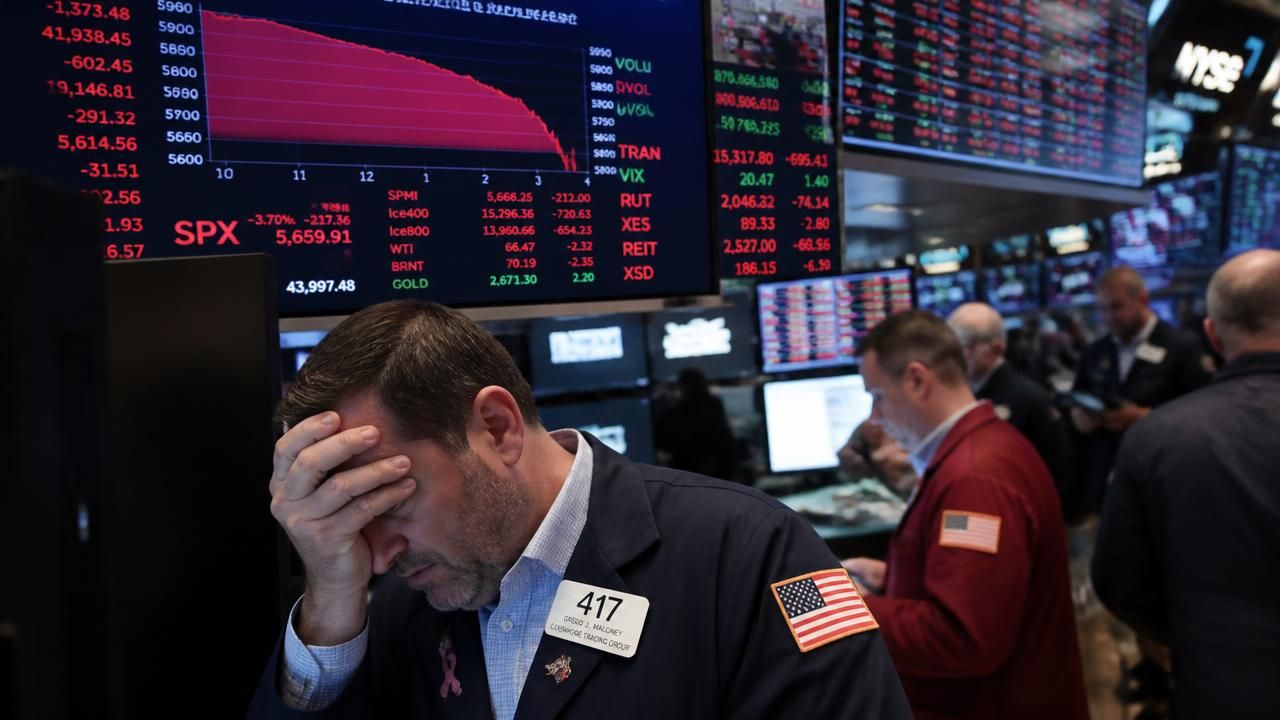
The drubbing on Wall Street deepened into something more consequential this week: the S&P 500 sank 3.7%, and the Nasdaq composite flipped negative for the year, erasing the gains that had made 2025 a banner year for U.S. equities. At the center of the decline is the same group of artificial-intelligence-linked companies that drove the market's record run — a handful of megacap technology names whose enormous valuations give them outsized sway over every major index.
The headline was carried across outlets largely intact. NPR, MSN and The Philadelphia Inquirer all ran variations of the same wire report — "S&P 500 sinks 3.7% and the Nasdaq composite goes negative for the year" — while The Globe and Mail framed the session more aggressively: "US stocks tumble, and the S&P 500 drops as the sell-off for AI stocks accelerates." The divergence in headlines is telling, if modest. The wire version leads with the numbers; the Globe and Mail leads with the cause, signaling that the AI trade itself — not a broad-based economic shock — is where the story now sits.
The reversal of the AI trade
For much of the year, the market's direction has been set by a narrow cohort of AI beneficiaries. Those stocks carry hefty market values, which means each percentage point of movement translates into an unusually large swing in the index. They were responsible for Wall Street's big gains in 2025, and, as NPR's reporting put it succinctly, they "are now behind the big slide for the market."
"AI stocks have hefty market values and have a much bigger impact on the market's direction. They were responsible for Wall Street's big gains this year and are now behind the big slide for the market." — NPR News
The mechanics are straightforward. When a small number of companies account for a large share of total index market capitalization, the index stops behaving like a broad measure of corporate America and starts behaving like a leveraged bet on a single theme. For months, that concentration amplified upside: every fresh round of capital-spending commitments, chip-order guidance beat or data-center expansion announcement flowed straight into the S&P 500 and Nasdaq. The same structure now amplifies the downside, with each downgrade or cautious earnings note rippling across the entire market rather than being absorbed within a single sector.
Concentration cuts both ways
This is not the first time investors have been reminded of that arithmetic. Market strategists have spent much of the year warning that index returns were increasingly dependent on a narrow group of companies, a concentration that historically has preceded sharper drawdowns when sentiment shifts. The Nasdaq's move into negative territory for the year is the clearest evidence yet that the cushion built during the rally has been consumed.
What makes the current slide notable is that it appears to be a repricing of the AI thesis rather than a reaction to a single macroeconomic data point. Sell-offs driven by a disappointing inflation reading or a central-bank surprise tend to be broad and short-lived; sell-offs driven by doubts about a dominant investment theme tend to be narrower at the start and more persistent if the doubts hold. Investors are now openly questioning whether the enormous sums being committed to data centers, chips and power infrastructure will produce returns on the timeline that valuations imply.
What it means for ordinary investors
- Index funds are not immune. Because the biggest AI names sit at the top of cap-weighted benchmarks, a passive investor in an S&P 500 or Nasdaq-tracking fund has meaningful exposure to the very trade that is unwinding.
- Diversification matters again. Equal-weight and value-oriented strategies have lagged during the AI boom; sessions like this one are precisely when that gap narrows.
- Volatility is structural, not incidental. Expect larger daily swings in the indexes as long as a handful of companies dominate their weighting.
- The year-to-date scoreboard resets. The Nasdaq's turn negative erases the psychological anchor of a winning year, which can itself influence fund flows and sentiment.
The bigger picture
Wall Street's AI enthusiasm was never purely speculative. It was underwritten by real capital expenditure, real revenue growth in chips and cloud services, and real demand from enterprises experimenting with generative tools. Nothing about a single brutal session invalidates that. But markets price expectations, not just current results, and the expectations embedded in AI valuations have been extraordinarily generous. A 3.7% drop in the S&P 500 is a sharp move, not a crisis — but it is a reminder that the market's recent prosperity has rested on a surprisingly narrow foundation.
The coverage itself reflects how the story is being processed. Wire services, syndicated across MSN and regional papers like The Inquirer, delivered the number first and the explanation second. The Globe and Mail inverted that order, putting the AI sell-off in the headline as the active agent. Both are accurate. The difference is emphasis — and emphasis is where the debate about what happens next will be fought.
What to watch
The next several sessions will be dominated by three questions: whether earnings guidance from the largest AI-linked companies confirms or undercuts the spending story; whether the selling broadens beyond technology into industrial, utility and financial shares; and whether buyers step in on the dip as they have repeatedly during this cycle. For now, the answer to the third question is the one that matters most — and the one that will determine whether this week's slide is a correction within a bull market or the beginning of something longer.