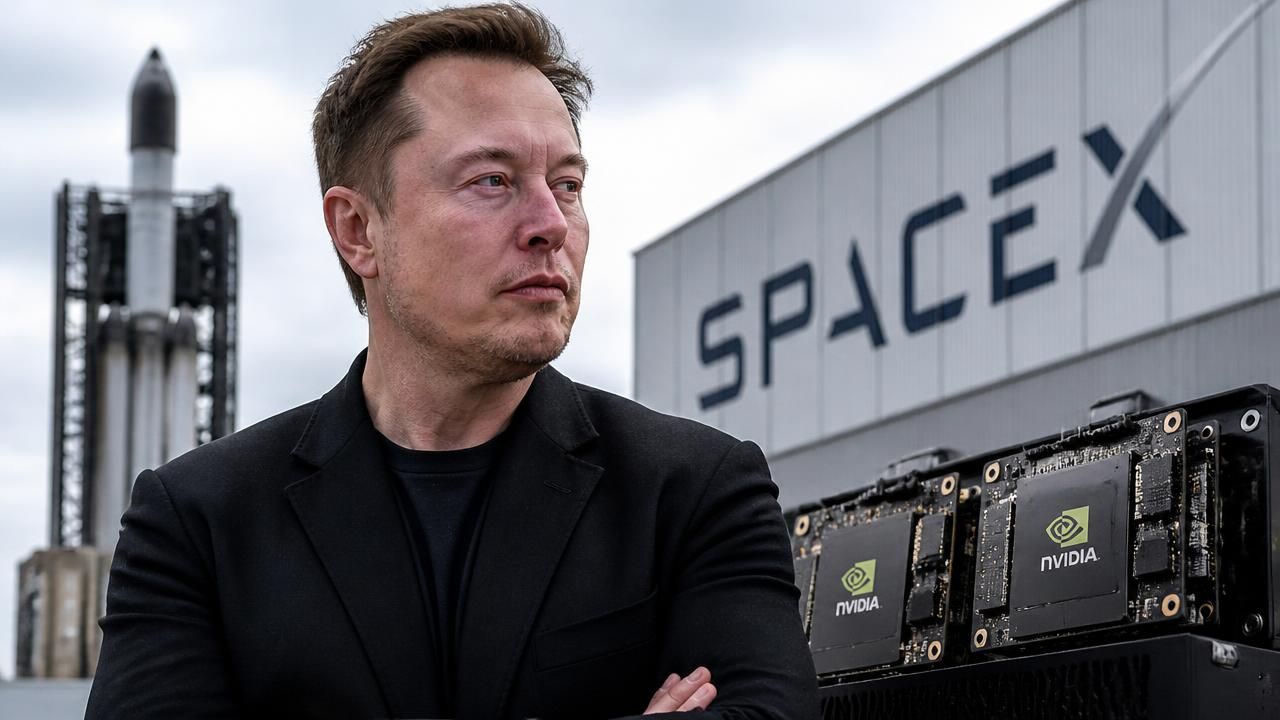
SpaceX has closed a roughly $40 billion debt deal backed by advanced AI chips, but the financing has run into an unusually cosmic problem: the lender group wants contractual assurances that Elon Musk will not fire their collateral into orbit.
According to people familiar with the matter, lenders backing the $43 billion package — secured by some $40 billion of cutting-edge Nvidia semiconductors — have pushed for language barring SpaceX from launching the chips into space. The standoff, first reported by the Financial Times and confirmed in outline by other outlets, pits the most ambitious element of Musk's artificial-intelligence strategy against the risk models of the banks and funds underwriting it.
The collateral problem
The dispute is deceptively simple. In a conventional secured lending, a borrower pledges assets that a lender can seize, repossess and resell if the loan sours. SpaceX has told lenders it intends to keep the chips on Earth, where they can power terrestrial data centers and, in a default, be recovered and sold into a liquid secondary market.
Lenders have expressed concerns that if the group later decided to shoot the valuable chips that underpin their loans into space, it would prevent them from reclaiming and selling the semiconductors in the event of a default — people familiar with the matter told Ars Technica.
That fear is not abstract. Satellites are hard to reach, harder to retrofit and, once on orbit, essentially beyond the practical reach of any trustee or bankruptcy court. A chip on a satellite in low Earth orbit is, for recovery purposes, gone.
Musk's orbital data center bet
The chips are central to Musk's long-stated ambition to power AI models with data centers cooled by the vacuum of space — a vision in which satellites packed with accelerators beam results back to Earth, sidestepping the land, power and water constraints that increasingly throttle terrestrial AI buildouts. Executing it requires exactly what the lenders are financing: vast quantities of the most advanced, most expensive silicon on the planet.
The framing across outlets diverges sharply. The Financial Times and Ars Technica treat the story as a deal-structure and creditor-rights question — a collision between science-fiction ambition and the mundane covenants of secured lending. Aggregators and consumer-facing outlets such as MSN lean into the narrative clash, casting it as "Elon Musk's dream meets Wall Street reality," with headlines warning that lenders want to stop the rocket man from launching $40 billion of hardware beyond their grasp. CNBC, meanwhile, reported the arc from the opposite end: SpaceX has closed the $40 billion debt deal for AI chips, a financing milestone Musk himself promoted — a reminder that, for all the friction, the money has been raised.
Why space is a repo man's nightmare
The legal backdrop explains the lenders' anxiety. The 1967 Outer Space Treaty bars national appropriation of celestial bodies, and no country exercises sovereignty over orbital space. Repossession of an asset in orbit would require cooperation across jurisdictions, launch capacity, rendezvous capability and insurance markets that do not meaningfully exist. Re-entry adds a further hazard: a recovered chip that survives launch and retrieval might not survive the trip home. Secured lenders accustomed to Uniform Commercial Code filings and physical inventory are being asked to accept orbital mechanics as a credit risk.
The merger question, and the empire's overlaps
The chip financing does not exist in isolation. The New York Times has reported that Musk wants to merge Tesla and SpaceX, two companies whose businesses already overlap substantially — in AI compute, in Nvidia procurement, in Musk's own attention and capital allocation. Tesla's own AI push and SpaceX's satellite ambitions both depend on the same scarce accelerators, and both are increasingly entangled with Musk's other ventures, including xAI.
That overlap matters for creditors. If the same class of chips can be allocated to a terrestrial data center, a Tesla training cluster or a satellite constellation, lenders want to know which balance sheet holds title and where the hardware physically sits. The launch restriction, in that light, is less a quixotic demand than an attempt to pin down an asset in a corporate structure that is famously fluid.
The political backdrop
There is also a political dimension that could shape SpaceX's regulatory environment. Ars Technica has examined what Texas' blue wave means for Musk and SpaceX, a question with real stakes for the company's Starbase launch site and its historically warm relationship with state officials. Local and state politics influence everything from launch permits and road closures to tax abatements and infrastructure spending — levers that matter when a company is asking capital markets to underwrite decades-long orbital infrastructure.
For lenders, political risk and orbital risk now compound each other: a launch restriction is only as good as the borrower's compliance, and compliance is only as strong as the governance and regulatory climate surrounding the borrower.
What to watch
- Covenant language. Whether the final agreement contains an explicit prohibition on launching collateral, or a softer notification-and-consent requirement, will set a precedent for financing space-based compute.
- Chip provenance. How SpaceX allocates Nvidia hardware between Earth-bound AI work and satellite payloads, and whether lenders get audit rights.
- The Tesla-SpaceX question. Any merger would reshuffle collateral across entities and could force a renegotiation of the debt terms.
- Insurance and salvage markets. If orbital data centers proceed, a genuine market for recovering or valuing space-based assets would have to emerge — a prerequisite for institutional lending at scale.
For now, the deal is a case study in how the AI boom's insatiable demand for compute is colliding with the oldest rule of secured lending: know where your collateral is. Musk's answer, increasingly, is "above the atmosphere." His lenders' answer is a firm, contractual no — at least until someone figures out how to repossess a satellite.