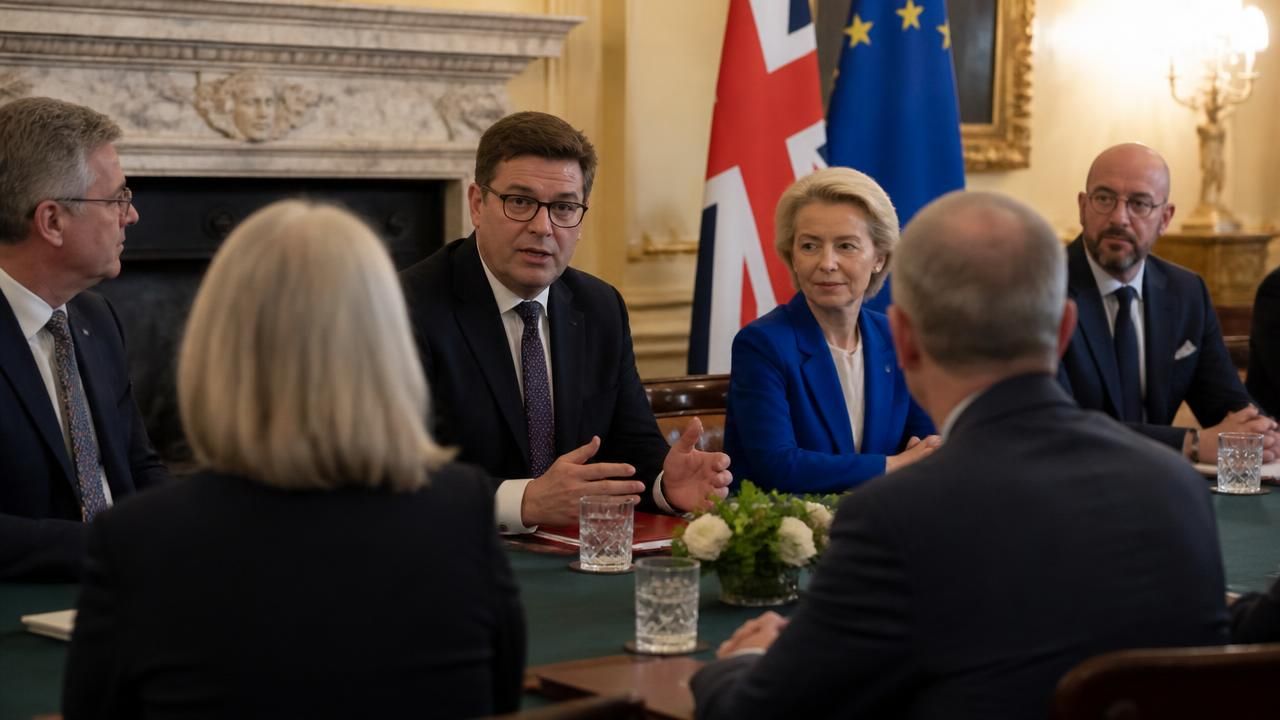
Ten years after British voters chose to leave the European Union, Prime Minister Andy Burnham sat down with the bloc's most senior officials on Friday in one of the most closely watched diplomatic encounters since the divorce was finalized — a rare summit convened explicitly to repair a relationship that both sides now describe as underperforming.
The meeting, held in London and carried by broadcasters including the BBC's pooled coverage, brings Burnham face to face with the EU's top leadership for the first formal bilateral summit of its kind in years. NPR framed the encounter simply: top EU officials are meeting the prime minister "looking to mend more fences," a decade on from the referendum that set the two sides on separate paths.
A decade of distance, and a push to close it
The historical arc is familiar. The United Kingdom voted 52% to 48% to leave in June 2016; Article 50 was triggered in March 2017; the country formally departed on Jan. 31, 2020, and the Trade and Cooperation Agreement — the thin treaty that now governs roughly half a trillion pounds of annual commerce — took effect at the end of that year.
What followed, by most industry accounts, was friction: customs paperwork, veterinary checks on food and agricultural goods, tightened rules for services professionals, and a steady drumbeat of complaints from exporters about costs that did not exist inside the single market. Burnham has argued that those frictions amount to self-inflicted damage that a sitting government has an obligation to reduce, even if the political price is high.
The Globe and Mail summarized the stakes in its headline: "U.K. and EU hold rare summit as Burnham seeks to mend Brexit damage." MSN's coverage struck the same note, describing a rare gathering aimed at strengthening ties as the prime minister pursues repair.
What is actually on the table
Officials on both sides have been careful to set expectations below the level of a dramatic reset. Nobody in London or Brussels is talking about rejoining the single market or the customs union. Instead, the agenda is built around what diplomats call "low-hanging fruit with high symbolic value":
- Mobility for professionals. Easier short-term visas and mutual recognition of qualifications for engineers, architects, and touring creative workers.
- Sanitary and phytosanitary alignment. A deal to reduce border checks on food and plant products, long the single biggest complaint from British farmers and food exporters.
- Research and student exchange. Fuller association with EU science funding programs and a rebooted youth mobility scheme.
- Energy and security. Closer coordination on electricity interconnectors and continued cooperation on sanctions and defense procurement.
Yahoo's reporting pointed to a second act: Burnham intends to use a key UK-EU summit next month as a platform to push for still closer ties, suggesting Friday's meeting is a staging post rather than a conclusion. That sequencing matters — it signals a deliberately incremental strategy, building public comfort with each small step before attempting the next.
How the story is being framed
Coverage across outlets converges on the same facts but diverges on emphasis. NPR's framing is procedural and diplomatic — a summit about fences. The Globe and Mail leans on the domestic political frame, casting the meeting as the prime minister's attempt to remediate what Brexit wrought. MSN's wire-style treatment splits the difference, foregrounding the rarity of the summit itself.
"U.K. and EU hold rare summit as Burnham seeks to mend Brexit damage" — The Globe and Mail
The word doing the most work across all four versions is "rare." Summits at this level were routine before 2016 and became exceptional afterward; the fact that this one is happening at all is being read in Brussels as evidence that the ice is thinning.
The politics back home
None of this is costless. A meaningful share of the British electorate regards any deepening of EU ties as a betrayal of the 2016 result, and opposition politicians have been quick to characterize the summit as a slow-motion reversal. Burnham's counter-argument is economic: growth forecasts have been repeatedly downgraded since 2020, and business groups — from the Confederation of British Industry to small exporters' associations — have made friction reduction their single loudest demand.
On the EU side, member states remain wary of offering a major economy the benefits of integration without the obligations. Brussels has consistently insisted that market access and regulatory alignment travel together, and any British request that appears to seek "cherry-picking" will meet resistance from capitals that spent years insisting the single market is indivisible.
What to watch
The concrete deliverables from Friday's session — likely a joint statement and a set of working groups rather than signed agreements — will be less telling than the follow-through before next month's summit. Watch three indicators: whether a veterinary or SPS deal is formally tabled, whether the youth mobility scheme survives its first round of domestic criticism, and whether the two sides commit to a standing ministerial dialogue rather than another one-off gathering. A decade after the referendum, the question is no longer whether Britain and the EU will talk, but whether talking can be converted into terms that both publics will tolerate.