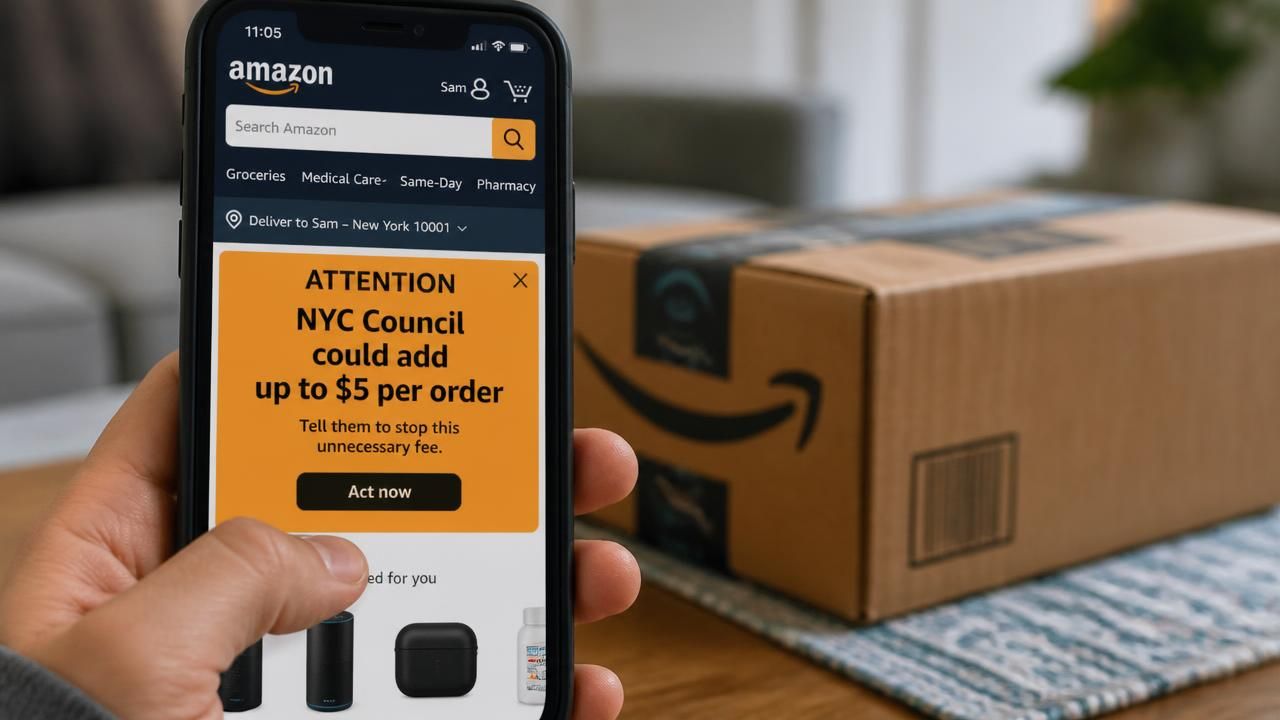
Amazon is using its own homepage and mobile app to campaign against a New York City bill, turning the retailer’s vast consumer reach into a political megaphone. Shoppers logging into Amazon have been greeted by a vertical banner that reads “ATTENTION NYC Council could add up to $5 per order,” with a button urging them to “Act now.” App users see a similar message as a pop-up, according to Bloomberg, which Ars Technica cited in its report on the rollout. The Verge also highlighted the alerts, underscoring how unusual it is for an e-commerce platform to push political messaging directly into the shopping experience.
The target is the Delivery Protection Act, a city measure backed by Mayor Mamdani and the Teamsters. The bill has become a proxy fight over last-mile delivery, labor protections, and the cost of e-commerce in dense cities. Amazon says the legislation could raise costs for consumers by as much as $5 per order. Supporters, including the mayor, argue the bill is needed to protect delivery workers. The exact mechanics of the fee are disputed, and Amazon’s banner presents the figure as a warning rather than a neutral estimate.
A pop-up campaign with national implications
The campaign is notable less for its message than for its medium. Amazon has not specified whether the messaging targets New York City residents based on addresses saved in Amazon accounts or uses other techniques, such as device location services. Ars Technica noted that it only saw the banner when logged into Amazon, suggesting the company may be using account-level data to decide who sees the appeal. That detail matters because it shows how a retailer can convert routine customer logins into a targeted political channel without a traditional advertising buy.
“ATTENTION NYC Council could add up to $5 per order” — the banner Amazon is showing to logged-in shoppers, with a button reading “Act now.”
Ars Technica described the move as unprecedented: Amazon is using its app and website to try to convince shoppers not to support a New York City bill. The company’s call to action asks customers to lobby the City Council, effectively mobilizing its consumer base as a grassroots pressure group. For a company that already controls a dominant share of online shopping, the campaign raises questions about platform power and the blurry line between commerce and politics.
The political alliance behind the bill
Forbes framed the fight as a confrontation pitting New York City Mayor Mamdani and the Teamsters against Amazon. The mayor’s support gives the bill a powerful political champion, while the Teamsters’ involvement ties it to a broader labor campaign to organize and protect delivery drivers. The New York Post described Mamdani as escalating the Amazon fight by backing a bill that risks a price hike for customers, while the retailer threatens to move New York City operations. That framing casts the mayor as willing to absorb corporate resistance in exchange for labor support.
Media coverage has emphasized different angles. Ars Technica and The Verge focused on the novelty of Amazon using its storefront for political persuasion. Forbes cast the dispute as a high-stakes clash between City Hall and labor on one side and Amazon on the other, while also arguing it could reshape last-mile delivery from A to Z. MSN and the New York Post highlighted Amazon’s warning of higher costs and its threat to move operations, with the Post portraying the mayor as the aggressor. Together, the coverage shows a story that is simultaneously about consumer prices, worker protections, and corporate political leverage.
Amazon’s threat to leave, again
MSN reported that Amazon is threatening to leave New York City again, this time over the delivery bill, as it rallies customers to fight it. The word “again” carries historical weight. In 2019, Amazon scrapped plans for a major campus in Long Island City after fierce local opposition, a decision that became a defining example of the company’s willingness to walk away when politics and public pressure complicate its expansion. Whether the latest threat is a negotiating tactic or a credible operational plan is unclear. Amazon has not publicly detailed what it would move, how quickly, or under what conditions.
Still, the threat matters because Amazon’s New York footprint is not limited to corporate offices. The company operates delivery stations and logistics networks that feed one of the densest e-commerce markets in the country. A departure or retrenchment would not just be a symbolic blow to City Hall; it could affect local jobs, delivery times, and the broader last-mile supply chain. The dispute also lands as cities across the country are watching how New York handles the balance between labor protections and the cost of rapid delivery.
Two narratives, one last-mile battlefield
Amazon’s narrative is simple: the bill will cost consumers. By placing a dollar figure in front of shoppers, the company frames the legislation as a direct threat to household budgets. Supporters of the bill tell a different story: delivery workers face demanding quotas, safety risks, and uneven pay, and the city has a responsibility to set standards. The Teamsters’ involvement places the fight within a larger national effort to organize logistics workers and challenge Amazon’s labor model.
The deeper question is who bears the cost of convenience. Last-mile delivery is the most expensive part of the e-commerce supply chain, and companies have long pushed costs onto drivers, subcontractors, and public infrastructure. If New York imposes new protections, Amazon could absorb the expense, pass it to customers, or rework its delivery network. Each option carries political consequences. That is why Forbes argued the Mamdani-Amazon fight could reshape last-mile delivery beyond New York: a victory for either side would offer a template for other cities weighing similar rules.
What happens next
The immediate battlefield is the New York City Council, where the Delivery Protection Act will be debated and voted on. Amazon’s campaign is designed to generate constituent pressure before that vote, using the company’s own interface to reach shoppers who may not otherwise follow local legislation. The mayor’s backing gives the bill momentum, but Amazon’s threat to move operations and its warning about higher prices could sway council members worried about jobs and cost of living.
The outcome will depend on how convincingly each side frames the stakes. If the bill passes, Amazon may challenge it politically, legally, or operationally. If it stalls, labor groups will likely escalate their campaign, arguing that the city bowed to corporate pressure. Either way, the episode marks a new phase in the relationship between platform giants and local governments: Amazon is not just lobbying behind closed doors; it is putting its political message directly in front of millions of shoppers.