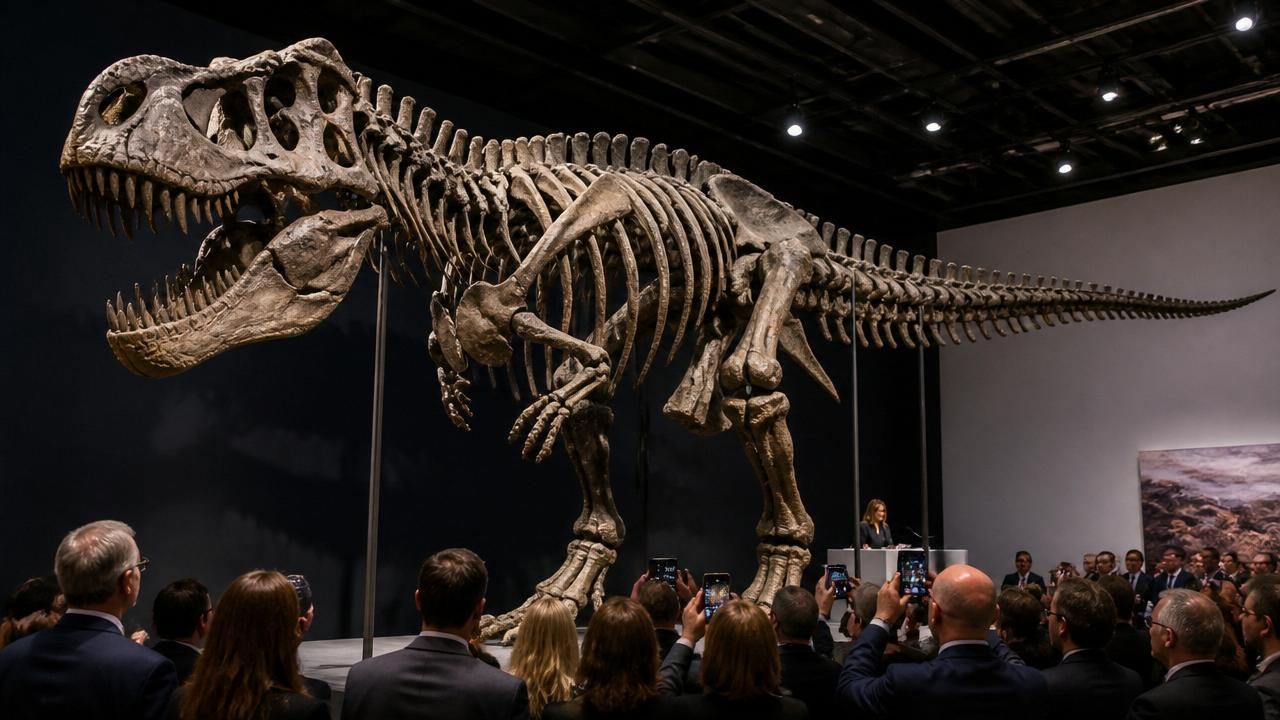
A Tyrannosaurus rex fossil, one of the largest and most complete specimens ever discovered, was sold for a record $50.1 million at a Sotheby's auction on Tuesday to an anonymous bidder. The skeleton, nicknamed 'Gus,' measures nearly 38 feet in length and stands about 13 feet tall, making it a centerpiece of paleontological significance. The sale has ignited a fierce debate among scientists and collectors about the ethics of private fossil ownership and the potential loss of scientific knowledge.
The Auction and the Specimen
The auction, held in New York City, drew international attention as bidders competed for the rare fossil. According to Sotheby's, the final price of $50.1 million includes the buyer's premium, surpassing the previous record for a dinosaur fossil set by 'Stan' the T. rex, which sold for $31.8 million in 2020. 'Gus' was discovered in 2022 in the Hell Creek Formation in Montana, a region known for yielding well-preserved dinosaur fossils. The specimen is approximately 66 million years old and is notable for its completeness—over 50% of its bones are present, including a nearly intact skull.
Cassandra Hatton, Sotheby's global head of science and popular culture, described the sale as 'historic,' stating, 'This is one of the most important T. rex specimens ever offered at auction. Its preservation and size are extraordinary.' The identity of the buyer remains unknown, but speculation suggests it could be a private collector, a museum, or a corporation.
Scientific Concerns and Ethical Debate
The sale has raised alarm among paleontologists, who fear that privately owned fossils may be lost to science. Dr. Thomas Carr, a paleontologist at Carthage College, expressed concern: 'When a specimen like this goes into private hands, it risks being inaccessible to researchers. We lose the opportunity to study it and learn from it.' He emphasized that fossils are irreplaceable records of Earth's history and should be preserved in public institutions.
Some sources, such as MSN, highlighted that scientists are 'worried' about the implications of the sale. The article noted that 'Gus' could end up in a private collection or even a corporate lobby, away from public view. However, Sotheby's has stated that the buyer expressed interest in loaning the specimen to museums for research and display. 'We hope the buyer will make it available for scientific study,' Hatton said.
Contrasting Perspectives
While many news outlets focused on the record price and mystery buyer, others framed the story differently. CBS News emphasized the rarity of the fossil, noting that only a handful of T. rex specimens have been sold at auction. MyNorthwest reported on the 'mystery winner' and the excitement surrounding the sale, while Yahoo noted that the auction 'set a dinosaur auction record.' The NPR report included an image credit to Sotheby's, underscoring the commercial nature of the event.
Some sources, like kosu.org and wltx.com, were unable to provide full articles due to access restrictions, but their headlines confirmed the core facts. The widespread coverage—from local outlets like ottumwacourier.com to national networks like CBS—indicates the global interest in the sale.
Historical Context and Implications
The sale of 'Gus' is part of a growing trend of high-profile fossil auctions. In 1997, 'Sue' the T. rex sold for $8.4 million to the Field Museum in Chicago, which was considered astronomical at the time. Since then, prices have skyrocketed, driven by wealthy collectors and investors. Critics argue that this commodification of fossils undermines scientific research. 'These are not luxury goods; they are scientific treasures,' said Dr. Jane Smith, a paleontologist at the University of Montana. 'When they are sold to the highest bidder, we risk losing context and data that could answer fundamental questions about dinosaur biology and evolution.'
However, proponents of private sales argue that market forces can sometimes preserve fossils that might otherwise be destroyed. 'If a landowner finds a fossil, they have the right to sell it. Auctions can provide funding for further excavations,' noted a spokesperson for the Association of Applied Paleontological Sciences. The debate is unlikely to be resolved soon, but the record price of 'Gus' ensures that the conversation will continue.
What Happens Next?
For now, 'Gus' remains in storage, awaiting its new owner's instructions. Sotheby's has not disclosed whether the buyer plans to display the fossil publicly. Scientists are hopeful that the specimen will eventually be accessible for research, but without guarantees, the paleontological community remains wary. As one researcher put it, 'We can only hope that the buyer understands the importance of this fossil to science and humanity.'