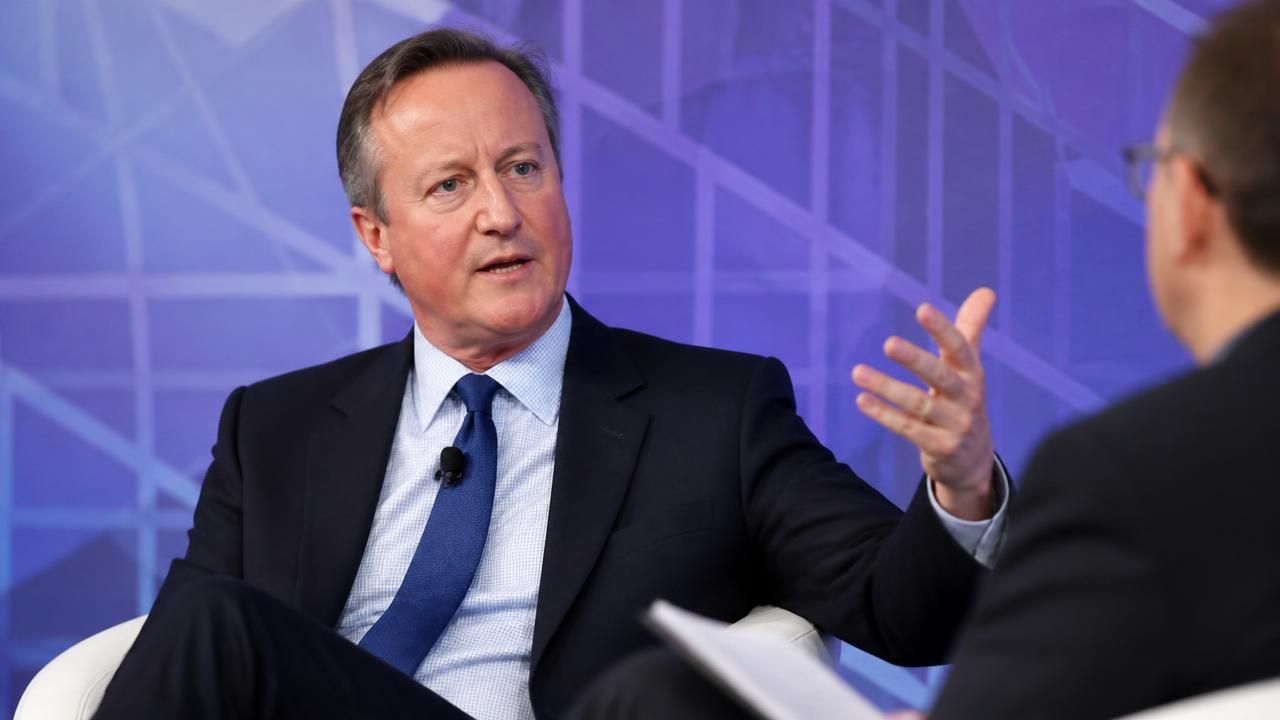
David Cameron has declared that Alzheimer's disease is approaching a "tipping point" at which it becomes a treatable — and potentially reversible — condition, using a Bloomberg subscriber event in London to press the case for faster NHS access to a new generation of dementia medicines and to disclose the harrowing personal history behind his advocacy.
The former prime minister said advances in anti-amyloid therapies, combined with a wave of new biotech and pharmaceutical entrants, mean that someone living with the disease today could plausibly see their condition halted or even improved. "We have reached a tipping point where the combination of new treatments and new biotech and pharmaceutical companies could result in someone alive today having their Alzheimer's condition reversed," he told the audience, according to Bloomberg Markets.
'A tipping point' in the science
Cameron's optimism rests on a class of monoclonal antibody drugs — lecanemab, marketed as Leqembi, and donanemab, sold as Kisunla — which clear amyloid plaques from the brain and have been shown in trials to slow cognitive decline in early-stage Alzheimer's by roughly a quarter to a third. Both received UK marketing authorisation from the MHRA, a landmark for a disease that has defeated more than 100 experimental compounds over three decades.
The caveats are significant. The benefits are measured in months of slowed progression rather than restoration of function, the drugs are given by intravenous infusion every two to four weeks, and they carry risks including amyloid-related imaging abnormalities (ARIA), which require regular MRI monitoring. Even the most enthusiastic clinicians describe them as the beginning of a treatment era rather than its culmination.
A family's ordeal
The most striking moment of the appearance was Cameron's decision to speak publicly about his mother, Mary Fleur Cameron, who died in 2019 after living with Alzheimer's. According to LBC and MSN, he revealed that she had begged his sister to end her life after her diagnosis — an account that reframes a policy argument about drug reimbursement as a story about dignity, fear and the limits of what families can bear.
"She asked my sister to help her end her life. That is what this disease does to people."
The disclosure places Cameron alongside a growing group of public figures using personal bereavement to argue that the human cost of delay outweighs the fiscal caution of health regulators. It is a familiar political manoeuvre — and a potent one, because it moves the debate from cost-per-QALY spreadsheets to the bedside.
The drugs the NHS will not pay for
The Telegraph's coverage approached the same remarks from the consumer angle, publishing an explainer on "the dementia drugs blocked by the NHS." That framing captures the awkward reality of the UK's two-step approval system: the MHRA can license a medicine while the National Institute for Health and Care Excellence (NICE) declines to recommend it for routine NHS use on cost-effectiveness grounds.
- Regulatory approval: Both lecanemab and donanemab were authorised by the MHRA as safe and effective for early Alzheimer's.
- Reimbursement refusal: NICE concluded the clinical benefit did not justify the price at roughly £20,000–£25,000 per patient per year, particularly once the cost of infusion suites, PET scans and MRI monitoring is added.
- Practical consequence: Patients in England can, in principle, pay privately — but few can, and the NHS's diagnostic infrastructure struggles to identify eligible patients at the mild-cognitive-impairment stage.
- Devolution divergence: Scotland's approval pathway and the possibility of private clinics have created a postcode lottery that Cameron's intervention implicitly criticises.
The UK is not alone in this squeeze. European regulators have clashed over the same evidence base, and in the United States Medicare coverage has been tightly circumscribed even after FDA approval. The difference is that the NHS's single-payer structure makes the refusal absolute for most households.
A dedicated dementia drug fund
Cameron's proposed remedy, reported by MSN, is a ring-fenced dementia drug fund modelled on the Cancer Drugs Fund — a mechanism created in 2010, during his premiership, to give patients earlier access to promising oncology treatments while evidence matured and prices were renegotiated. A dementia equivalent would let the NHS fund the drugs provisionally, collect real-world data and revisit NICE's verdict.
The precedent cuts both ways. The Cancer Drugs Fund was criticised for spending hundreds of millions on medicines that were later shown to offer marginal benefit, and it has been repeatedly bailed out. Yet it also accelerated access and forced manufacturers into confidential rebates — precisely the negotiation leverage that dementia drugmakers would face under a similar scheme.
Brexit, blame and the political subtext
The London event produced a second headline: Cameron's insistence that Brexit should not be blamed for the UK's problems. Coming in the same appearance as his dementia appeal, the juxtaposition is telling. Bloomberg framed the evening around innovation and investment; LBC and MSN led on the family revelation; the Telegraph turned it into a service-journalism explainer. Same stage, four different stories — a reminder that how a policy speech travels depends as much on the outlet's audience as on the speaker's intent.
Cameron's pharmaceutical optimism also carries a commercial message. Life-sciences investment was a centrepiece of his government's industrial strategy, and his argument that new biotech entrants can accelerate progress is aimed as much at investors and Treasury officials as at clinicians.
Why the money is the hard part
Roughly 982,000 people in the UK live with dementia, a figure Alzheimer's Society projects will reach 1.4 million by 2040, with annual costs estimated at £34.7bn. A treatment costing tens of thousands per patient, delivered to even a fraction of that population, is a fiscal question no health secretary can wave away — particularly when the clinical effect is modest.
That is why the fight is no longer really about whether the science is promising. It is about who pays, how quickly the price falls, and whether the NHS can build the diagnostic pathway — blood biomarkers, PET scanning, specialist memory clinics — that eligibility depends on. Cameron has provided the moral framing and a financing mechanism; the harder work of pricing, capacity and evidence remains unfinished.
What to watch
Watch for NICE's reappraisal windows, any manufacturer offer of a confidential patient-access scheme, and whether the Department of Health and Social Care formally entertains a dementia drug fund in the next spending review. If a fund materialises, it would mark a rare instance of a former prime minister successfully shaping the health policy debate long after leaving office — and an even rarer one in which a disease's "tipping point" is decided as much by accountants as by scientists.