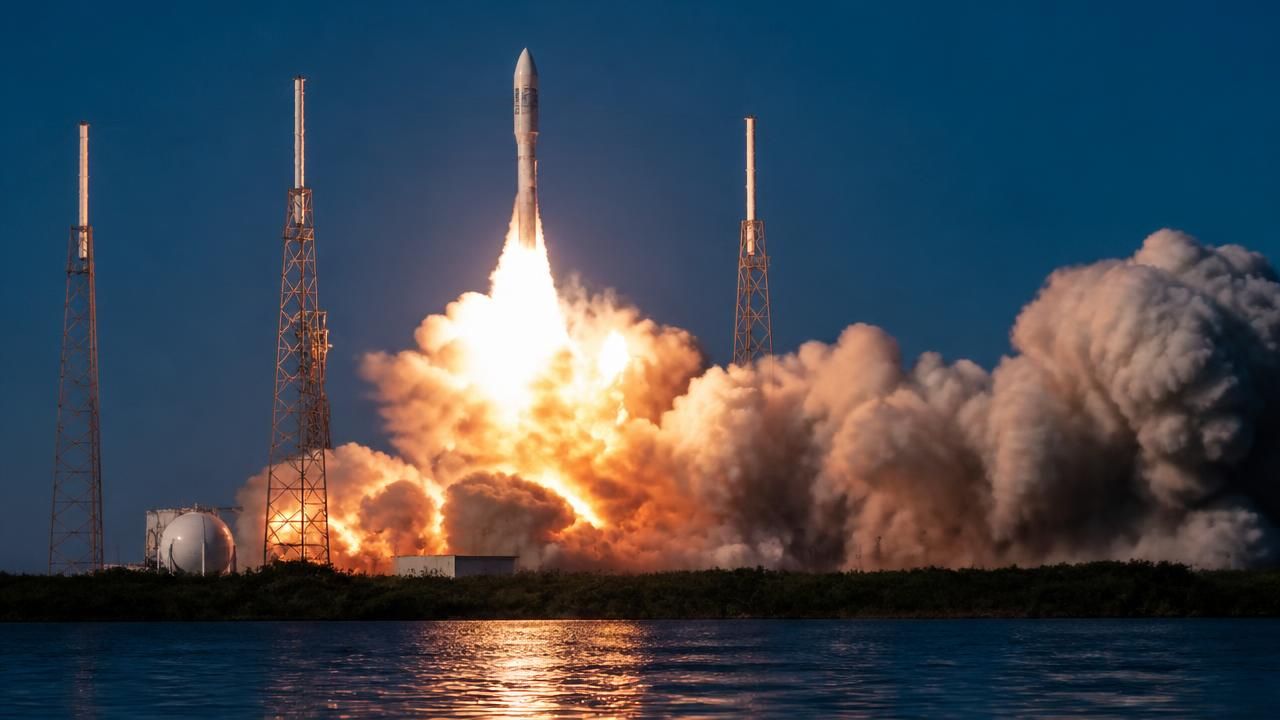
United Launch Alliance's Vulcan rocket suffered a catastrophic failure Sunday, falling back to Earth minutes after liftoff along with the 40 Amazon Leo broadband satellites it was carrying, according to reporting from Ars Technica. The loss of the vehicle and its payload marks the most serious setback yet for the Boeing-Lockheed Martin joint venture and sends ripple effects across the US launch industry, the military's space procurement plans and Amazon's multibillion-dollar effort to challenge SpaceX's Starlink.
The mission had been billed as a return-to-flight launch for Vulcan, a rocket that has already weathered a string of anomalies in its short operational history. Instead, it ended with both the booster and its commercial payload destroyed, and with Vulcan now expected to be grounded for an indefinite period while investigators determine what went wrong.
What happened
According to Ars Technica, the Vulcan Centaur lifted off Sunday and then failed within minutes, with the rocket and its 40 Amazon Leo satellites falling back to Earth. Outlets covering the launch — including MSN's aggregated reports and Alabama-based coverage from Yahoo — described the flight as a return-to-flight mission, underlining that Vulcan was already operating under heightened scrutiny before Sunday's failure.
The loss of the payload is significant in its own right. Sunday's flight was the first of 38 Vulcan launches booked by Amazon to build out its Leo constellation, a network of broadband internet satellites intended to compete directly with SpaceX's Starlink. Amazon has committed enormous capital to the constellation, and each dedicated launch represents a meaningful share of the deployment schedule. Losing 40 satellites on the very first contracted flight delays that build-out and forces Amazon to reassess its manifest.
"Sunday's failure is expected to ground the rocket for an indefinite period of time." — Ars Technica
A rocket with the military on board
Vulcan's importance extends well beyond Amazon. The vehicle is on contract to launch roughly half of the US military's national security space missions over the next several years, a role that makes it one of the most strategically significant rockets in the American fleet. Those missions — surveillance, secure communications and early-warning satellites — are among the most sensitive payloads the government flies, and they depend on a small pool of certified launch providers.
That pool has narrowed dramatically since the retirement of the Delta IV and Atlas V. ULA has been counting on Vulcan to carry its legacy business into the next decade, while the Space Force has relied on Vulcan and SpaceX's Falcon family to provide assured access to space. A prolonged grounding therefore creates a scheduling problem for the Pentagon as much as a commercial one: national security launches cannot simply be shifted to another provider without years of lead time, mission-specific integration work and renegotiated contracts.
Politically, the failure also complicates the broader push to sustain two independent US launch providers. Ars Technica framed the outcome bluntly, describing it as "a crushing setback that will ripple across all sectors of the US space industry" — a reminder that the strategy of depending on SpaceX as a counterweight only works if the counterweight can fly.
A history of close calls
Vulcan is no stranger to anomalies. According to Ars Technica, the rocket overcame failures with its strap-on solid rocket boosters on two of its four previous flights. In both instances, the vehicle corrected for the problem in flight and continued to orbit, successfully deploying its payloads. Those incidents nonetheless triggered months-long reviews and investigations before ULA was permitted to resume flying.
That pattern matters for what comes next. The earlier anomalies established a template: a stand-down, a formal investigation, corrective actions, and a return to flight only after certification. Sunday's failure is different in kind, because the mission did not recover. With the payload lost, investigators will face pressure to determine whether the fault lay with the solid rocket boosters that caused trouble before, with the BE-4 main engines supplied by Blue Origin, with the Centaur upper stage, or with an integration or guidance issue.
Alabama's stake in the outcome
Regional coverage from MSN and Yahoo emphasized the rocket's provenance: Vulcan is built in Decatur, Alabama, where ULA operates a sprawling factory that has been a anchor of the state's aerospace workforce. Alabama outlets described the vehicle as the "Alabama-built" and "Decatur-built" Vulcan, a framing that highlights how much local employment and state pride are tied to the program's success. A lengthy grounding translates into uncertainty for the production line, supplier network and workforce that support it.
The regional and national framings diverge in emphasis but not in substance. National outlets focused on the strategic and competitive consequences — a blow to SpaceX's rivals and a question mark over military launch capacity. Local outlets focused on the hardware, the factory and the community that built it. Both converge on the same conclusion: the vehicle that was supposed to secure America's second launch option is now grounded.
What comes next
- An investigation and stand-down. ULA will convene a failure review board, a process that historically has taken months and required NASA and Space Force sign-off before flights resume.
- A scheduling crunch for the Pentagon. National security missions assigned to Vulcan will slip, potentially pushing more near-term work toward SpaceX by default.
- Pressure on Amazon. Losing 40 satellites on the first of 38 contracted launches threatens the deployment timeline for Amazon Leo and may force the company to lean more heavily on other providers.
- A competitive imbalance. With Vulcan grounded, SpaceX faces even less credible competition in the US launch market at a moment when Starlink's dominance is already a policy concern in Washington.
The immediate questions are technical — what failed, when, and whether the fault is systemic. The larger question is strategic. For a decade, US policymakers have argued that assured access to space requires more than one reliable rocket. Sunday's failure is a test of whether that architecture can absorb a loss of this magnitude, and of how quickly ULA can convince its government and commercial customers that Vulcan is ready to fly again.