A new set of James Webb Space Telescope results is sharpening one of astronomy's central questions: how do icy building blocks survive and travel in young planetary systems? The most detailed finding comes from Beta Pictoris, a 20-million-year-old star about 64 light-years from Earth, where a team led by Sarah Betti of the Space Telescope Science Institute in Baltimore used Webb to detect water ice and carbon dioxide ice in the star's debris disk. The study, published in Science, suggests the ingredients needed for water-rich worlds may be common around young stars.
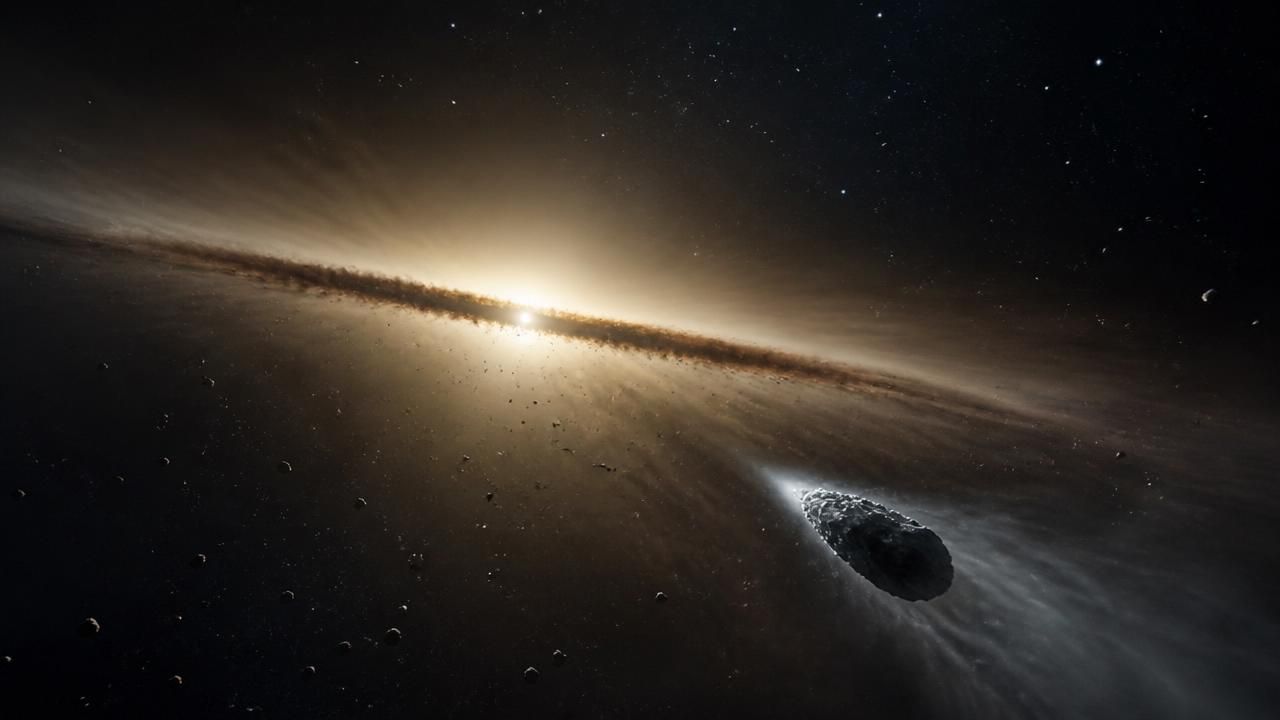
Beta Pictoris is not a new target. Its disk was among the first ever imaged, in 1984, and because it is seen almost exactly edge-on, it has become a natural laboratory for studying how planetary systems grow. It is a debris disk, meaning its dust is constantly replenished by collisions among comets and planetesimals—the small bodies that serve as building blocks of planets. Astronomers have already found three planets around the star. Ars Technica framed the result as ice older than the star it orbits, a shorthand for the possibility that some icy material survives from the cloud that formed Beta Pictoris.
Glassy ice, comet-like chemistry
Webb's infrared sensitivity allowed Betti's team to look for ice in the disk. They found both water and carbon dioxide ice. The water ice is glassy rather than crystalline, and it is mixed with carbon dioxide in roughly the same proportions seen in comets of our own Solar System. That match is important: it suggests that the chemical recipe for water-rich worlds may not be rare.
The findings suggest that ingredients necessary to form water-rich worlds might be common around young stars.
The missing ice
The result also fits into a long-running debate about the origin of ice in planetary systems. Some ice may be inherited from the cold molecular cloud that collapsed to form a star, while some may form and be processed in the disk. The glassy state of the water ice offers a clue about the history of heating, collisions, and radiation in the Beta Pictoris system. Ice is notoriously hard to detect directly, and Webb's ability to see it in a debris disk is a significant step.
An interstellar comet's dusty ice
The Beta Pictoris result is not the only icy story from Webb. Separate coverage from MSN and Mashable focused on the interstellar comet 3I/ATLAS. Reports say Webb discovered that the object is made of unusual dusty ice grains and found a subtle difference in the comet's ice. Interstellar comets are rare messengers from other planetary systems; 3I/ATLAS follows 1I/'Oumuamua and 2I/Borisov as one of the few known interstellar objects. Its ice is important because it preserves material that formed around another star.
Where the Beta Pictoris study looks at the raw ingredients around a young star, the 3I/ATLAS observations examine a finished, traveling remnant. The comet's dusty ice grains appear unusual, and the subtle spectral difference in its ice suggests that interstellar ices can vary in ways that local comets do not. That diversity matters for models of how planets assemble and how water is delivered. If interstellar objects carry different ice chemistry, then the building blocks of habitable worlds may be more varied than a single solar-system template implies.
A hidden planet in Webb images
ScienceDaily reported another Webb result: astronomers discovered a hidden alien planet in James Webb images. The detection underscores how Webb data are being mined for faint companions that were missed in earlier observations. Directly imaging a planet is difficult because the star's light overwhelms the planet's glow, but Webb's infrared instruments and advanced data processing can reveal subtle signals. The discovery adds to the growing list of planets found through direct imaging, a method that complements the transit and radial-velocity techniques that dominate exoplanet science.
Each outlet frames the story differently. Ars Technica emphasizes the chemical implications of ice in a young debris disk: the finding that water and carbon dioxide ice in Beta Pictoris resemble solar-system comets. MSN and Mashable highlight the oddity of 3I/ATLAS, treating it as an interstellar visitor with a distinctive icy signature. ScienceDaily focuses on the hidden planet, a discovery that speaks to Webb's ability to reveal unseen worlds. Taken together, the reports show a telescope doing what telescopes do best: turning different kinds of faint light into a broader picture of how planetary systems form, evolve, and transport the ingredients of life.
Why it matters
The common thread is ice. In Beta Pictoris, ice is found in a disk where planets are still forming. In 3I/ATLAS, ice is found in a comet from another star system. In the hidden-planet images, Webb is finding the planets themselves. The three results do not answer every question, but they narrow the gap between the chemistry of interstellar space and the chemistry of worlds. They also show why Webb's infrared vision is so valuable: ice, dust, and faint planets are all easier to see in the infrared than in visible light.
For astronomers, the next steps are clear. More Webb observations of Beta Pictoris can test whether its ice is inherited, formed in the disk, or both. Continued monitoring of 3I/ATLAS and future interstellar objects can show whether its dusty ice is typical or exceptional. And the hidden planet will need follow-up observations to confirm its orbit and atmosphere. The early results suggest that the ingredients for water-rich worlds are not only present but widespread—and that the universe may be more chemically connected than once thought.