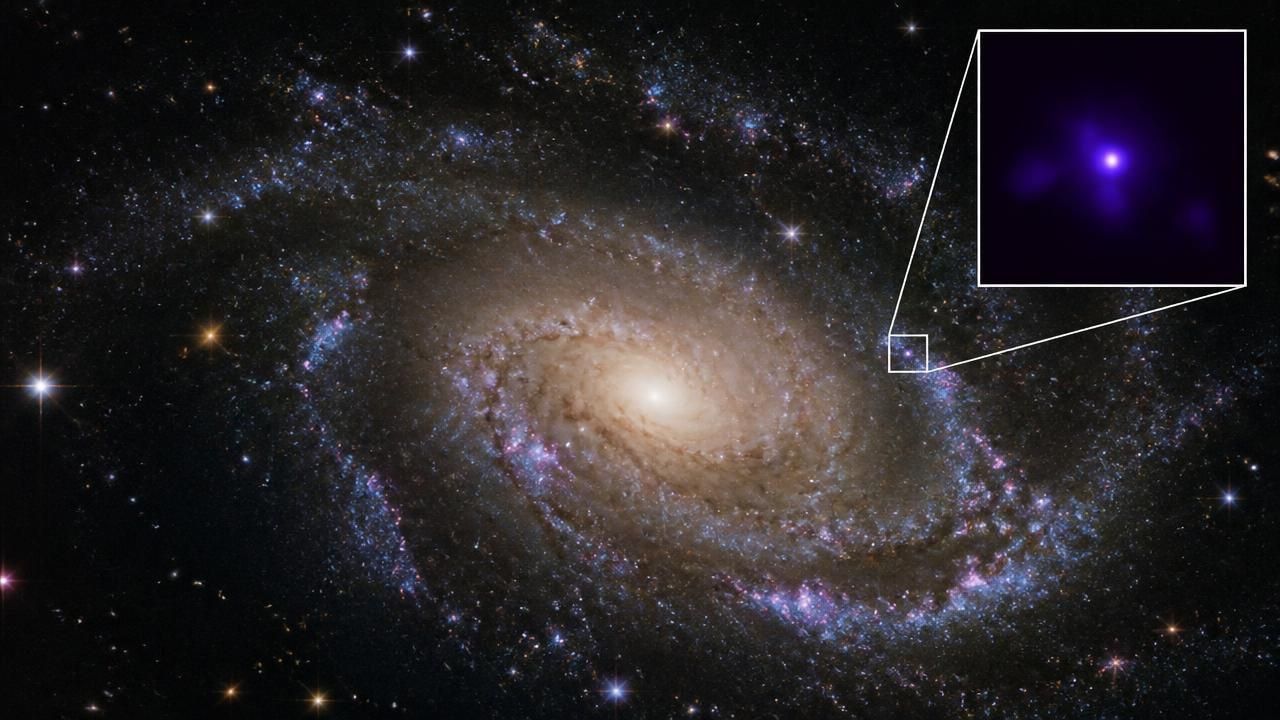
Astronomers using NASA’s Chandra X-ray Observatory have identified the likely source of repeated outbursts from AT 2016blu, a giant, unstable star in the spiral galaxy NGC 4559, about 30 million light-years from Earth. The star, estimated at no less than 33 times the Sun’s mass, has erupted again and again in events that resemble supernovas but leave the star intact — a phenomenon known as a supernova impostor. The new X-ray data point to a compact companion, either a black hole or a neutron star, orbiting the massive star and drawing material from it.
NASA announced the finding with a composite image that combines Chandra X-ray data with optical observations from the Sloan Digital Sky Survey. The image credits list NASA/CXC/University of Virginia/M. Aghakhanloo et al., optical data from SDSS, and processing by NASA/CXC/SAO/P. Edmonds. The result was distributed through Newswise and picked up by outlets including MSN, Space.com via UA.NEWS, and AroundPrague.cz, each emphasizing a different part of the story: NASA the X-ray breakthrough, MSN the 113-day rhythm and possible black hole, Space.com the compact companion, and AroundPrague the star that faked 27 supernovas.
A repeat performer in a distant spiral
AT 2016blu has puzzled astronomers for about 15 years. Over that span, observers have counted roughly 27 outbursts — eruptions bright enough to be mistaken for a supernova from afar. The outbursts recur on a roughly 113-day cycle. That clock-like periodicity is central to the new interpretation: it suggests an orbital rhythm, not random violence in the star’s outer layers. In a binary system, a companion can pass closest to the massive star once per orbit, triggering enhanced mass transfer and brightening. The 113-day beat matches that picture.
Supernova impostors are eruptions that can mimic a supernova from afar, but the massive star survives the blast.
Such impostors are not new to astronomy. Eta Carinae’s 19th-century Great Eruption is the best-known example of a massive star producing a supernova-like display without destroying itself. Luminous blue variables and other evolved massive stars are prone to unstable mass loss, and many live in binaries. What has been missing for AT 2016blu is a clear mechanism for why its eruptions repeat so regularly. Chandra’s X-ray view provides that mechanism by revealing emission from the vicinity of a compact object.
What Chandra detected
X-rays are a key diagnostic because they can emerge from gas heated to millions of degrees as it falls toward a compact object. In this scenario, the massive star sheds material, especially near closest approach to its companion. The compact object’s gravity captures some of that gas, forming an accretion flow. The infalling material heats up and radiates X-rays, while the disturbance can also drive optical outbursts in the star’s envelope. The result is a repeating cycle of brightness changes across the electromagnetic spectrum.
The companion’s exact identity remains uncertain. It could be a black hole or a neutron star; both are compact remnants capable of accreting matter and producing X-rays. The data do not yet settle which. That ambiguity is itself important, because it places AT 2016blu in a class of interacting binaries that can illuminate how massive stars lose mass and how compact objects form and grow.
- The star: AT 2016blu, a massive and unstable star estimated at at least 33 solar masses.
- The galaxy: NGC 4559, a spiral galaxy about 30 million light-years away.
- The rhythm: Outbursts recur roughly every 113 days.
- The history: About 27 eruptions over roughly 15 years have mimicked supernovas.
- The suspect: A black hole or neutron star companion accreting material from the giant star.
Black hole or neutron star?
MSN framed the discovery around the possibility that a companion black hole is responsible for the 113-day eruptions, while other coverage emphasized that a neutron star could fit the observations as well. Space.com, syndicated through UA.NEWS, described Chandra as pointing to a compact companion of AT 2016blu. AroundPrague.cz took a more dramatic line, describing a star that faked 27 supernovas and was being fed on by a hidden black hole or neutron star. These are not competing theories so much as different emphases: the core finding is a compact companion, and the black-hole-versus-neutron-star question remains open.
Why the discovery matters
The finding helps explain one of the longest-running puzzles about AT 2016blu: why a star would produce so many supernova-like eruptions without ending its life. If the eruptions are driven by binary interaction, they are a sign of mass transfer rather than imminent collapse. That has consequences for how astronomers interpret other repeat outbursts in massive stars, especially those with periodic light curves.
It also adds to a broader picture of massive stars as products of their environments. Many massive stars are born in binaries and triple systems, and interactions with companions can strip envelopes, spin up stars, create X-ray binaries, and shape the final supernova. AT 2016blu offers a nearby-in-cosmic-terms laboratory for watching that process in action, though 30 million light-years is still far beyond direct resolution of the system.
For now, the Chandra result gives astronomers a coherent framework: a massive star, a compact companion, an eccentric orbit, and a 113-day close approach that feeds the companion and lights up the system. Follow-up observations will be needed to determine whether the companion is a black hole or a neutron star, to measure the orbit more precisely, and to track how the star’s mass loss changes over time. But the supernova impostor has moved from mystery to testable astrophysics.