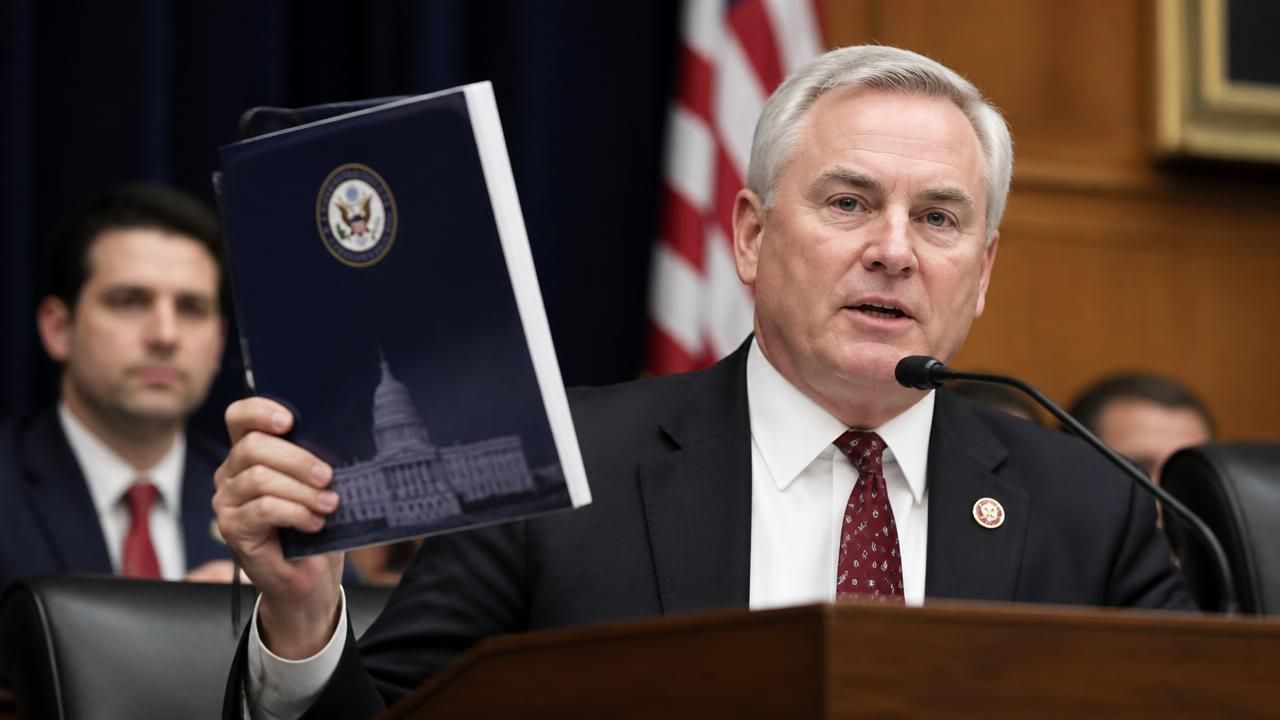
The Republican-led House Oversight Committee on Tuesday released the final product of a 15-month investigation into Jeffrey Epstein and his network, concluding that the federal government failed for decades to hold the financier accountable for the sexual abuse of dozens of young women and girls — and calling on the Justice Department to keep investigating.
The report, formally titled a review of the federal government’s mishandling of the Epstein and Ghislaine Maxwell criminal investigations, was issued by Chairman James Comer of Kentucky as he prepares to hand the gavel to a successor. It represents one of the most sweeping congressional indictments of federal law enforcement’s handling of a case that has shadowed American politics for nearly two decades.
What the report found
According to the committee, the failures were not confined to a single administration, agency, or decade. The report traces a chain of missed signals stretching from Epstein’s 2005 arrest in Palm Beach County, Florida, through the controversial 2008 non-prosecution agreement brokered by federal prosecutors in Miami, to his 2019 death in federal custody in Manhattan while awaiting trial on sex-trafficking charges.
“The federal government failed survivors,” the committee’s findings state, describing what Republicans characterize as systemic breakdowns at the Justice Department, the FBI, and the state and local level. The report also faults the handling of the case against Maxwell, Epstein’s longtime associate, who was convicted in 2021 on sex-trafficking charges and sentenced to 20 years.
Multiple outlets framed the release around the report’s central verdict: that government “failures” allowed Epstein to continue committing sex crimes well after Florida authorities first investigated him in 2005. NBC News and MSNBC’s coverage emphasized the committee’s conclusion that the government “failed” survivors, while the New York Post highlighted how the failures allowed Epstein to operate for years after the Florida arrest.
Trump cleared — and the political charge
Perhaps the most closely watched element of the report was its conclusion that it found no evidence of wrongdoing by President Donald Trump in connection with Epstein. Conservative-leaning outlets led with that finding, with Yahoo News summarizing the report as concluding “no Trump wrongdoing” alongside “major Epstein probe flaws.”
The report’s dual structure — criticism of federal institutions paired with an exoneration of the sitting president — drew immediate scrutiny from Democrats, who have argued that the committee’s work was shaped to protect the White House while satisfying public demand for accountability. The Atlantic, in commentary published alongside the report’s release, framed the moment in far more sweeping terms, describing an “Epstein election” that it argued has come to define the trajectory of the MAGA movement.
The political stakes are amplified by timing. The report lands as Trump’s Justice Department faces what NBC News described as an exodus of top officials, even as incoming Democratic oversight prepares to take up the Epstein file with subpoena power of its own.
Criticism cuts both ways
Not all of the committee’s criticism was aimed at past administrations. The Boston Herald reported that the House Oversight Committee also criticized the current Trump administration over the release of Epstein records — an unusual intra-party rebuke that underscores how the Epstein files have become a political liability across party lines.
The report urges the Justice Department to interview “key witnesses” who were never fully questioned, and to pursue leads the committee says were left dormant. The Guardian reported that Republicans explicitly called on DOJ to further investigate those witnesses, signaling that the committee views its work as a referral rather than a conclusion.
Comer, in his final act as chairman, issued a parting message to both the department and his Democratic colleagues: keep investigating.
Beyond the committee room
The fallout is already spreading into new venues. A key Senate Democrat has vowed to probe the banks that handled Epstein’s accounts, according to American Banker — opening a financial front that could implicate institutions that maintained relationships with the disgraced financier long after his 2008 conviction.
The reputational consequences also continue to ripple outward. The University of Maine System’s board committee voted to back the removal of former Senate Majority Leader George Mitchell’s name from a campus building over his past ties to Epstein, the Maine Campus reported — a reminder that the report’s release will accelerate scrutiny of prominent figures whose associations were previously considered settled.
Meanwhile, House Republicans have selected Rep. Jim Jordan as the panel’s next leader, a move that will shape whether the committee’s investigative posture toward the Epstein case continues or pivots.
What comes next
- Justice Department: Whether the report generates new interviews or subpoenas remains unclear; DOJ has not indicated how it will respond to the committee’s referrals.
- Senate: Democratic-led inquiries into Epstein-linked financial institutions are expected to proceed independently of the House effort.
- Survivors: Advocates have long argued that institutional accountability matters only if it produces consequences for those who enabled Epstein; the report’s focus on process failures has drawn mixed reaction.
For a case that has generated thousands of headlines, a congressional report, several prosecutions, and one suicide in federal custody, the committee’s central claim is that the machinery of American justice saw Epstein clearly — and chose, repeatedly, not to act.