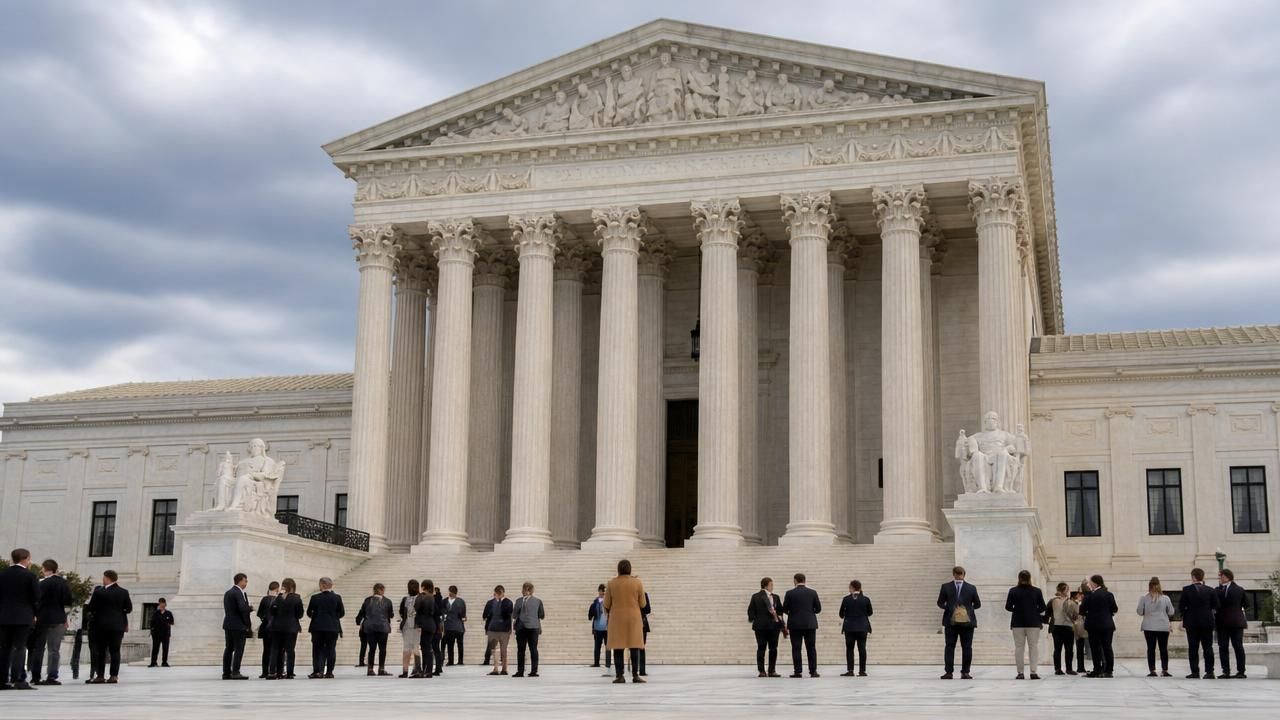
The Supreme Court appeared sharply divided Tuesday over a question that reaches far beyond the fields and packing houses at the center of the dispute: whether federal agencies may continue to impose fines on businesses for violating the law, or whether those enforcement actions must be routed through the courts.
The case arises from the government's temporary worker visa program — specifically the H-2A agricultural visa channel that brings tens of thousands of foreign farmworkers into the United States each year — and from a company's challenge to the way a federal agency handled allegations that it broke the rules governing that program. The company argues that the agency should not be able to act as investigator, prosecutor, judge and jury in its own case, and that disputes over penalties belong before an Article III court.
What the Court Is Weighing
At issue is a structural question about the modern administrative state: when Congress authorizes an agency to enforce a statute, does that authorization include the power to adjudicate alleged violations internally and assess monetary penalties, or does the Seventh Amendment's guarantee of a jury trial — and the Constitution's separation of powers — require the government to sue in federal court instead?
According to accounts of Tuesday's arguments, the justices split along now-familiar lines, with the court's conservative majority skeptical of the agency's position and the liberal wing warning that a ruling against the government could upend decades of routine enforcement across labor, environmental, securities and safety law. The New York Times–affiliated public radio reports carried by NPR, WRVO and WKYU all described the court as "seems split," while Reuters framed the argument as a test of "the limits of federal agency powers in a farmworker rights case" — a telling difference in emphasis. The broadcast headlines foreground procedure; Reuters foregrounds the workers whose protections are at stake.
"The company involved says enforcement issues should go through the courts, not the federal agency alone."
That single sentence, from NPR's coverage, captures the heart of the petitioner's theory: an agency that both brings a charge and decides its merits is, in the company's view, insufficiently impartial to impose a penalty that carries the weight of law.
Why Farmworkers Are at the Center
The H-2A program is one of the most heavily regulated corners of American agriculture. Employers must certify that they attempted to recruit domestic workers first, pay a government-set wage, provide housing and transportation, and abide by a long list of contractual obligations. Enforcement historically has run through administrative channels because the workers involved are, by design, transient and often reluctant to press claims in open court — a dynamic that labor advocates say makes swift agency action essential.
Critics of the administrative model counter that agency adjudications stack the deck against employers, offering limited discovery, no jury and deferential appellate review. The case arrives at a court that has spent the better part of a decade chipping away at agency authority — from Kisor and West Virginia v. EPA to last term's decision in SEC v. Jarkesy, which held that the Securities and Exchange Commission cannot seek civil penalties for securities fraud through in-house proceedings when the claims are legal rather than equitable in nature.
The Stakes Beyond the Farm
If the justices extend Jarkesy's reasoning to the labor context, the practical consequences could be substantial. Agencies that police wage-and-hour rules, workplace safety, immigration compliance and environmental standards rely on administrative penalties to resolve thousands of disputes a year without flooding federal dockets. A broad ruling could force regulators to file suit in district courts, dramatically slowing enforcement and raising costs for the government — and, critics argue, effectively handing deep-pocketed employers a procedural advantage.
- For employers: Greater access to jury trials and federal court review, but likely more litigation and uncertainty.
- For workers: Potentially slower resolution of abuse complaints, with advocates warning of a chilling effect on vulnerable visa holders.
- For agencies: A possible re-engineering of enforcement programs built over decades.
- For the courts: A surge in new federal filings if administrative channels narrow.
The case also lands in a political environment in which immigration enforcement and agricultural labor policy are already the subject of intense partisan contest. Neither the Trump nor Biden administration has shown much appetite for shrinking the H-2A program, which growers depend on, even as the legal architecture supporting it is being re-litigated.
What Comes Next
A decision is expected by the end of the term, likely in late June. Court watchers will be looking closely at how the justices write about the distinction between penalties that are "remedial" — designed to compensate victims — and those that are "punitive," a line that dominated the Jarkesy argument and appears to be doing the same work here.
Whatever the outcome, the case is unlikely to settle the broader question of how far Congress may delegate adjudicatory power to executive agencies. With several related petitions working their way through the lower courts, Tuesday's argument looks less like a final word than another chapter in a long-running argument about who decides — an agency, a jury, or a judge.