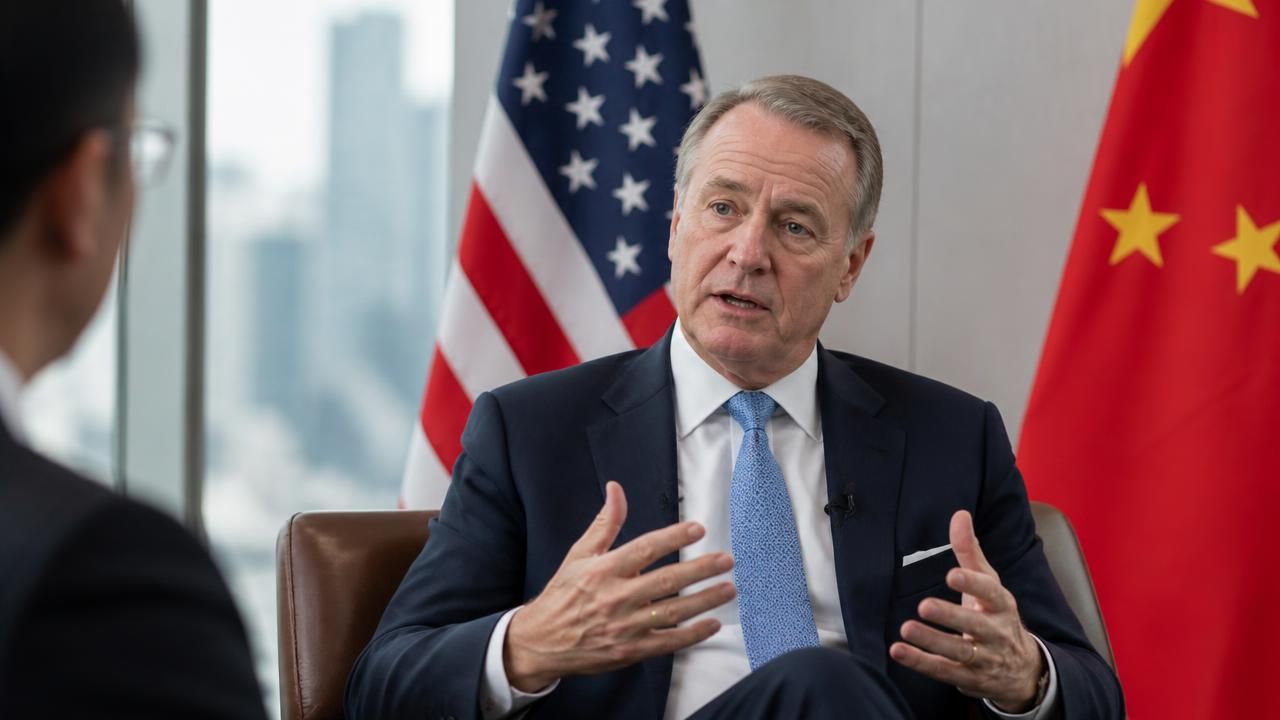
US Ambassador to China David Perdue said relations between Washington and Beijing remain "bumpy," but insisted the United States is seeking to diversify its economic exposure to China rather than sever ties entirely — a distinction with heavy consequences for global supply chains, capital flows and corporate strategy.
Perdue made the remarks in an exclusive interview on the sidelines of the Citi China Conference in Shanghai, one of the largest annual gatherings of global financiers and corporate executives focused on the Chinese market. His appearance at the conference — a venue where Wall Street's China exposure is routinely on display — underscored the fine line the US administration is trying to walk between security-driven caution and continued commercial engagement.
Diversification vs. Decoupling
The ambassador's framing places him at the center of one of the defining economic debates of the decade: whether the world's two largest economies are "decoupling" or merely "de-risking." US officials have increasingly favored the language of diversification — spreading supply chains across Vietnam, Mexico, India and Eastern Europe — while rejecting the charge that they are trying to wall off China entirely.
"Relations remain bumpy," Perdue said, while stressing that Washington wants to "diversify rather than decouple" from China.
For markets, the nuance matters. A genuine decoupling would imply a sharp contraction in bilateral trade and investment, with knock-on effects for multinational earnings, currency markets and emerging-market debt. Diversification, by contrast, suggests a gradual reallocation — slower, more expensive, but far less disruptive to a global economy still deeply intertwined with Chinese manufacturing and demand.
The remarks also arrived against a backdrop of persistent friction: tariffs on Chinese goods, export controls on advanced semiconductors, restrictions on outbound US investment in sensitive Chinese technologies, and continuing disputes over Taiwan and the South China Sea. Each of those issues has fed the perception in Beijing that Washington's stated preference for "competition, not conflict" masks a broader containment strategy.
A Second Front: Mexico
The China relationship is not the only diplomatic channel where the US is under scrutiny. In parallel, Chinese and American officials have clashed publicly over Washington's posture toward Mexico, with Beijing accusing US diplomats of "sowing discord" in the China-Mexico relationship.
China's embassy in Mexico issued a sharp statement condemning what it called "malicious smears" by US officials against China-Mexico cooperation, pushing back on American claims that Chinese investment and trade in Mexico carry strategic or security risks. Reporting by EFE framed the episode as Beijing accusing a US ambassador of deliberately damaging China-Mexico ties; other coverage, including a Rio Times headline suggesting a US envoy argued that "China gains from Mexico chaos," reflected the more adversarial framing favored by some outlets.
The dispute matters because Mexico has become a central pillar of Washington's diversification strategy. As US companies shift production closer to home under the "nearshoring" model, Mexico has absorbed record levels of investment — but so have Chinese firms, which have built factories in Mexico partly to access the US market under the USMCA trade pact. That dynamic has turned Mexico into an arena where the "diversification vs. decoupling" argument is being fought in concrete terms.
How the Story Is Being Framed
Different outlets emphasized markedly different elements of the same underlying story:
- Bloomberg focused on the ambassador's conciliatory language, highlighting the "diversify, not decouple" formulation as a signal of pragmatic intent toward Beijing.
- Global Times and Chinese state-aligned media amplified Beijing's rejection of US criticism of China-Mexico cooperation, casting Washington as the aggressor seeking to divide regional partners.
- EFE framed the Mexico dispute as a diplomatic rebuke, emphasizing Beijing's accusation that a US ambassador is sowing "discord."
- Regional outlets tended toward more confrontational headlines, framing China as a beneficiary of instability in Mexico.
That divergence is itself significant. Where US business media hear reassurance, Chinese outlets hear accusation; where Washington describes risk management, Beijing describes containment. The gap in interpretation is exactly the kind of miscommunication that has made the relationship "bumpy" in Perdue's own words.
Why It Matters
For financial markets, the ambassador's comments reinforce an expectation that the US-China relationship will remain managed rather than ruptured — a base case that supports continued trade flows but keeps a risk premium on exposure to both economies. Companies operating in both markets face a durable uncertainty: they must plan for diversification while hedging against the possibility that political pressure accelerates into something closer to decoupling.
For the broader geopolitical picture, the twin episodes in Shanghai and Mexico City illustrate how thoroughly economic statecraft has become the primary language of diplomacy. Ambassadors now speak as much about supply chains and investment screening as about treaties.
What remains unclear is whether the language of diversification can survive contact with domestic politics in Washington, where pressure for tougher measures on China remains strong, and in Beijing, where officials are increasingly inclined to read American intentions in the harshest possible light.
Note: Several aggregated feeds reviewed for this report returned access restrictions or unrelated archival material and were not used in the reporting above.