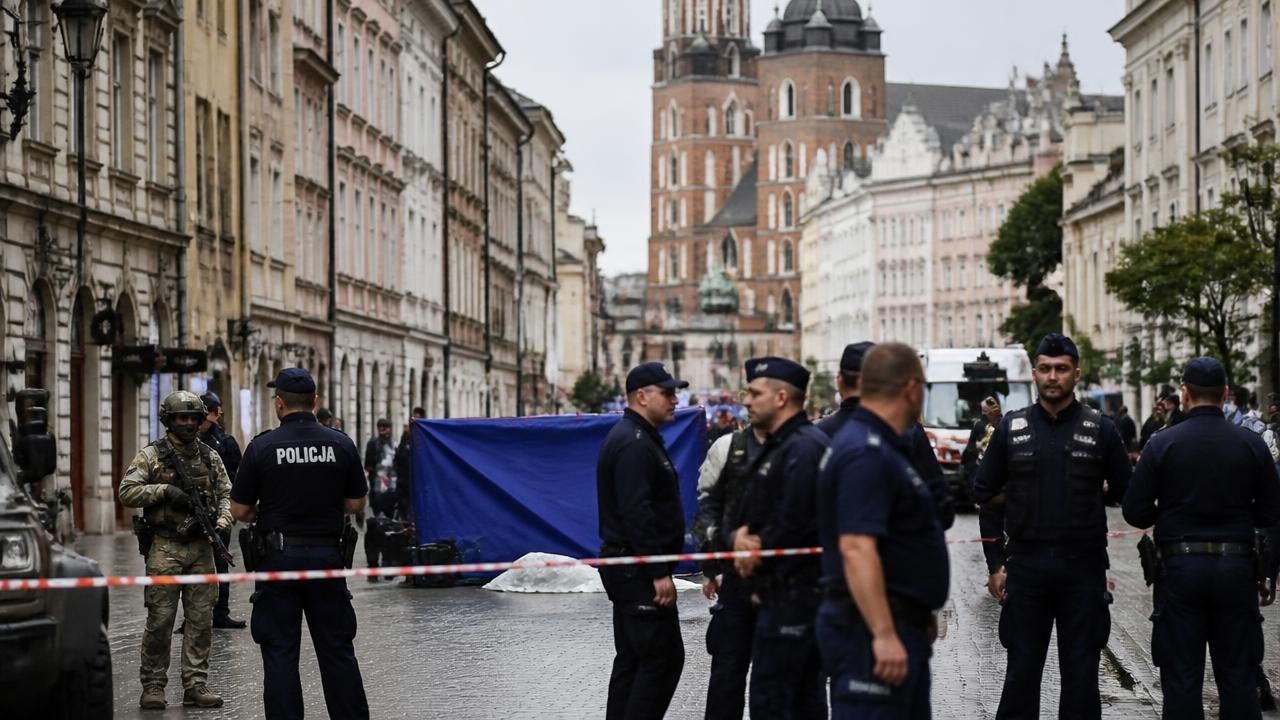
The gunman who opened fire in central Kraków, killing at least six people and wounding more than a dozen others, died in hospital on Monday morning, Polish police said, closing one chapter of an attack that has shaken a country unaccustomed to mass gun violence — even as investigators opened a far broader inquiry into what they are now treating as a possible act of terrorism.
Police announced the death in a post on X, saying the suspect had succumbed to injuries sustained during the incident. Authorities said they were still searching for clues about his motive, and appealed to the public for patience as forensic teams worked through the scene and the suspect's home.
What happened
According to the accounts pieced together from Polish police, prosecutors and multiple international outlets, a lone gunman opened fire in a busy square in Kraków, the historic southern city that is one of Poland's leading tourist destinations. The first reports spoke of five dead and multiple wounded; within hours the toll had risen to six killed and 15 injured, with Bloomberg reporting 16 wounded. HuffPost and other outlets settled on six dead and 15 wounded, while The Guardian described the suspect as having "killed six."
Police confirmed the assailant died in hospital on Monday morning, saying on X that investigators were still working to establish the motive behind an attack that shocked the nation.
Among the dead is a British citizen, according to Polish police cited by Yahoo News and the Daily Mail — a detail that has drawn the British government's consular machinery into the response and given the story an international dimension beyond the European coverage that dominated the first 24 hours.
Three more bodies at the suspect's home
The most disturbing development came as investigators searched the suspect's residence. Police found three additional bodies there, a discovery that raised the death toll far beyond the initial square-side count and reframed the incident as something potentially more extensive than a single public attack.
The Daily Mail reported that the dead found at the property were the shooter's parents and sister, and described the sequence as a family murder that preceded the rampage in the city centre. That account has not been independently confirmed across all outlets, and Polish police have not publicly detailed the identities of the three, but the discovery is consistent with the pattern seen in several European mass-casualty attacks in which the perpetrator's violence begins at home.
The result is a confusing tally that has shifted repeatedly in official and media accounts: five dead, then six, then a figure of nine when the three bodies at the residence are included. Editors at several aggregators have updated headlines multiple times, contributing to public uncertainty about the scale of the attack.
A terror investigation, and questions of ideology
Polish prosecutors are investigating the attack as a terror act, according to mycentraloregon.com and other outlets citing the prosecutor's office. Police have also launched a terror probe, the Daily Mail reported.
Yahoo News described the gunman as holding far-right views, and the Daily Mail characterised the incident as a "far-right attack" — framing that, if borne out, would place the Kraków killings within a wider European pattern of ideologically motivated violence by lone actors. Investigators have not publicly confirmed a manifesto, online footprint or organisational affiliation, and the question of whether the attacker acted alone or was inspired by, rather than directed by, any group remains open.
Coverage has diverged notably on this point. Outlets focused on breaking news — Bloomberg, NBC News, The Guardian and MSN's syndicated feeds — emphasised the operational facts: the death of the suspect, the toll, the police statement. The Daily Mail and Yahoo, by contrast, foregrounded ideology and the family deaths, producing a narrative of a far-right attacker whose violence began at home. The discrepancy is not necessarily contradiction, but it reflects how differently newsrooms weigh confirmed fact against contextual framing in the first days of a story.
A country unaccustomed to this
Poland has among the lowest rates of firearm homicide in Europe, and mass shootings on this scale are rare enough that the attack has prompted national mourning and a political reckoning. Legal gun ownership in Poland requires permits issued by police, and is considerably more restrictive than in the United States — a contrast Polish commentators have been quick to draw, and one that makes the question of how the suspect obtained his weapon central to the investigation.
The attack also lands in a charged political environment, with questions already being raised about security in public spaces, the resourcing of police, and the monitoring of extremist material online. Kraków's main square, a UNESCO-listed tourist hub, is normally among the most heavily trafficked and closely watched public spaces in the country.
- Dead: at least six in the square; three further bodies found at the suspect's home, according to police.
- Injured: 15 to 16, depending on the outlet and the time of reporting.
- Suspect: died in hospital on Monday morning; described in some reports as holding far-right views.
- Investigation: being treated as a terror act by prosecutors; motive still officially undetermined.
- International dimension: a British citizen is among the dead.
What is still unknown
Four days into the story, the essentials remain unresolved: the precise motive, how the weapon was acquired, whether anyone assisted the attacker, and why the toll released by police at the scene differed so sharply from the number of bodies eventually found at the residence. The suspect's death in hospital removes the possibility of a trial and, with it, the most direct route to answering those questions.
What is clear is that the trajectory of the coverage — from a chaotic first report of five dead in a market shooting to a multi-country terror investigation — illustrates how quickly a local incident becomes a national and international story, and how provisional the numbers are in the first hours of any mass-casualty event.