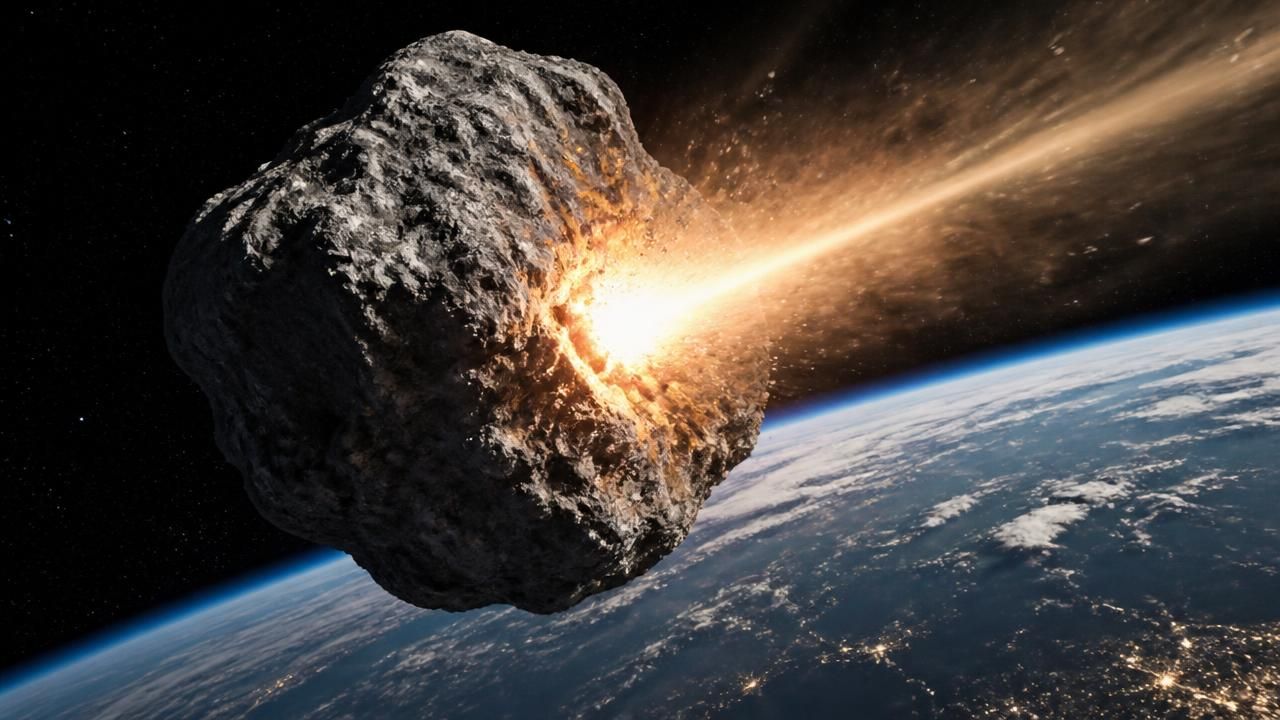
For decades, the nuclear option has been planetary defense's most cinematic — and most controversial — fallback. Now, a new study suggests that if humanity ever has to detonate a warhead against an incoming asteroid, the outcome may hinge less on the size of the bomb than on the geometry of the rock itself.
The research, reported by Science Daily and Phys.org and widely covered by aggregators including MSN and Yahoo, found that an asteroid's irregular shape dramatically affects how it responds to an X-ray blast. Depending on where the detonation occurs relative to the asteroid's lumpy, asymmetric form, the deflection efficiency can vary by nearly a factor of five.
The Core Finding: Angle Over Yield
The headline number circulating in coverage is striking: a 1-megaton nuclear blast could prevent as much as 97 percent of a city-killer asteroid — loosely defined as a body large enough to devastate a metropolitan region — from reaching Earth. But that figure comes with a critical caveat. The same detonation, aimed at the wrong side of the same asteroid, could deliver a fraction of that deflection.
An asteroid's irregular shape can dramatically affect how it responds to an X-ray blast, with deflection effectiveness varying nearly fivefold depending on the angle.
That variance is the study's real contribution. Prior work on nuclear deflection often modeled asteroids as idealized spheres or simple ellipsoids, an assumption that made the math tractable but potentially misleading. Real near-Earth objects are rubble piles and fractured monoliths, pitted and elongated, with densities and compositions that vary from surface to core. The new modeling suggests that this messiness is not a detail to be smoothed away — it is perhaps the single most important variable in a real deflection scenario.
How an X-Ray Blast Actually Deflects a Rock
A nuclear standoff detonation does not simply shove an asteroid. In the vacuum of space, the warhead's output arrives almost entirely as X-rays and other high-energy radiation, which are absorbed by a thin layer of the asteroid's surface. That layer vaporizes in microseconds, expanding outward like a rocket exhaust plume and imparting momentum to the remaining body — a process known as ablation-driven deflection.
Because the process is superficial, it is exquisitely sensitive to what the surface looks like and to the angle at which the energy arrives. A blast near a broad, flat face produces a relatively clean push. A blast against a concave crater or a protruding lobe can produce asymmetric thrust, wasted energy, or — worst case — a torque that spins up the asteroid or nudges it in an unhelpful direction.
The Short-Notice Problem
Coverage of the study has framed the finding around the scenario planetary defenders dread most: a threatening object discovered with only months or years of warning. Deflection methods that rely on slow, gentle pushes — gravity tractors, ion-beam shepherds, laser ablation campaigns — require years to a decade of lead time to work. A nuclear standoff burst is the only technique currently conceivable that can impart a large velocity change on short notice.
That makes precision a matter of civilizational stakes. A mission would need to arrive with enough time not only to detonate, but to characterize the target's spin state, shape, and interior structure — data that would have to be gathered by fast-reaction reconnaissance spacecraft launched alongside or ahead of the warhead.
Context: From DART to the Drawing Board
The study lands in a planetary defense landscape transformed by NASA's Double Asteroid Redirection Test, which in September 2022 slammed a spacecraft into the moonlet Dimorphos and measurably altered its orbit. DART proved that kinetic impact can work; it also revealed how much a rubble-pile target's structure shapes the outcome, ejecting a spectacular debris plume that amplified the deflection well beyond pre-mission estimates.
Nuclear deflection remains outside the realm of tested technology. The Outer Space Treaty of 1967 prohibits placing weapons of mass destruction in orbit or on celestial bodies, though detonating a warhead in deep space against an asteroid sits in a legally ambiguous zone that would require international consultation. Policy analysts have long argued that any nuclear option must be paired with robust governance, lest it become a cover for weapons development.
What the Study Does — and Doesn't — Settle
- It sharpens the targeting problem. Mission planners can no longer treat a deflection as a single scalar number; the aim point is a variable with enormous leverage.
- It underscores reconnaissance. You cannot pick the right side of an asteroid you have only seen as a smudge of light.
- It does not endorse the bomb. The findings describe physics, not policy. The researchers' models are simulations, and no nuclear deflection experiment has ever been conducted.
- It reinforces survey urgency. Finding threatening objects decades early remains far cheaper than any deflection campaign, nuclear or otherwise.
The broader lesson echoes what DART demonstrated and what the new modeling reinforces: asteroids are not billiard balls. They are geological objects with histories, fractures, and shapes — and any plan to save Earth from one will have to be built around those imperfections rather than in spite of them.